Learning from creature artists: the updated plan
You asked for two things before we try anything else: proper reading on how professional artists build creature models, and a test of how the fitter picks each part's tool, which we had skipped. This page has what the reading says, a first try of the artists' main method on eight of our true models, and the updated plan. The decisions are in chat. The earlier summary is on the roadmap page.
What was read
Three new reading sets today, about 110 sources, on top of last week's set on modelling animals part by part (33):
- How artists build a creature's base model from reference pictures: tutorials, courses and the Blender and ZBrush manuals (35 sources).
- Limbs, hands, feet and joins: one continuous arm with a hand, and how heads, limbs, tails, horns and teeth are attached (30).
- The algorithms behind those tools, and the methods that find such a tree in a 3D shape or in pictures (46).
The sources are mostly teaching material and software manuals, so the page states what artists commonly do, not measured results. The papers in the third set have measured results.
How artists build a creature, step by step
The same order shows up in every source, for any animal. The label on each step says where our fitter stands.
Line up the pictures
Front, side and top pictures, at the same scale, behind the work (Blender: reference images in each straight view; ZBrush: the floor grid).
we do this: the AI picture sheetsTrace the outline
Draw the outline over a picture as a curve, or paint it on three walls and keep where all three overlap (ZBrush ShadowBox). That overlap is exactly our carving. Artists use it only as a rough first block, mostly for hard objects.
we do this, but lean on it far morePut a tree of balls over the pictures
For creatures, all sources recommend this. Place one ball per joint over the front and side pictures, each with its own thickness, linked body → limbs → toes (ZBrush ZSpheres, Blender's Skin modifier). The software wraps one continuous skin around the tree. Few balls: a root at the pelvis or chest, the spine first, then about three per limb (shoulder, elbow, wrist) and one per finger or toe joint. Ready-made skeletons for animal groups are often moved and scaled over the pictures instead.
we don't do this yet: the centre of the new planBig shapes first, details never at this stage
Only the main masses. Before going on, artists check the outline alone from front, side, top and three-quarter, and shrink the view to see if the shape still reads.
our pictures still carry teeth and claws: the simplify stepJoin
Everything that bends shares one skin: body, neck, limbs, tail, wings, fins. Hard things stay separate pieces pushed into the body: eyes, teeth, horns, claws, shells, and every segment of an insect's leg. Separate pieces are fused by voxel remeshing when one surface is needed.
not yet: each part is a separate tool todayDetails last
Teeth are one tooth copied along a curved jaw; claws, spines and horns are small separate pieces. The mouth is built open from the start, so the inside can be shaped.
not yet: later, after the body worksThe tree, in Blender: an arm with a hand, as one body
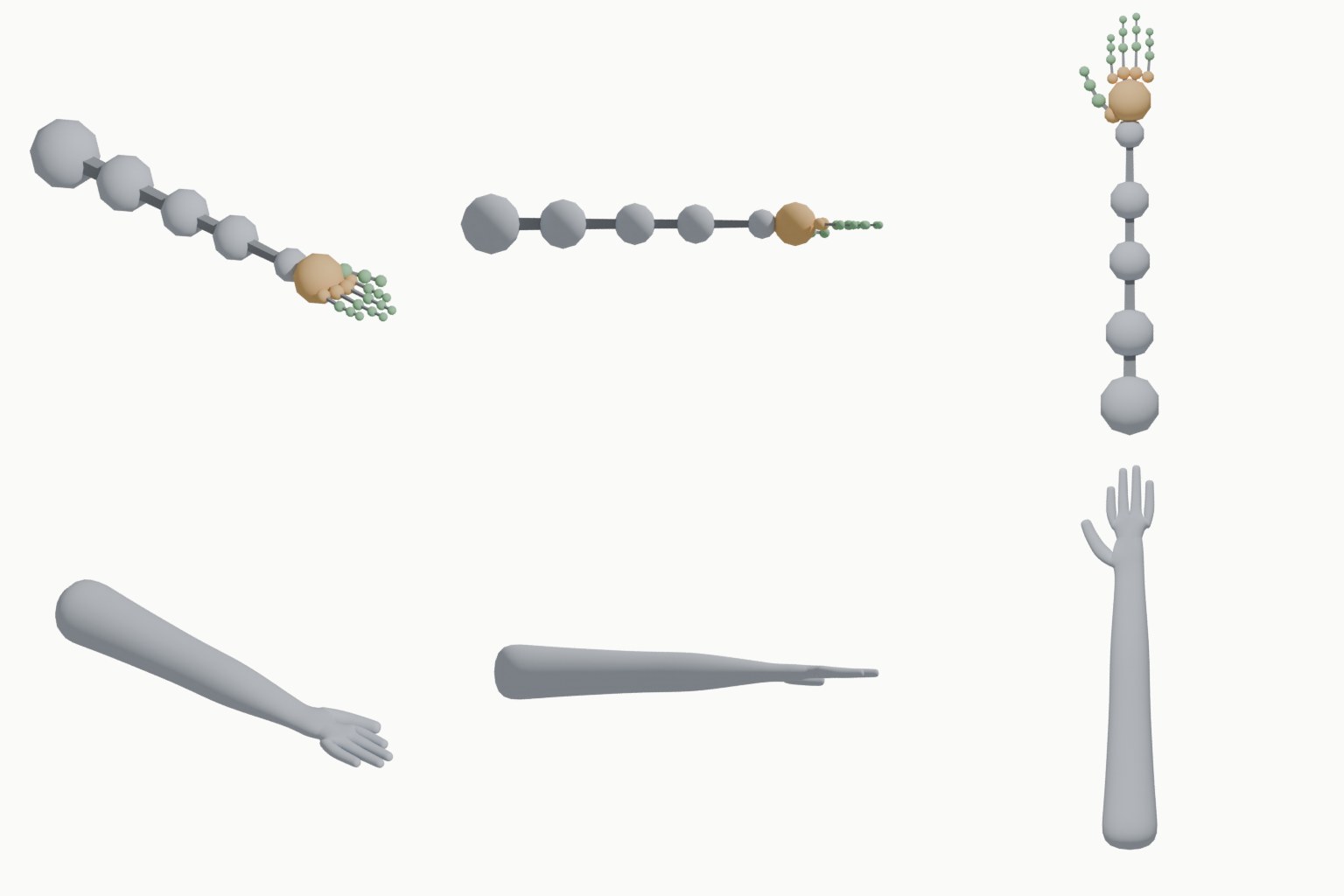
- A thickness per point, and two thicknesses for flat sections (the palm here; a tail fin or a flipper).
- Smooth joins at every fork, made by the modifier itself; no separate joining step.
- A skeleton for free: one click turns the tree into bones for posing, which helps the later step that curves the straight pose back into a natural one.
- A known algorithm: it is B-Mesh (Ji, Liu and Wang, 2010). Later papers fix its weak spot, messy surfaces at crowded forks (SQM, 2012; Piovarči, 2014).
- Hands and paws: a flat palm block with the fingers or toes pulled out of its front edge, or a hand made separately and joined at the wrist (both ends with the same number of edges).
- Paws add pads; hooves are one capped piece; bird feet are three or four toe chains.
- Insect and scorpion legs are different: rigid segments that fit into each other at sockets, not one skin. A chain of tubes, not a tree with one skin.
- Grow it from the tree (Skin modifier, ZSpheres): limbs, tails, necks.
- Bridge two edge rings of equal size: a hand made apart, joined at the wrist.
- Fuse by voxel remesh (ZBrush's DynaMesh): rough blocks melted into one surface.
- Blobs that melt together (metaballs): soft bodies.
- Keep it separate, pushed in: eyes, teeth, horns, claws, shells.
A first try: the tree of eight true models
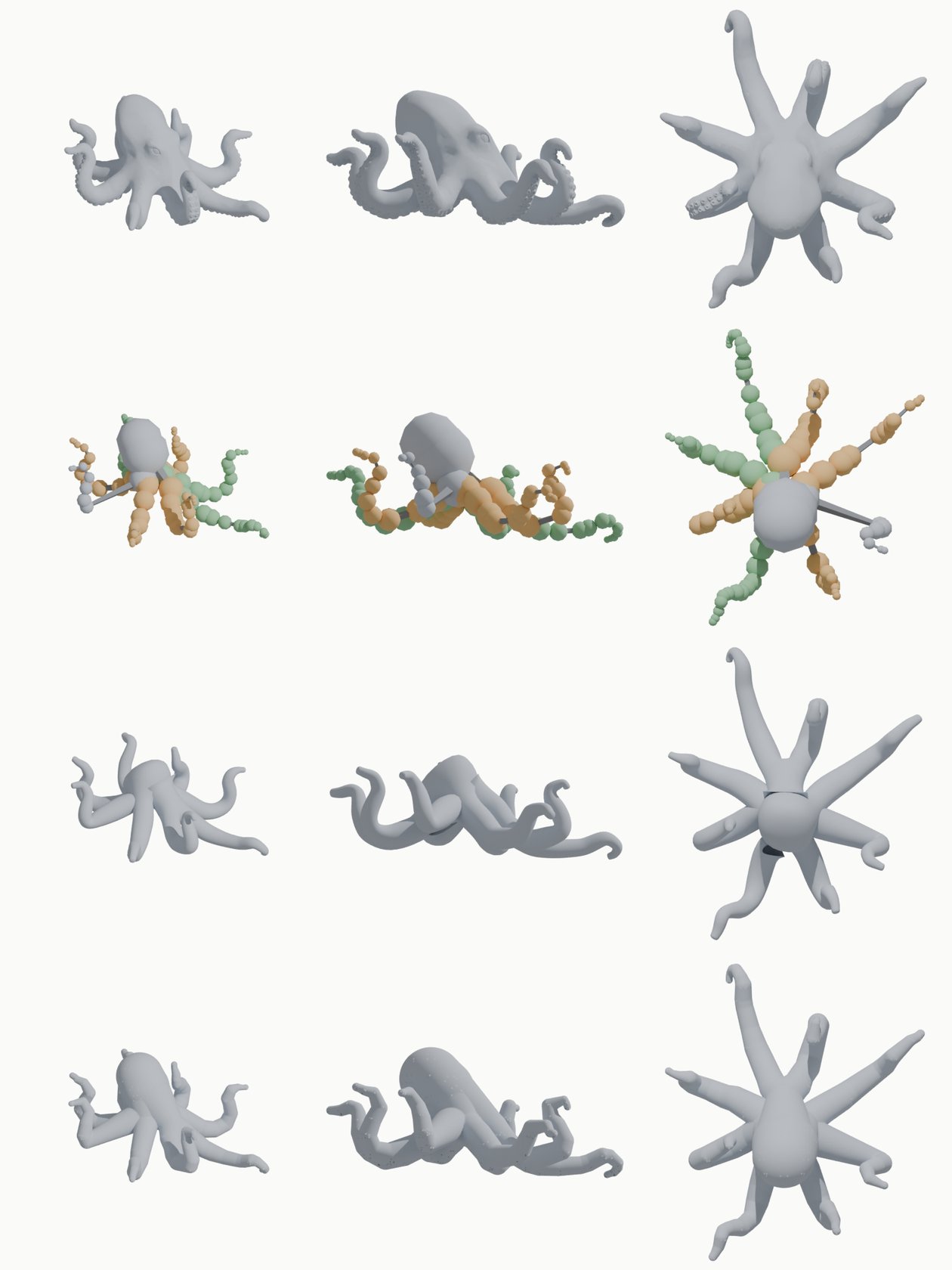
Made today with the simplest standard method, untuned: thin each true model's solid down to its centre line, read the thickness at each point, drop short branches that barely stick out, merge points that crowd together, and hand the points to Blender's Skin modifier. These are the true 3D models, not pictures: this shows what a tree can hold, not yet what we can get from pictures (that is T3 below). Click a row for the side and top views.
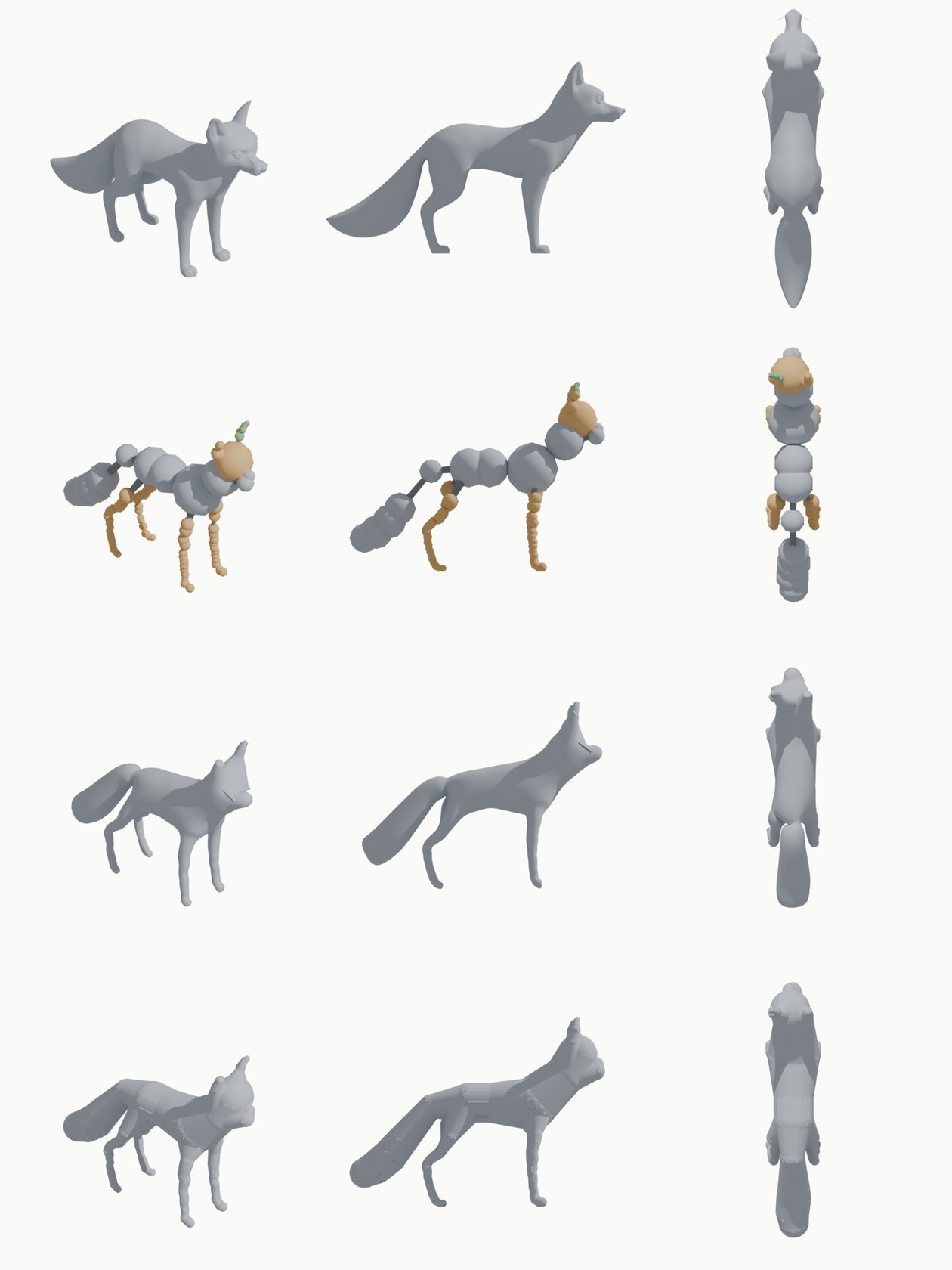
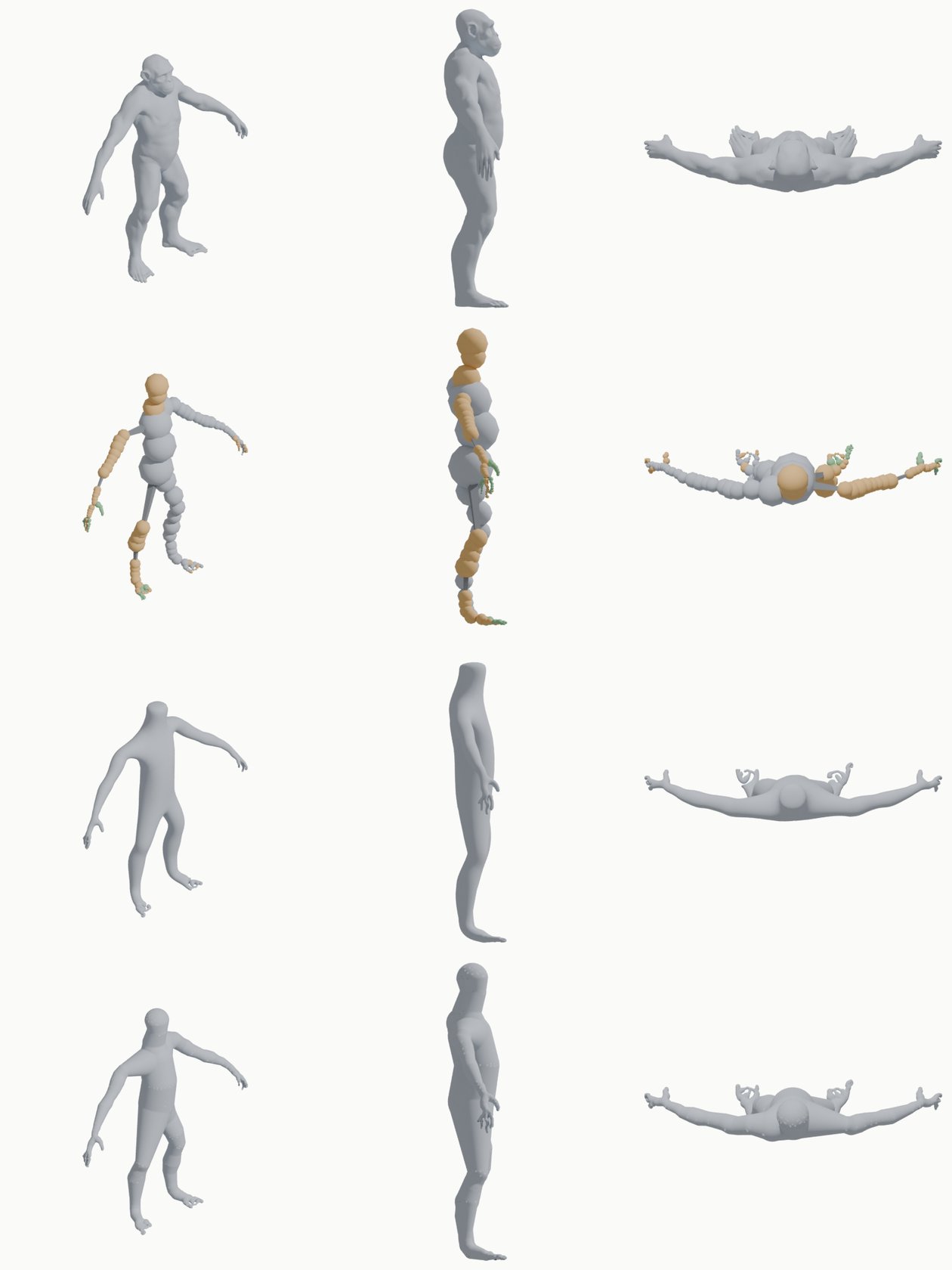
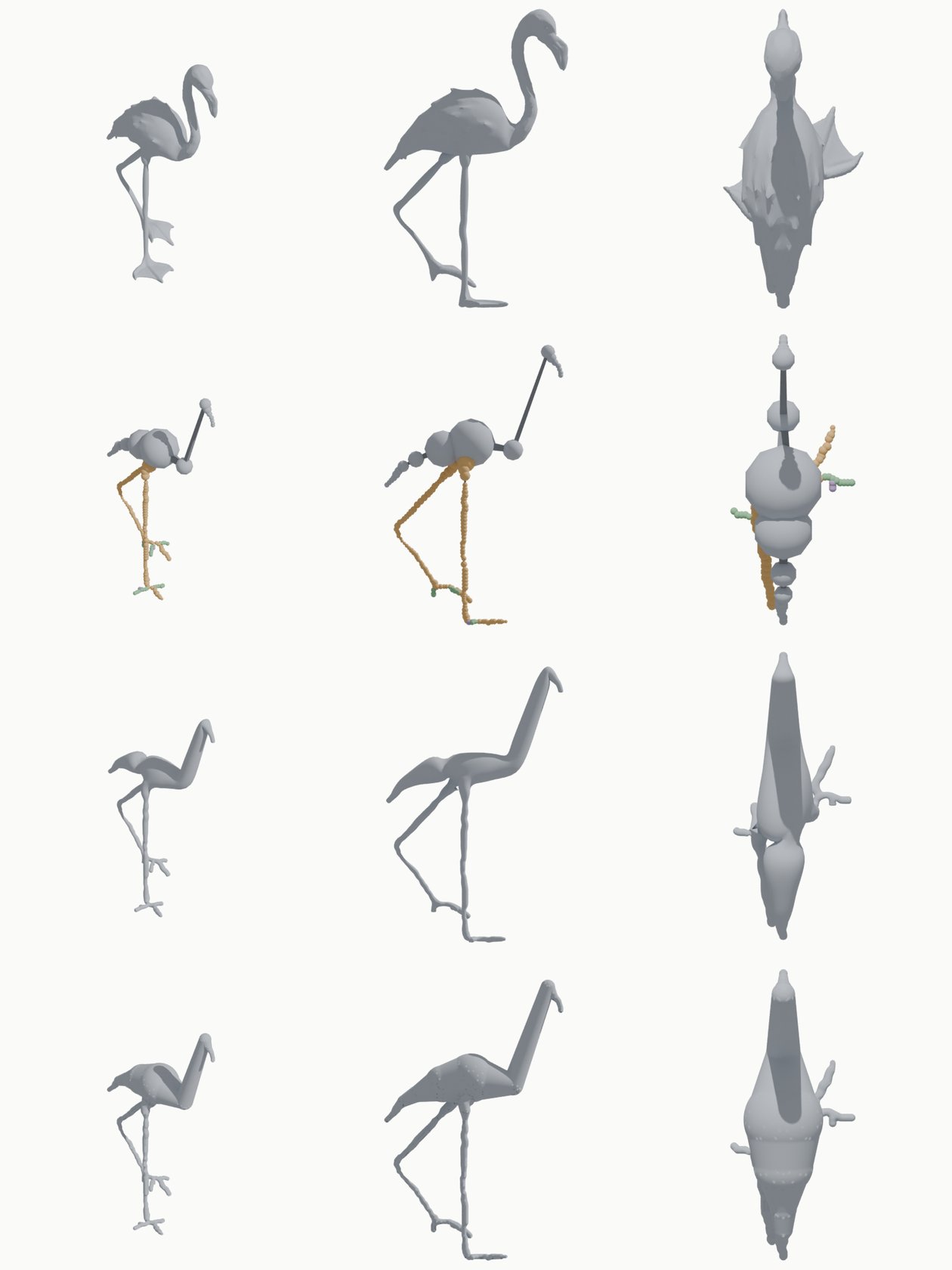
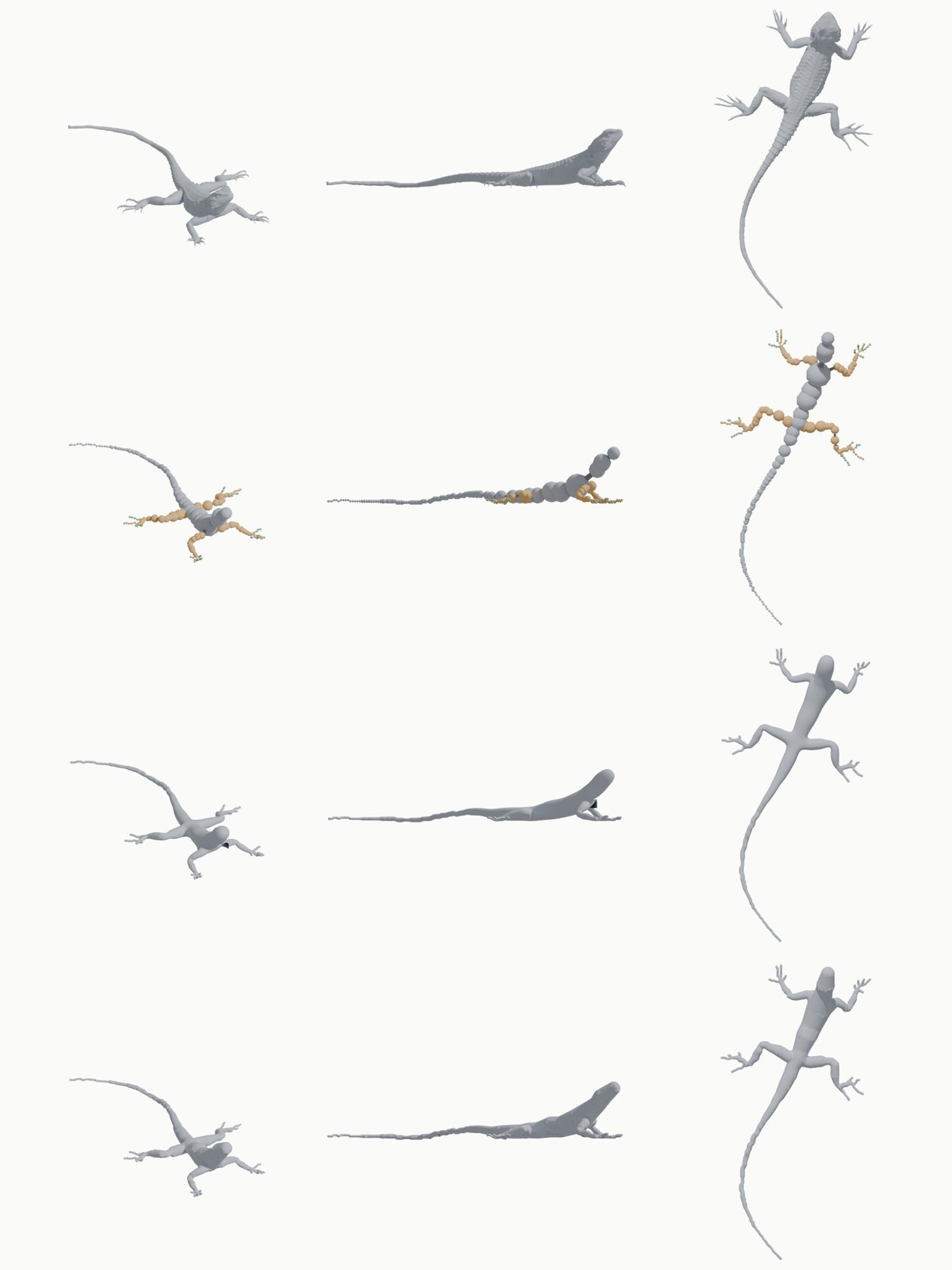
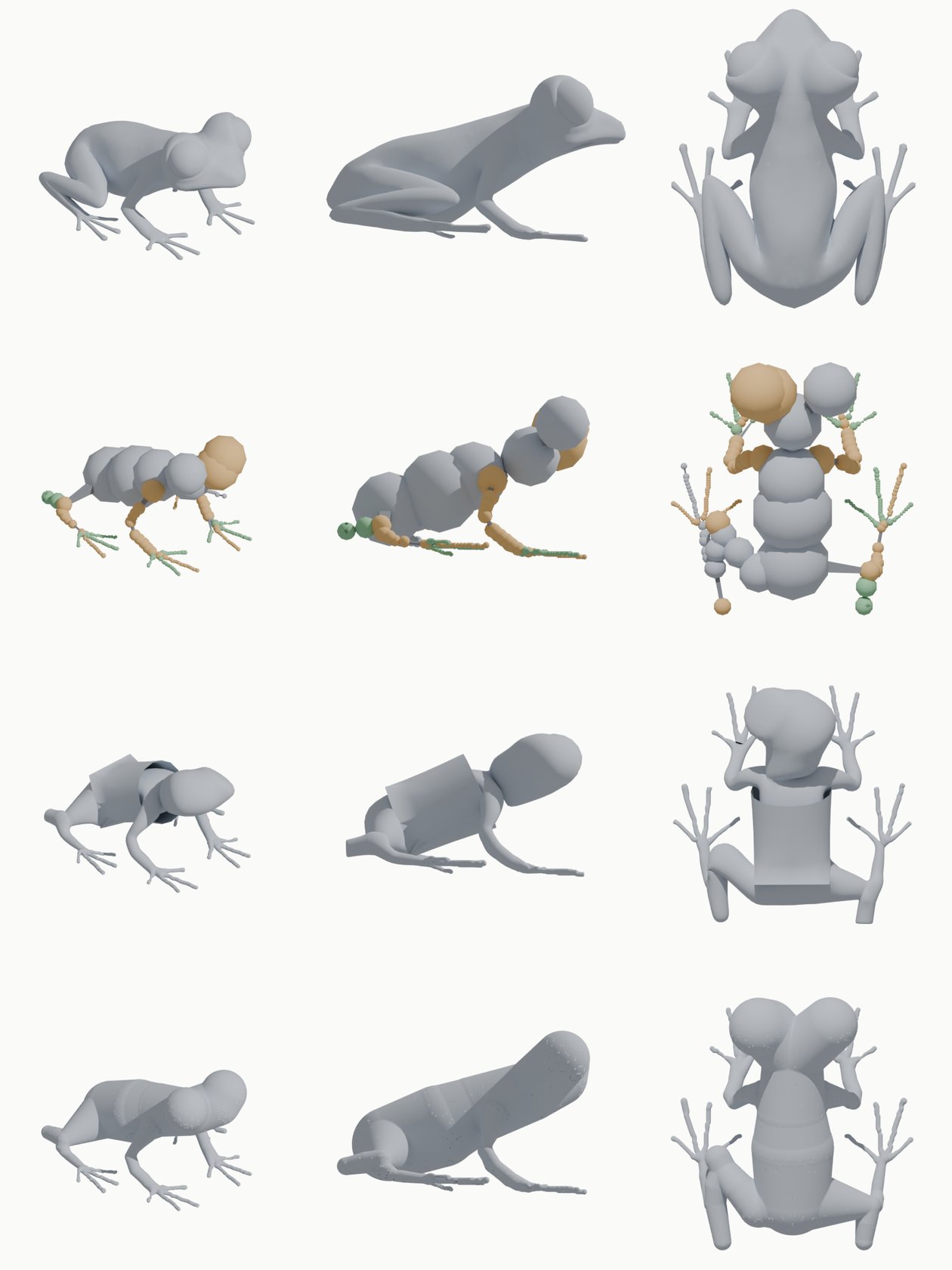
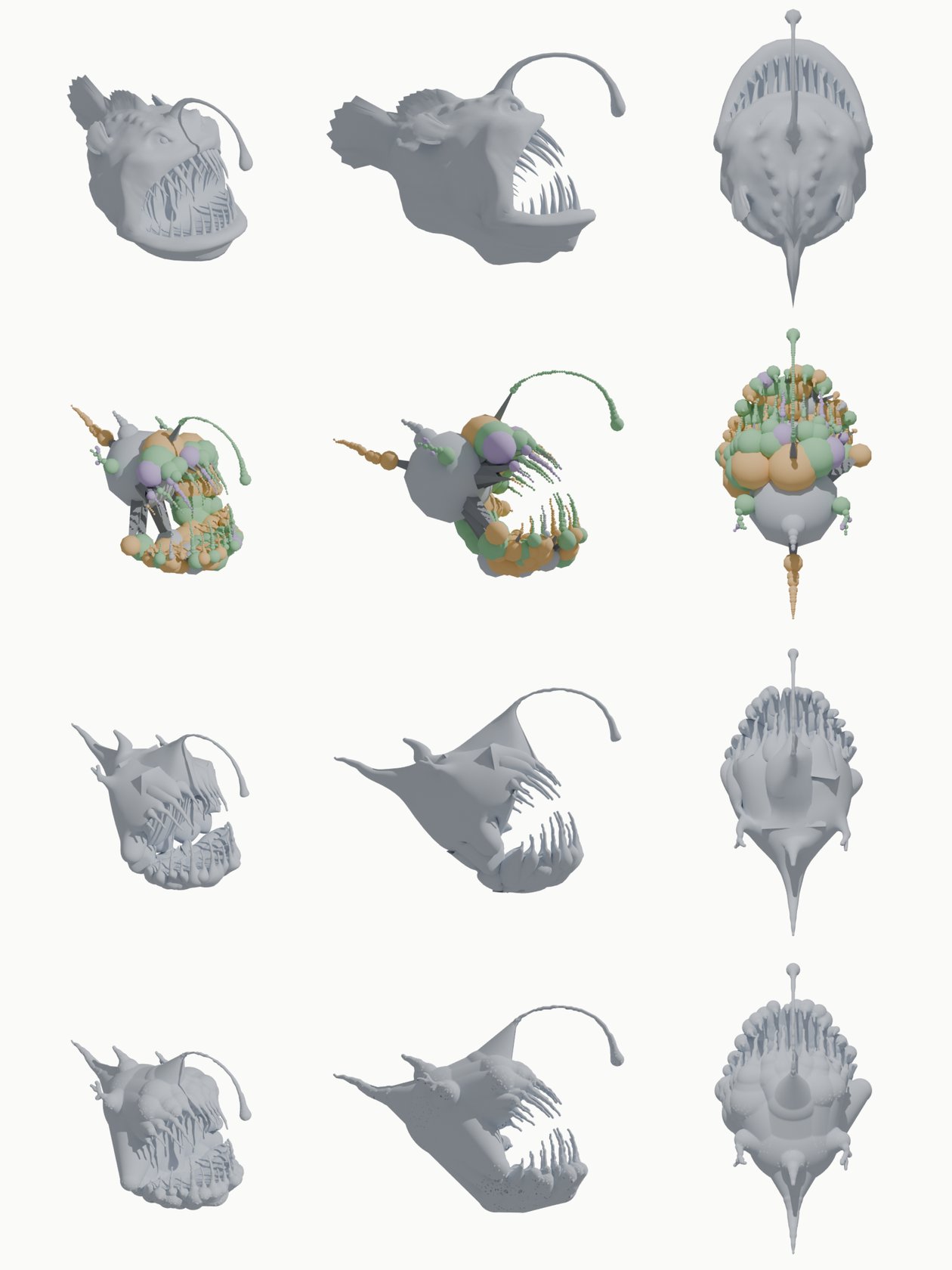
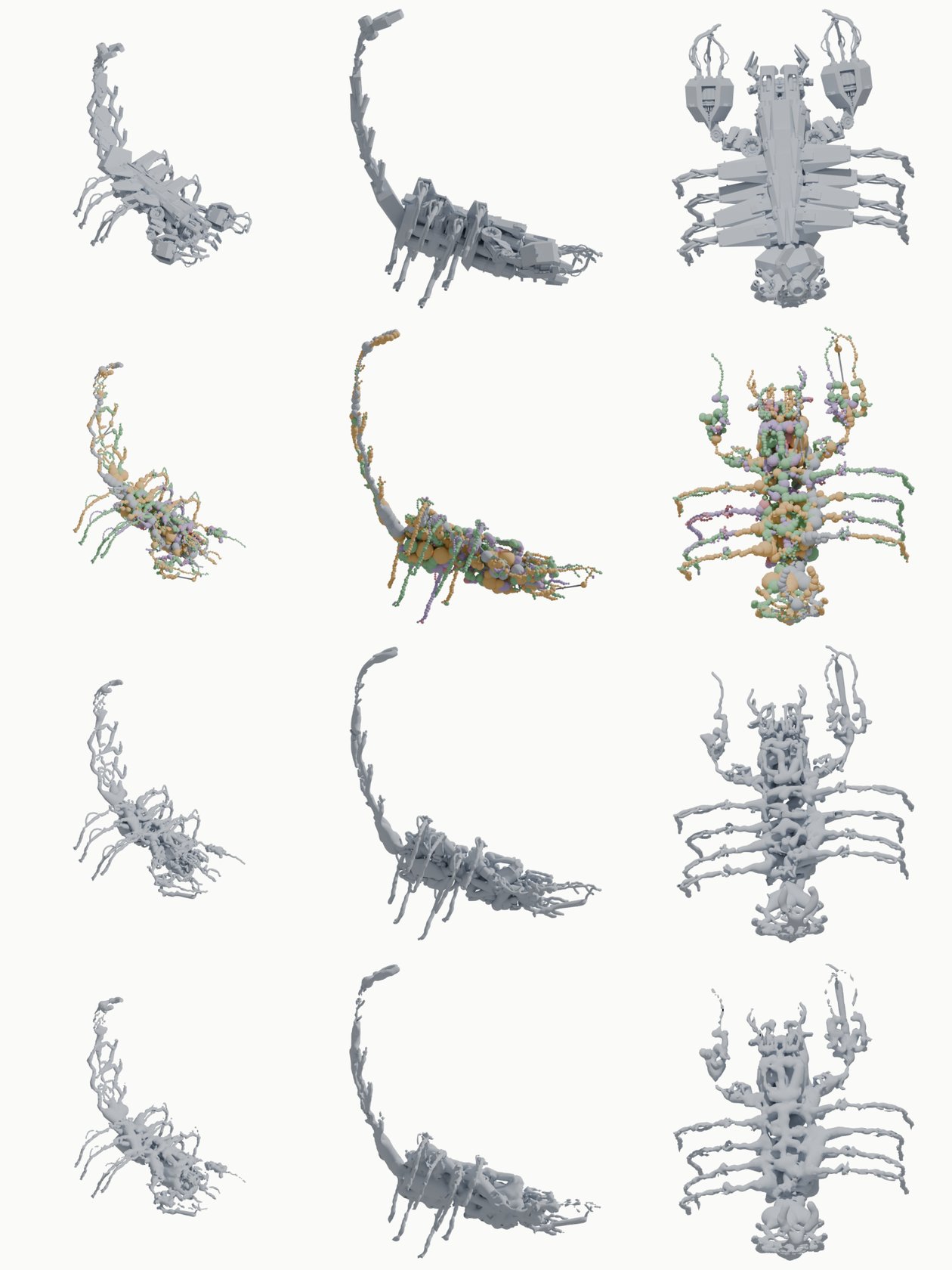
- The tree holds animals with limbs. Four of eight are recognisable at the first try and two more are close, with hands, feet and toes, which is where the carved blocks failed.
- Flat parts need two thicknesses (lizard body, bird body and wings, fins). The Skin modifier has them; the first try used one.
- Far too many points. The first try put 80 to 460 points in each animal (the scorpion 2,650); artists use about three per limb. Fewer points give a cleaner skin: merging crowded points is what removed most of the slabs.
- Hard-shelled animals (scorpion, crab, insects) need the separate-pieces path.
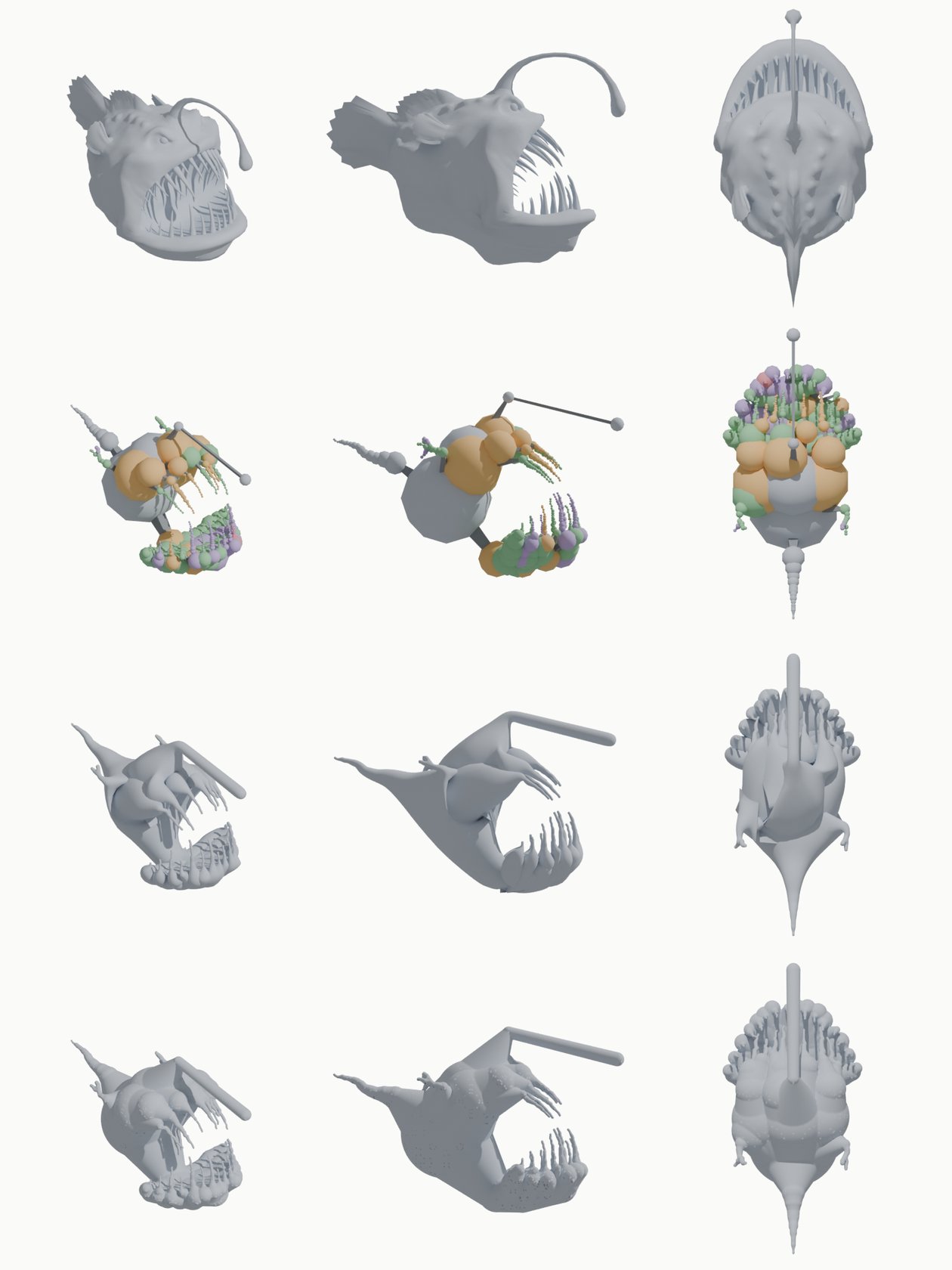
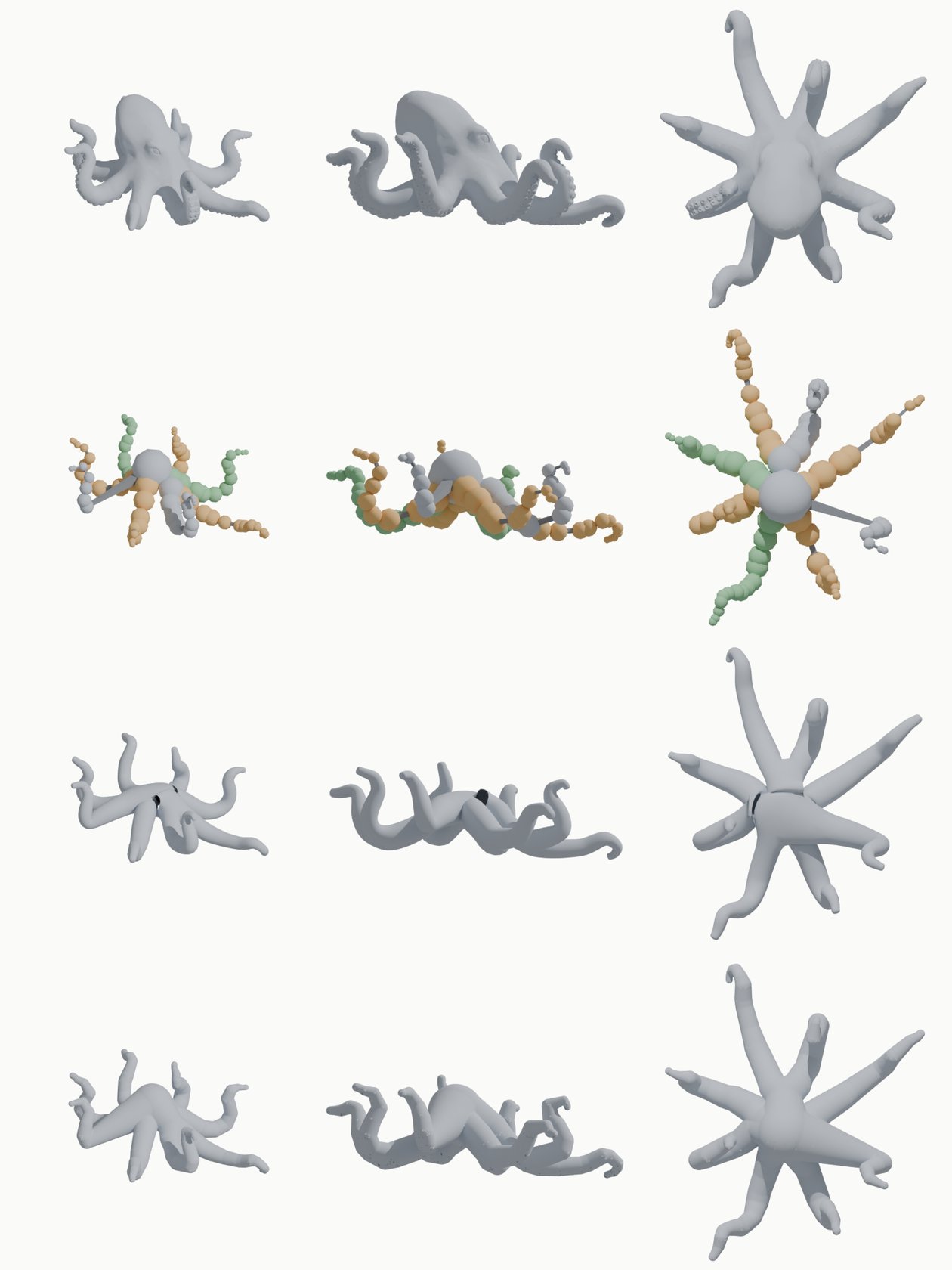
A stricter setting drops more short branches. On the anglerfish it removes some teeth but not the long ones, and on the octopus it drops the whole head, because the head does not stick out far compared with the body's thickness. So details have to go before fitting, in the pictures: your simplify-first idea (T2).
The stricter setting, anglerfish and octopus
How the tool is picked today, and the test we skipped

We only ever counted the result. From pictures, the rule picks the tool that is best against the true part in about 4 parts out of 10, and the wrong picks cost 4 of the 18 parts that could have passed. We never looked at how each choice was made, and never tried the rule on parts whose right answer is known. That is the gap you pointed out.
They do not fit everything and compare. They choose by what kind of shape the part is: long and round → a chain in the tree; forked → a fork in the tree; flat → a plate with thickness; compact → a ball or box; cupped → a shell; repeated → one copy, duplicated. With a tree, most of this can be read off the tree itself.
Three habits, all missing from ours. Check against people's answers: part splits are compared with splits drawn by people, and user studies ask whether the result matches what people meant. A shape type that cannot hold the part (a solid tool for a hollow part) is counted as an error, not as a slightly worse fit. Charge for flexibility: a bendier tool must beat a simpler one by more than its extra settings are worth (minimum description length, Leonardis 1997; part-count costs in DBW 2023 and SuperDec 2025). Report the gap to hindsight: Kobsik and colleagues (2026) choose among 45 candidates by lowest error and reach 65.6% overlap, where the best in hindsight would give 74.4%. We have the same gap.
The updated plan
Two changes. The choice test now comes first, alongside the clean truth tree and the simplified pictures. And the fitter now copies the artists' main method: draw a tree of balls over the pictures, then let the Skin modifier make one body, instead of carving a block and fitting a tool per part. The five tools stay, but only for what a tree cannot hold: fins and wings (sheet), shells and bells (hollow), and separate hard pieces.
T0 Test the tool choice new · first
- Show
- A page with every part's five candidate fits side by side, the number the rule used, the rule's pick and the right answer against the true part, so you can see each choice being made.
- Known answers
- Made-up parts whose right tool is known (a ball, a bent tapering rod, a fork, a fin, a cup), drawn in pictures with the same faults as AI pictures.
- Rules tried
- Today's (smallest error); smallest error plus a cost for each extra setting, so a simpler tool wins a near-tie; the artists' rule, read from the shape's tree.
- Pass
- Set before running: the known answer on at least 9 of 10 made-up parts, and at most 1 in 10 of the passable true parts lost to the choice.
- Who
- One Codex worker (code and page); the lab for the fits.
T1 A clean tree for every true model
- What
- The tree of each of the 37 true models, found from the 3D shape, replacing the ragged painted parts as the truth we judge against.
- Methods
- Three, compared: today's first try (thin the shape to its centre line, drop branches that barely stick out); shrinking the surface onto its centre line (Laplacian contraction); and the fewest balls that cover the shape (Coverage Axis, sphere-meshes).
- Better
- Two thicknesses per point for flat parts, and points only where the direction or thickness changes, about three per limb, as artists place them.
- Judged
- On made-up shapes whose tree is known, then by your eye on the 37 (true model beside its tree and its Skin body).
- Who
- Two Codex workers in parallel; the lab.
T2 Simplified pictures
- What
- The clay prompt, now saying what artists keep at the blocking stage: big masses only, mouth open, no teeth, claws, spines, eyes or texture, each finger or toe one simple shape.
- Where
- 4 true models and the 7 AI animals, every view (about 130 pictures).
- Judged
- Details gone, outline otherwise unmoved: the simplified outline against the original outside the removed details.
- Who
- Codex's image tool; the lab registers and paints.
T3 Draw the tree over the pictures
- What
- The artists' method in code. In each picture, each painted part's centre line and width (Teddy's method for drawn outlines; Hi-LASSIE does the same on a side view). Matched across views by the paint, the lines give the 3D tree and two thicknesses per point. The Skin modifier makes the body.
- Disagreement
- A view that disagrees is outvoted per branch, as the per-part view pick does now.
- Hands, feet
- A palm with finger chains; insect legs as chains of rigid segments.
- Judged
- Outline from every view, the T1 tree, and your eye. Starts when T1 and T2 have first results.
T4 Joins and hard pieces
- What
- Your worry about how parts attach. One skin for what bends; separate pieces pushed in for hard parts; voxel fusing where one surface is needed. A check that every piece touches what it belongs to, at the right place.
- First cases
- The agama's feet, the scorpion's claws and legs, the anglerfish's jaws (the open mouth as the gap between two jaw branches).
T5 Turnable 3D viewer
- What
- True model, tree and Skin body in one page you can turn, so a part you can't recognise in a still picture can be checked from any side.
- Who
- One Codex worker.
Later After the first round
- Templates
- A starting tree per animal group, as ZBrush ships ready-made ZSphere skeletons for quadrupeds, birds, reptiles and amphibians. It helps when the pictures disagree.
- More animals
- Ten new AI animals (the earlier T5), then all 37 kinds.
- Details
- Teeth, claws, spines as separate pieces on the finished body.
Now, before Codex resets
Done today: the reading, and the first tree on eight true models (above). Still to do: the five briefs, the made-up shapes for T0 and T1, and the lab data staged.
At the reset (Wednesday 4 am)
T0, T1 and T2 start together: three Codex workers, and image calls for T2. T5 starts when a worker is free.
After the first results
T3, then T4, built on the clean trees, the simplified pictures and the chosen rule. Each result comes to you as pictures.
Main sources
- Blender manual: Skin modifier
- ZBrush manual: ZSpheres, Adaptive Skin, Unified Skin
- Creature block-out with ZSpheres (CGHero)
- Creature concepting: a base mesh with ZSpheres (Autodesk course)
- ZBrush ShadowBox for beginners (video)
- B-Mesh: base meshes of articulated shapes (Ji, Liu, Wang 2010), the Skin modifier's method
- Base manifold meshes from skeletons (Piovarči 2014)
- Teddy: sketching 3D freeform shapes (Igarashi 1999)
- Hi-LASSIE: skeletons of animals from a few photos (2023), code
- Skeletons by Laplacian contraction (Cao et al. 2010)
- L1-medial skeleton of a point cloud (Huang et al. 2013)
The decisions are in chat.