Trees from joint marks
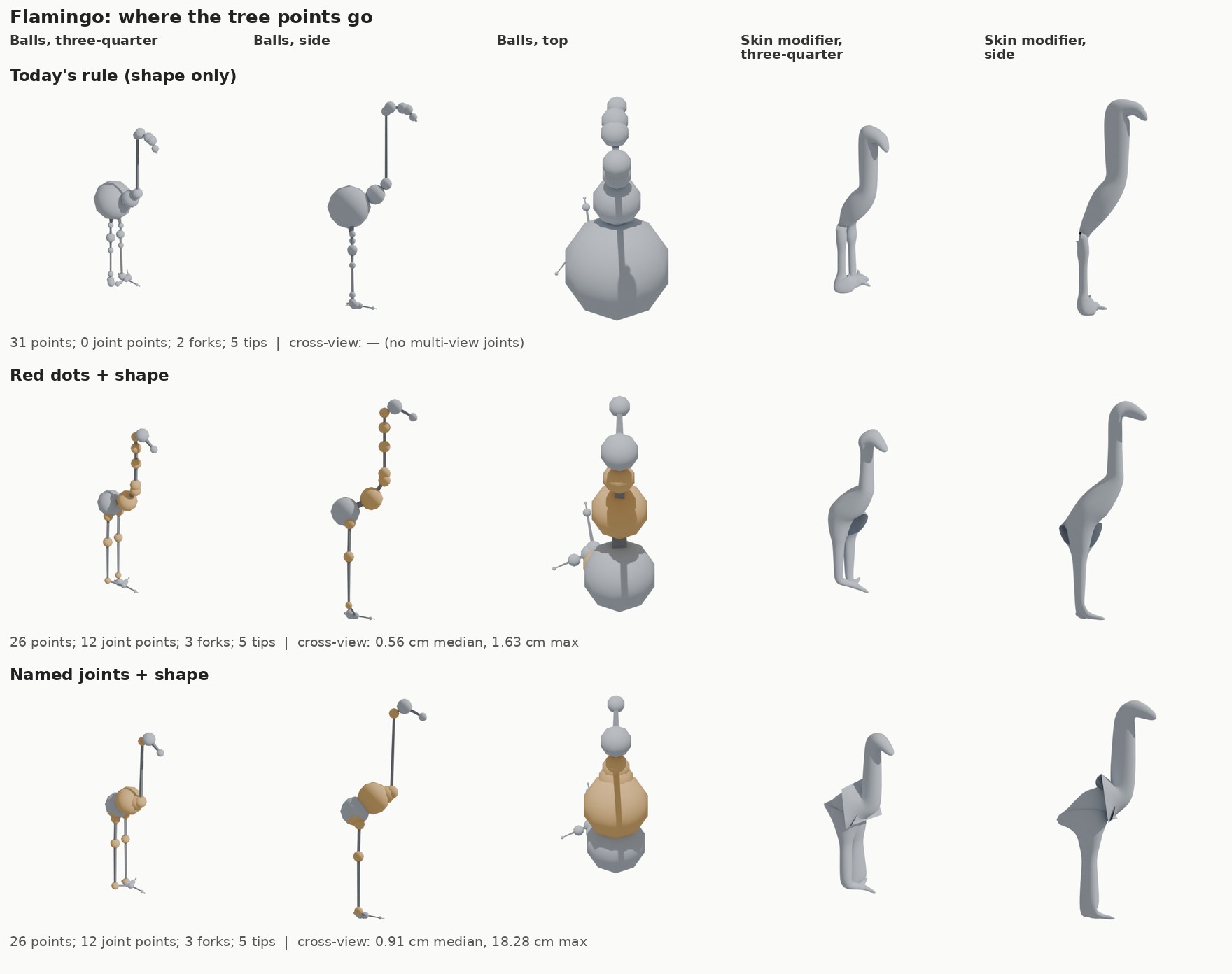
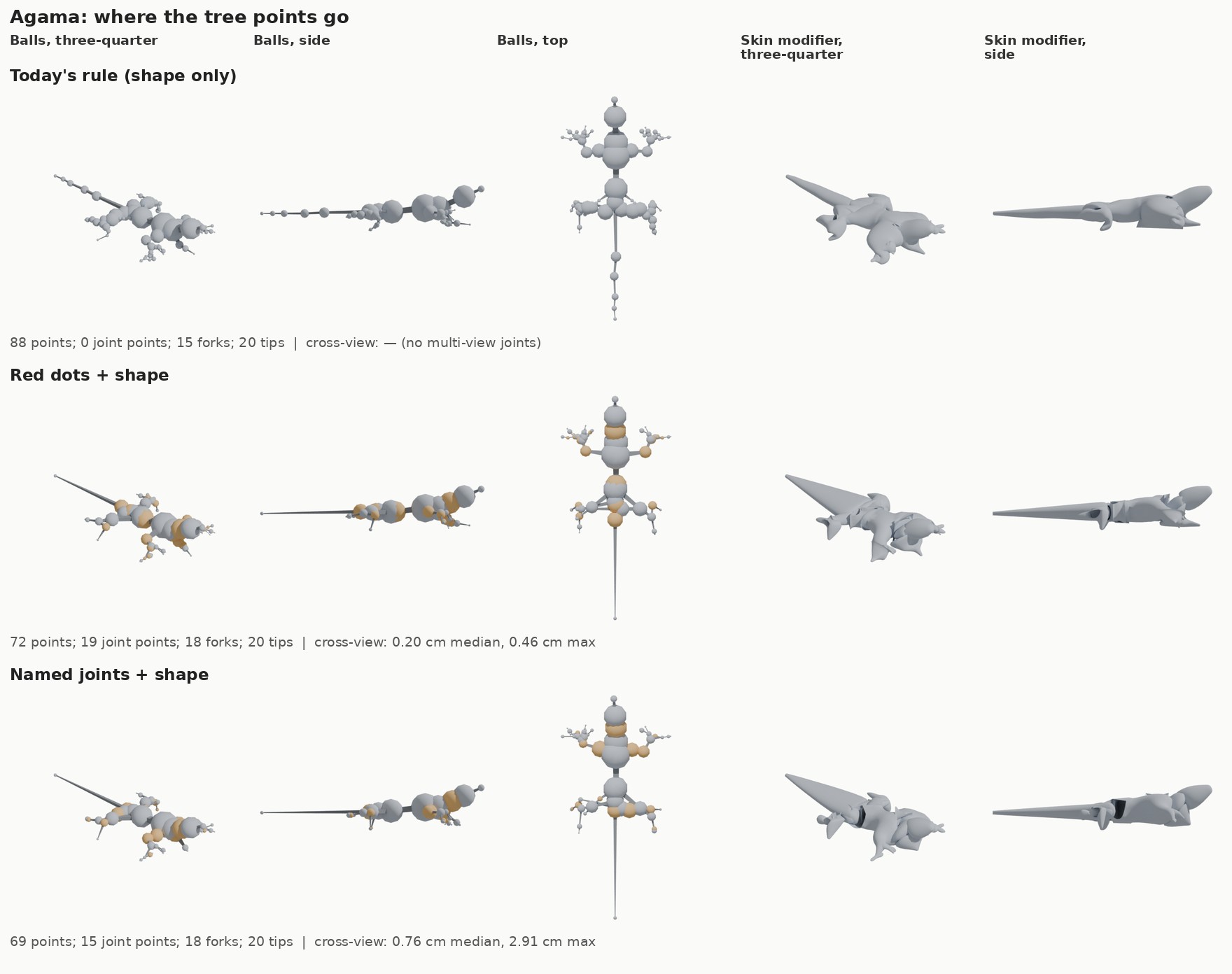
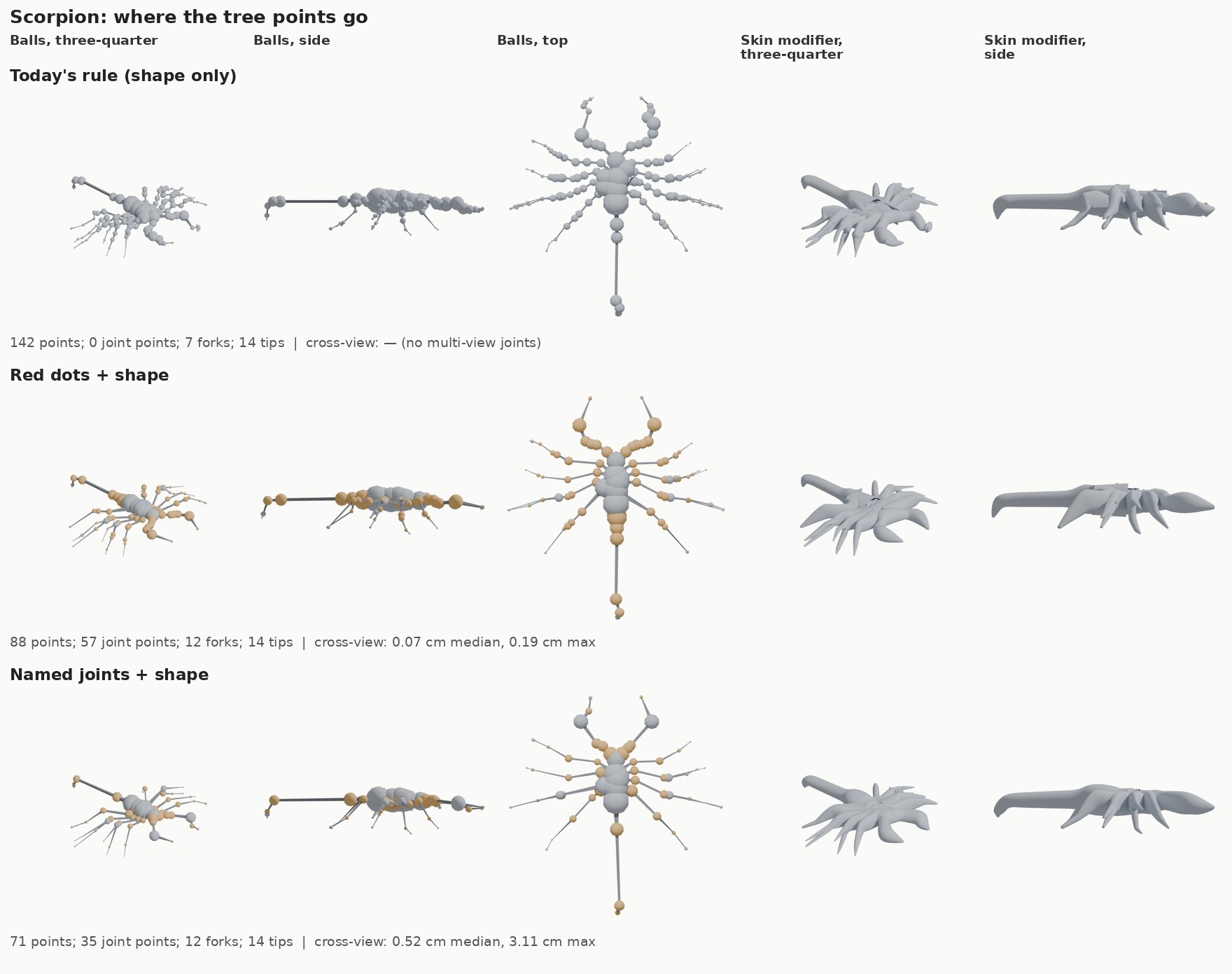
Three animals, one carved shape per animal, and three ways to choose the tree's points. Today's shape rule is compared with red dots from two tries and with named joint marks. Ball sizes come from the shape. These are checks to judge by eye; no skeleton answer key exists for these drawings.
In short
on the jointsWhere the points land
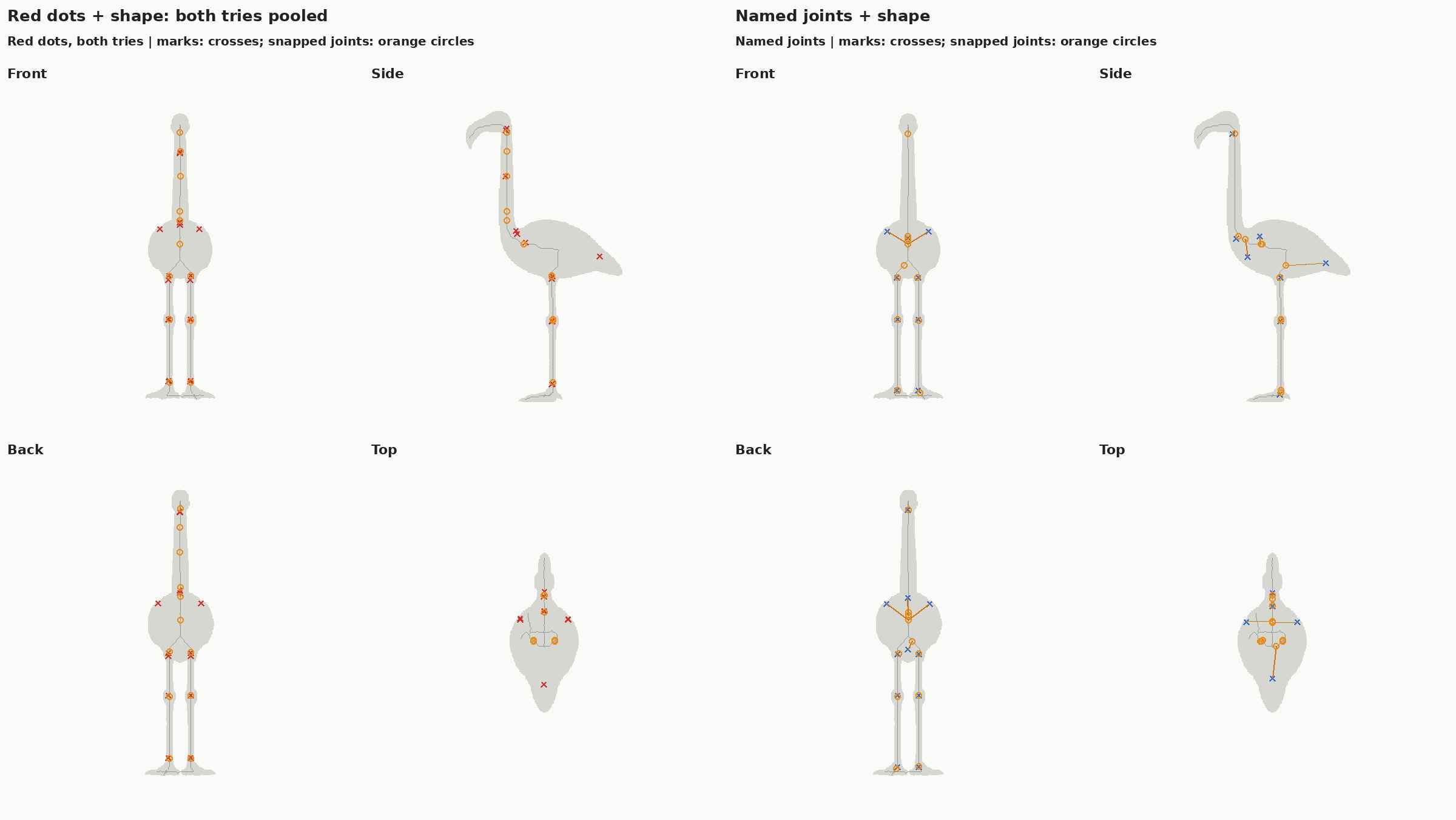
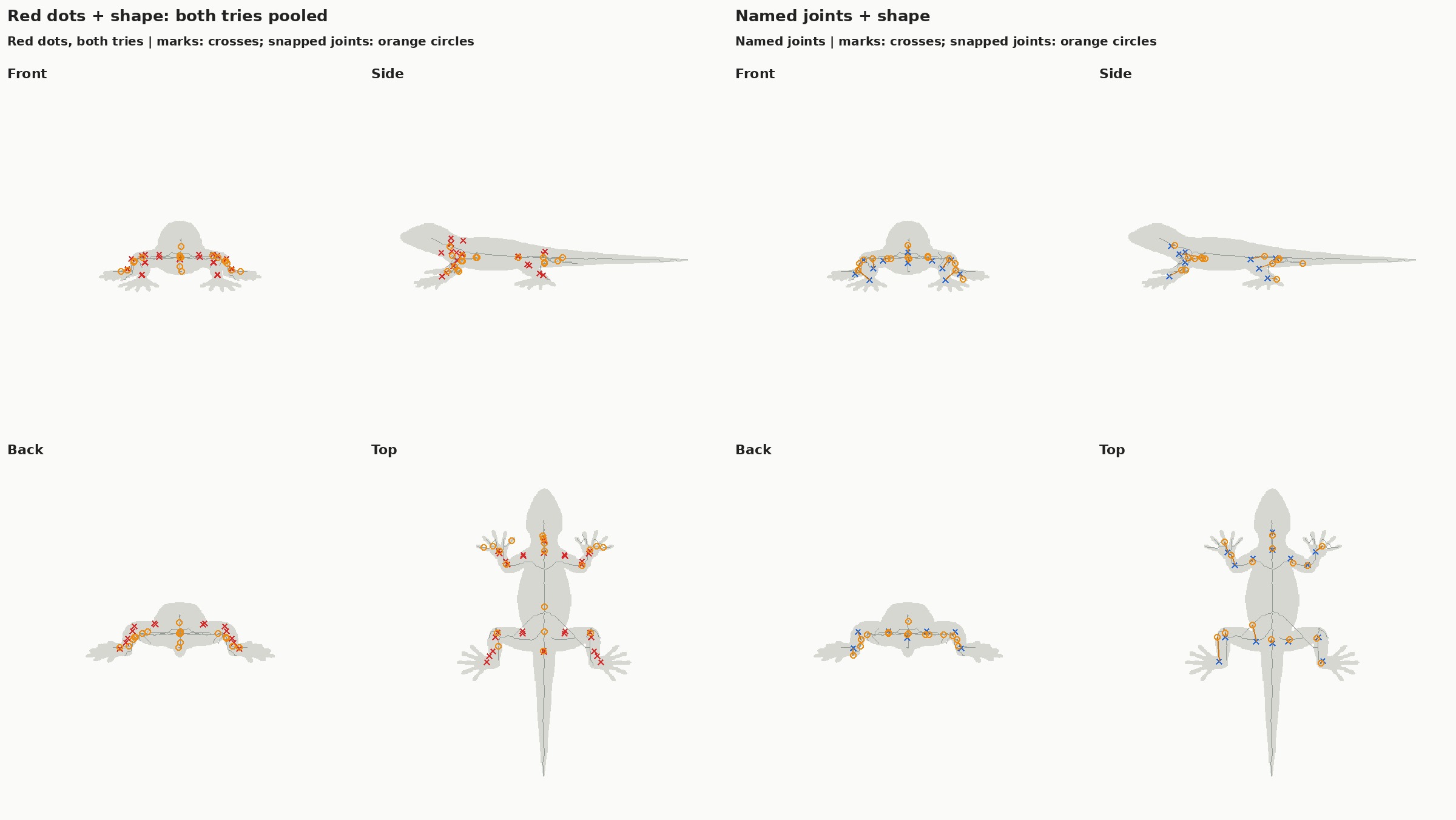
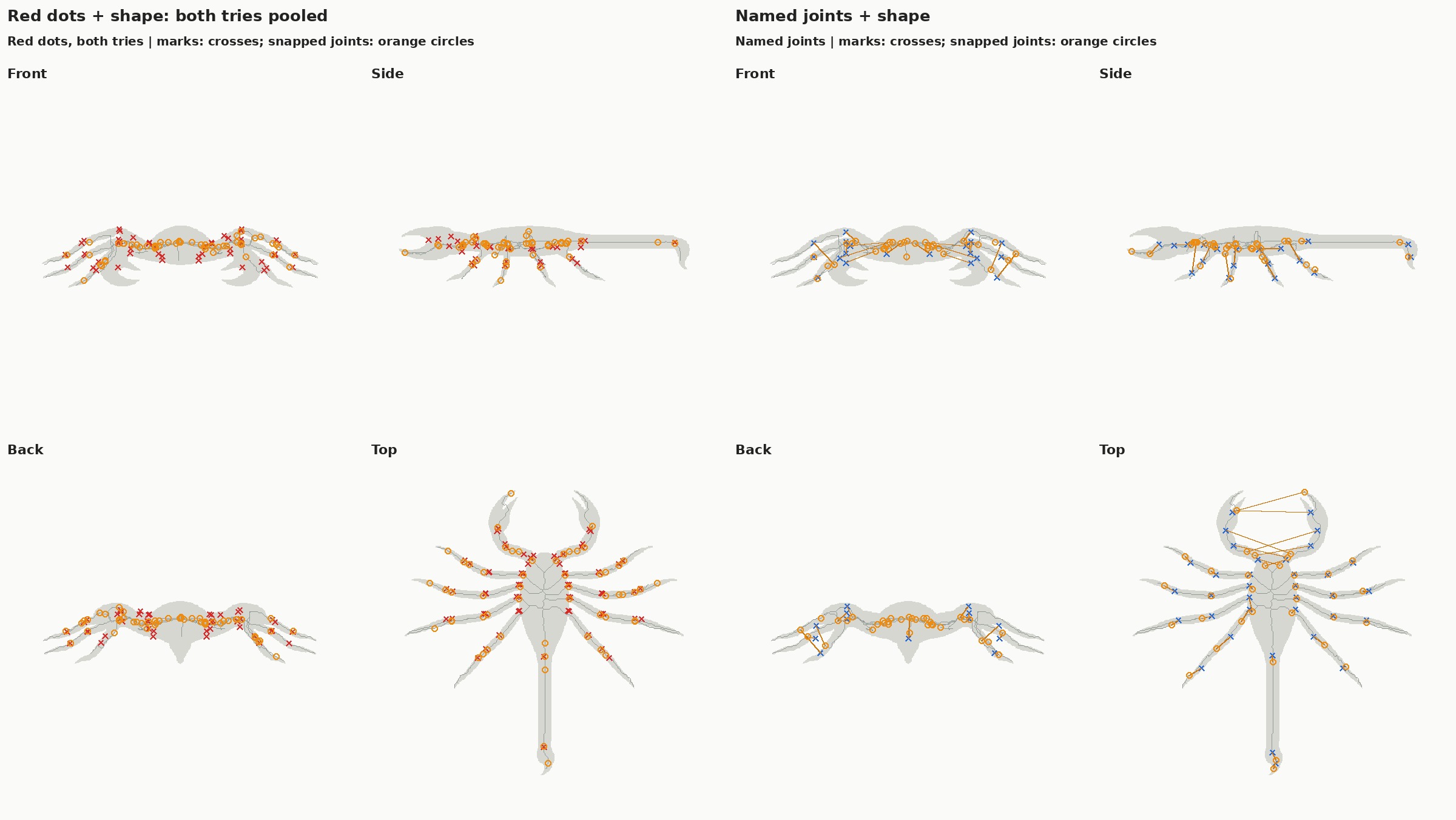
Where a mark sits on a limb the shape also has, the 3D joint lands on it and the views agree closely: red dots within 0.6 cm (flamingo, 130 cm), 0.2 cm (agama, 35 cm) and 0.1 cm (scorpion, 12 cm), median. But many dots find no limb in the shape and are left out: flamingo 18, agama 55, scorpion 103 (the flamingo's wing shoulders are folded into its body; agama and scorpion feet and toes).
2 of 3 betterWhat the trees make
Fewer points, at the joints: flamingo 31 to 26, agama 88 to 72, scorpion 142 to 88 (red dots). The flamingo's neck now bends with its curve (six points instead of a straight stick) and the scorpion's legs get a point at each bend instead of dozens of small balls. The agama is no better: the shape still adds every toe as a branch, and its Skin body folds (dark patches) where points crowd. The named variant snaps every joint somewhere, even with no limb near: the flamingo's shoulders and neck base pile up in the chest and its Skin folds there.
your callNext step
The idea works where the marks and the shape agree. Three faults to fix before a wider test: (1) a mark far from any limb is dropped, never snapped into the body; (2) the marks, not the shape, decide the points; the shape adds only real ends (no unmarked toes); (3) crowded points at forks are merged so the Skin body does not fold. The decision is in chat.
Flamingo
| Tree | Points | Joint points | Joints (≥2 views / 1 view) | Forks | Tips | Unused dots | Cross-view cm (median / max) |
|---|---|---|---|---|---|---|---|
| Today's rule (shape only) | 31 | 0 | 0 / 0 | 2 | 5 | — | — / — |
| Red dots + shape | 26 | 12 | 12 / 0 | 3 | 5 | 18 | 0.56 / 1.63 |
| Named joints + shape | 26 | 12 | 11 / 1 | 3 | 5 | — | 0.91 / 18.28 |
Cross-view distances measure the gap from the snapped centre-line joint to its matched mark in each supporting view, in centimetres. The summary includes joints seen in two or more views. Named joints that snap to the same cell share a ball and retain all names.
Outline mapping check (overlap with refs)
| Input | Front | Side | Back | Top |
|---|---|---|---|---|
| dots-1 | 0.956 | 0.977 | 0.952 | 0.985 |
| dots-2 | 0.959 | 0.976 | 0.951 | 0.984 |
| original | 0.966 | 0.978 | 0.968 | 0.992 |
Agama
| Tree | Points | Joint points | Joints (≥2 views / 1 view) | Forks | Tips | Unused dots | Cross-view cm (median / max) |
|---|---|---|---|---|---|---|---|
| Today's rule (shape only) | 88 | 0 | 0 / 0 | 15 | 20 | — | — / — |
| Red dots + shape | 72 | 19 | 9 / 10 | 18 | 20 | 55 | 0.20 / 0.46 |
| Named joints + shape | 69 | 15 | 15 / 0 | 18 | 20 | — | 0.76 / 2.91 |
Cross-view distances measure the gap from the snapped centre-line joint to its matched mark in each supporting view, in centimetres. The summary includes joints seen in two or more views. Named joints that snap to the same cell share a ball and retain all names.
Outline mapping check (overlap with refs)
| Input | Front | Side | Back | Top |
|---|---|---|---|---|
| dots-1 | 0.953 | 0.972 | 0.980 | 0.949 |
| dots-2 | 0.948 | 0.979 | 0.976 | 0.955 |
| original | 0.976 | 0.980 | 0.983 | 0.963 |
Scorpion
| Tree | Points | Joint points | Joints (≥2 views / 1 view) | Forks | Tips | Unused dots | Cross-view cm (median / max) |
|---|---|---|---|---|---|---|---|
| Today's rule (shape only) | 142 | 0 | 0 / 0 | 7 | 14 | — | — / — |
| Red dots + shape | 88 | 57 | 38 / 19 | 12 | 14 | 103 | 0.07 / 0.19 |
| Named joints + shape | 71 | 35 | 29 / 6 | 12 | 14 | — | 0.52 / 3.11 |
Cross-view distances measure the gap from the snapped centre-line joint to its matched mark in each supporting view, in centimetres. The summary includes joints seen in two or more views. Named joints that snap to the same cell share a ball and retain all names.
Outline mapping check (overlap with refs)
| Input | Front | Side | Back | Top |
|---|---|---|---|---|
| dots-1 | 0.932 | 0.968 | 0.941 | 0.924 |
| dots-2 | 0.944 | 0.968 | 0.945 | 0.932 |
| original | 0.970 | 0.968 | 0.956 | 0.961 |
How this was made
- Split the simplified sheet into front, side, back and top views. Register their scales, then carve the shape all four outlines allow, with two pixels of outline growth on a grid with 256 cells along the longest side.
- Fill enclosed holes, discard pieces smaller than 0.2% of the shape, and thin each piece to a centre line. Smooth its radii over two neighbour rings, prune short branches with the declared tip cap, and choose one root in each piece. All three rules share these cells.
- Today's rule is the unchanged v54 tree: retain bends and thickness changes as well as forks and tips, merge crowded points, and extend the tips toward the surface.
- Align each marked sheet view's animal outline box to its registered mask's box, ignoring red dots and tiny specks. The overlap table checks this mapping, including image-model drift.
- A red dot is a line of sight through the animal. Pool dots from both tries. A centre-line cell needs support from at least two views, within three pixels or half its projected radius, whichever is larger. Choose the cells with most supporting views and then smallest total distance; suppress nearby duplicates. A remaining dot can give a one-view joint only when its possible cells lie within two local radii of one another. Ambiguous dots stay unused.
- For each named joint, choose the centre-line cell with the smallest sum of squared pixel distances to that name's given positions. A name supplies correspondence even when the drawings disagree. Names do not override the centre line's topology.
- For each joint tree, keep joints, forks, tips and roots. Add at most one bulge on each stretch when the radius exceeds 1.3 times both end radii and lies more than one radius from each end. Link each point to its nearest kept ancestor. Merge crowded extra points within 0.6 times the larger radius; preserve every joint and original fork, tip and root.
- Read ball sizes from the shape. A point with two links gets two cross-section thicknesses in Blender's Skin frame; other points are round. Extend tips toward the surface. Grey balls are shape points and orange balls are joints; today's comparison is rendered all grey. No ball fit, sheets or shells are added.
- Render the balls and Blender's Skin modifier from the same trees. Report joint-to-mark projection gaps in centimetres; one-view joints have no cross-view check. These diagnostics do not establish anatomical correctness.