Joint marks: a first look
Can an image model mark where the tree's points belong, at the joints? Three AI animals, from easy to hard. The image model added red dots to each simplified sheet, twice, independently. In the variant, a model looked at the sheet and wrote down each joint's name and position in numbers (drawn here in blue, numbered). Nothing is built yet: this page is only the marks, for us to look at before going on. Back to the AI animals.
In short
kept1. The animal stays put
Adding the dots, the image model redrew each sheet; the outline moved very little (worst view 0.96 to 0.98 overlap with the original). One scorpion try moved more (0.94) and was redone.
same spots2. Two tries agree on where
When both tries mark a joint, they put it in the same place: within 2% of the sheet width for all flamingo and agama dots and 97% of the scorpion's. They differ on how many joints they mark: one try marks more (flamingo 33 vs 25, scorpion 114 vs 74).
by eye3. What they mark
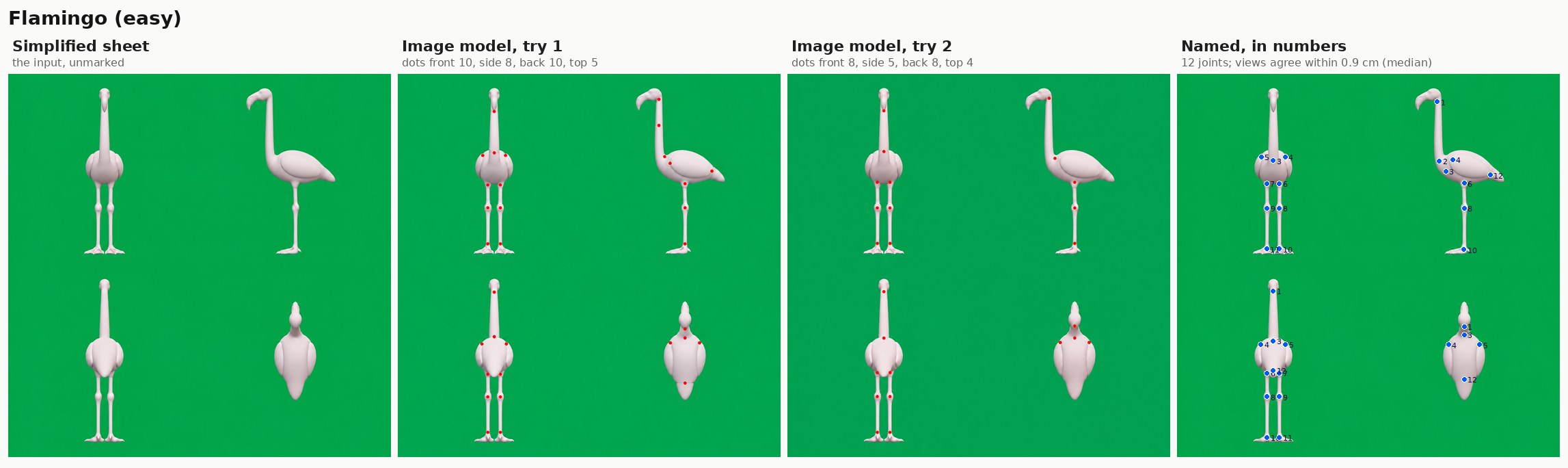
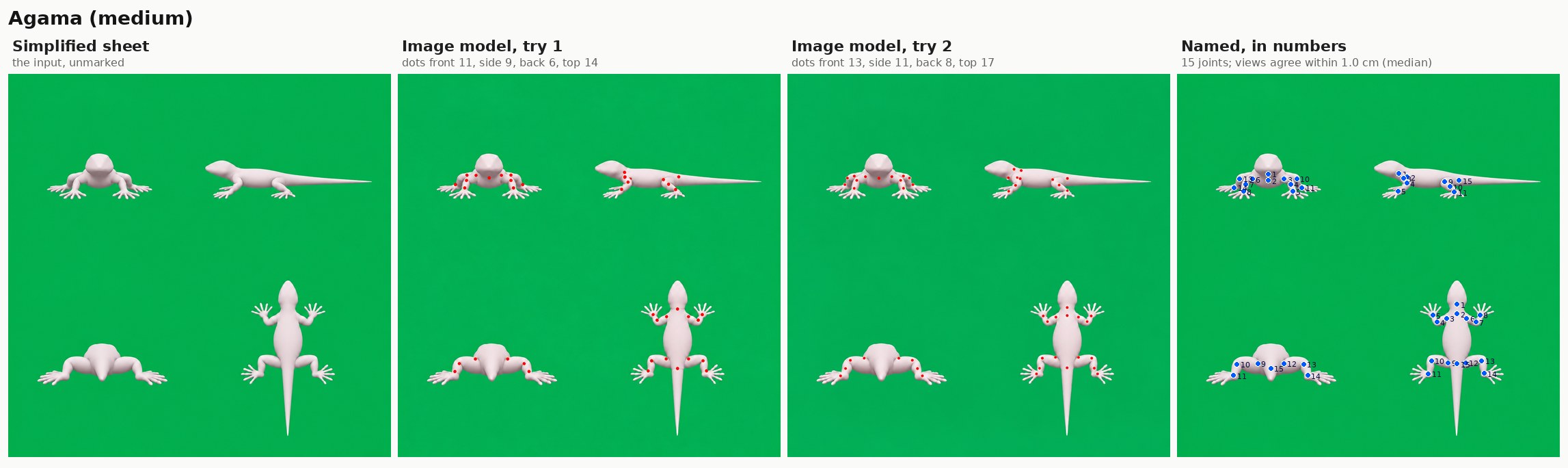
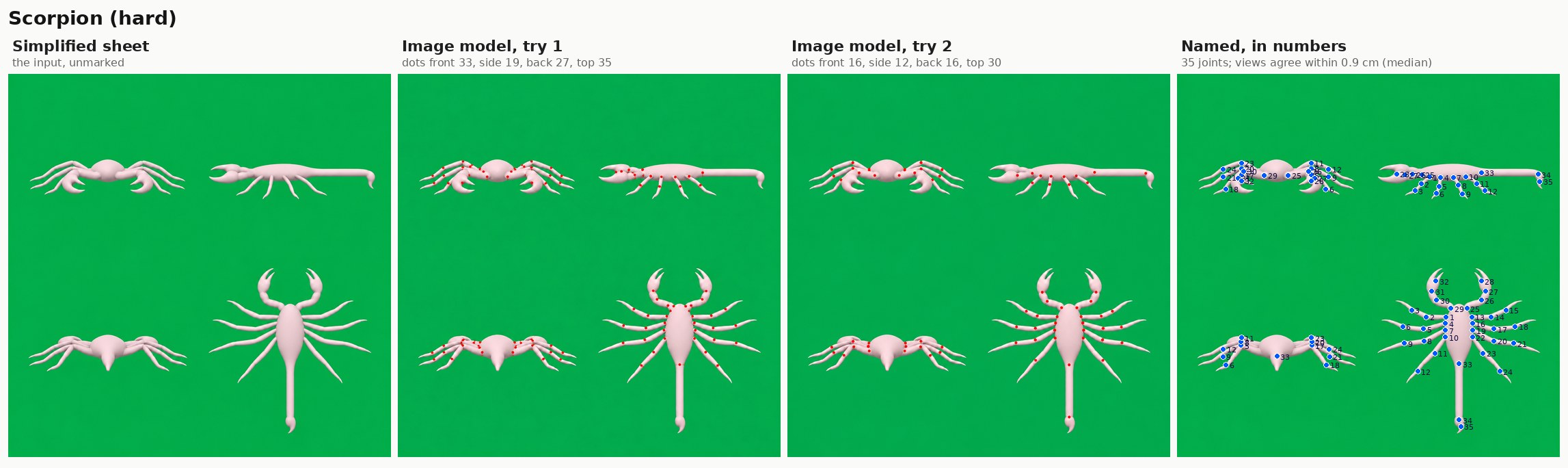
Flamingo: head-neck, neck base, hip, the backward-bending leg joint and the foot; the long neck gets only one or two bends. Agama: shoulders, elbows, wrists, hips, knees, ankles, neck; no dots on the straight tail. Scorpion: most leg bends in try 1, fewer in try 2; the smooth tail gets almost none.
names4. The named variant
12, 15 and 35 joints with names, so we know which joints belong to which leg. The same joint's position in different views agrees within about 1 cm (median): good for the flamingo (130 cm) and agama (35 cm), loose for the 12 cm scorpion, whose crossing legs it was unsure of.
The three animals
Columns: the simplified sheet as given; the image model's red dots, try 1 and try 2; the named joints in numbers, drawn on the sheet. Each sheet is front (top left), side with the head to the left (top right), back (bottom left), top with the head up (bottom right). Click a figure for full size.
| Animal | Dots, try 1 (front / side / back / top) | Dots, try 2 | Outline kept (worst view) | Named joints | Named: views agree (median / worst) |
|---|---|---|---|---|---|
| Flamingo (easy) | 10 / 8 / 10 / 5 | 8 / 5 / 8 / 4 | 0.976 / 0.974 | 12 | 0.9 / 16 cm |
| Agama (medium) | 11 / 9 / 6 / 14 | 13 / 11 / 8 / 17 | 0.981 / 0.977 | 15 | 1.0 / 4.1 cm |
| Scorpion (hard) | 33 / 19 / 27 / 35 | 16 / 12 / 16 / 30 | 0.968 / 0.962 | 35 | 0.9 / 4.8 cm |
What happens after the dots
- A dot is a line through the animal. A dot in the front view fixes left-right and height, not how far forward.
- Lines from different views meet at the joint. Side gives front-back and height, top gives left-right and front-back; where they cross inside the shape is the joint in 3D. Seen in one view only: it sits in the middle of the limb along that line.
- The views check each other. Front, side and back all show height, so the same joint must sit at the same height in each; a dot that disagrees is flagged, in centimetres.
- The joint moves onto the shape's centre line, so its ball sits in the middle of the limb.
- Joints are linked in the order the centre line passes them (shoulder, elbow, wrist); forks where the centre line splits; each limb gets an end point. The named variant's names also say which joints belong together.
- Ball sizes come from the shape's thickness at each point.
How this was made
Two Codex jobs on 2026-11-04: the image model edited each sheet with one fixed prompt (dots on every joint where the head, neck, body, tail or a limb bends or attaches; not the tips; nothing else changed), two independent tries per animal, a try redone only if its outline moved (one scorpion try); the variant looked at each sheet and gave named joints with pixel positions per view, checking its own points once. About 1% of the week's Codex use. Dot counts, outline overlap and the two-try comparison are measured by script.