AI animals: a 3D blockout from a simplified sheet
Plan v55, one report, as you asked. Eleven animals drawn by an image model, with no 3D model behind them; each has a final clay sheet and a simplified one, and the model is fitted to the simplified sheet only. The pass line was written in the experiment log before the run. All models here are made by script, none edited by hand. Every picture's columns are labelled. Turn the models in the 3D viewer. The decisions for the next round are in chat.
In short
0 of 111. The pass line
Fixed before the run: the four views overlap the simplified sheet by 0.90 on average and 0.85 at worst, and the unseen view overlaps at least 0.03 better than the carved shape. No animal meets both; 8 were needed.
The numbers2 + 3 of 112. The unseen view
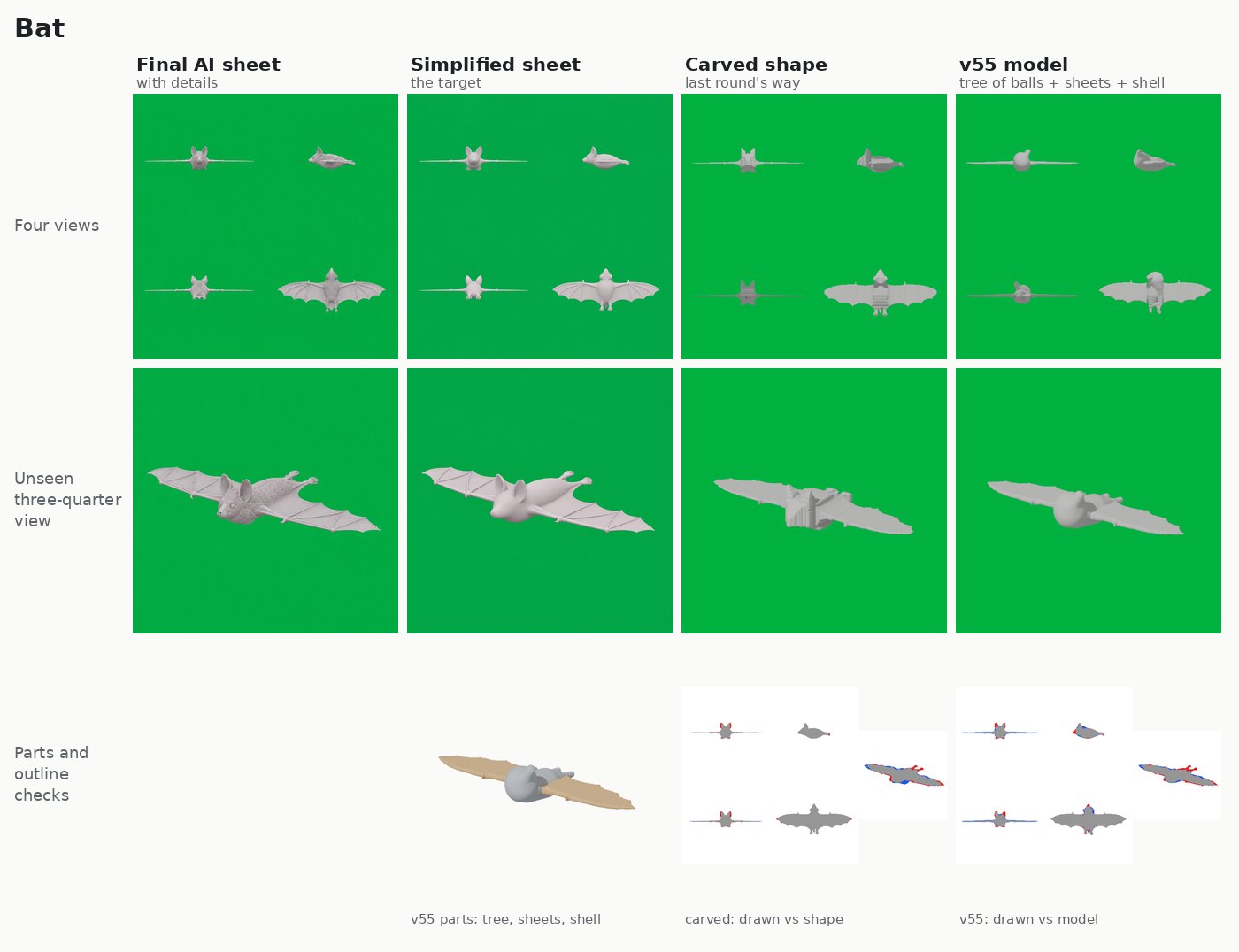
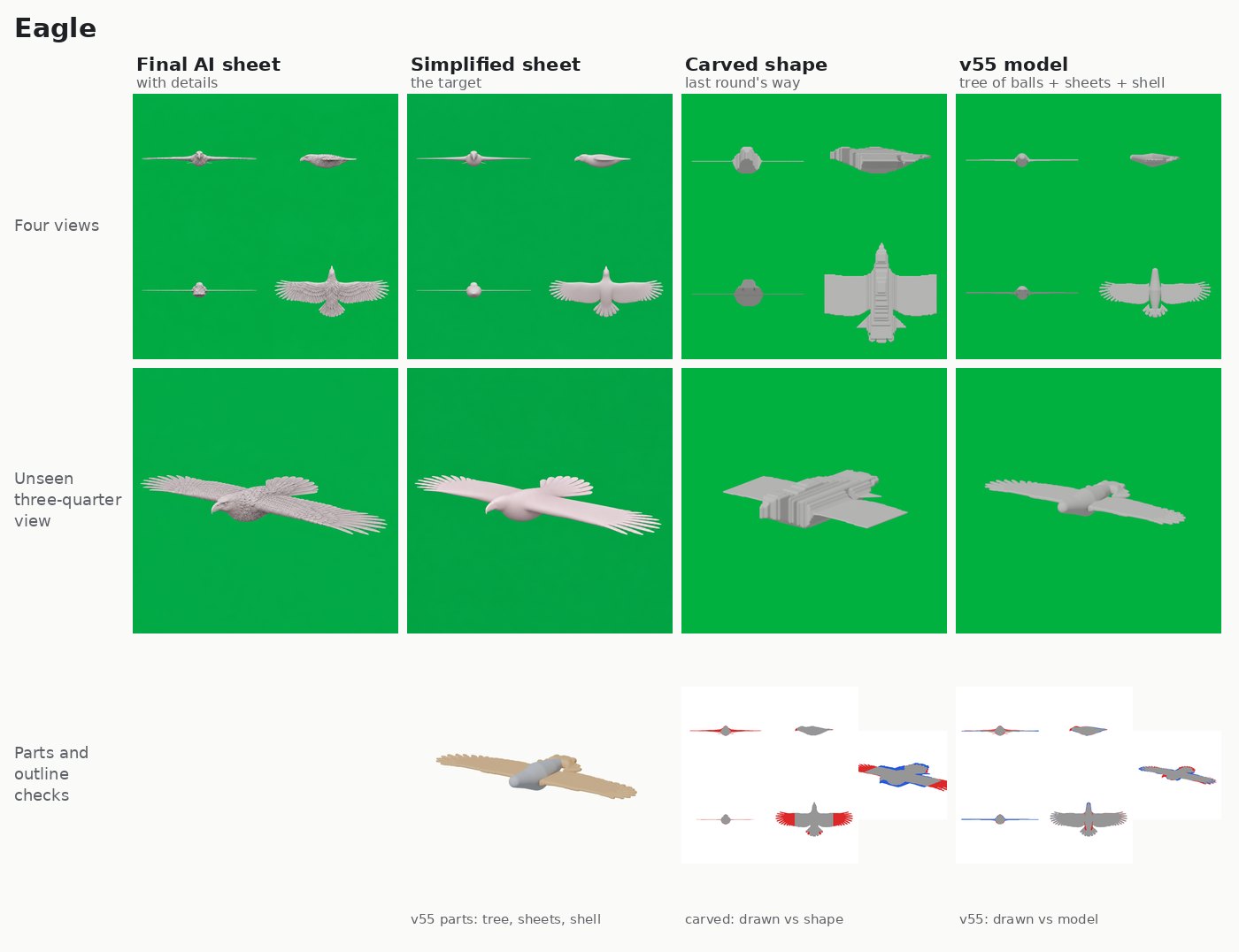
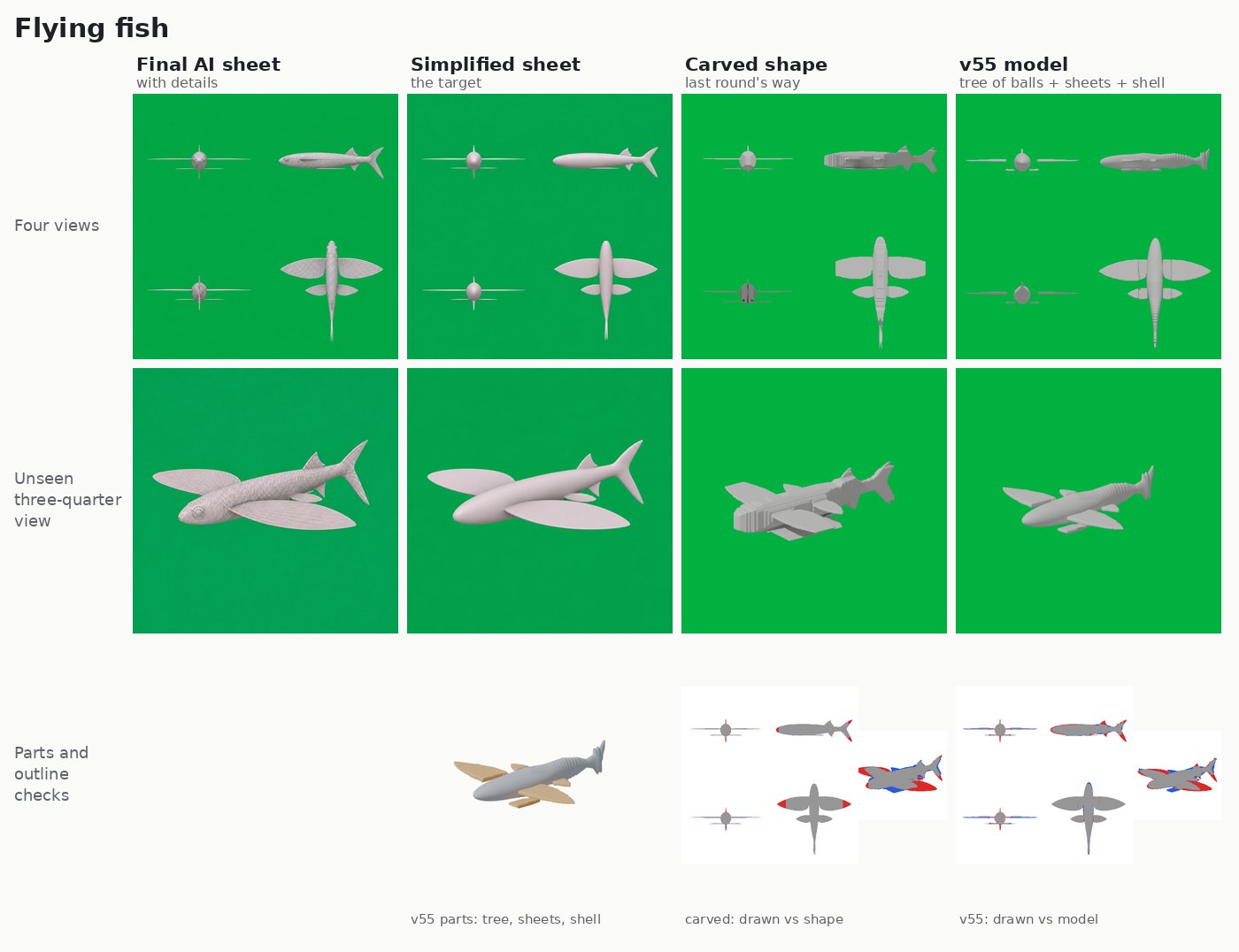
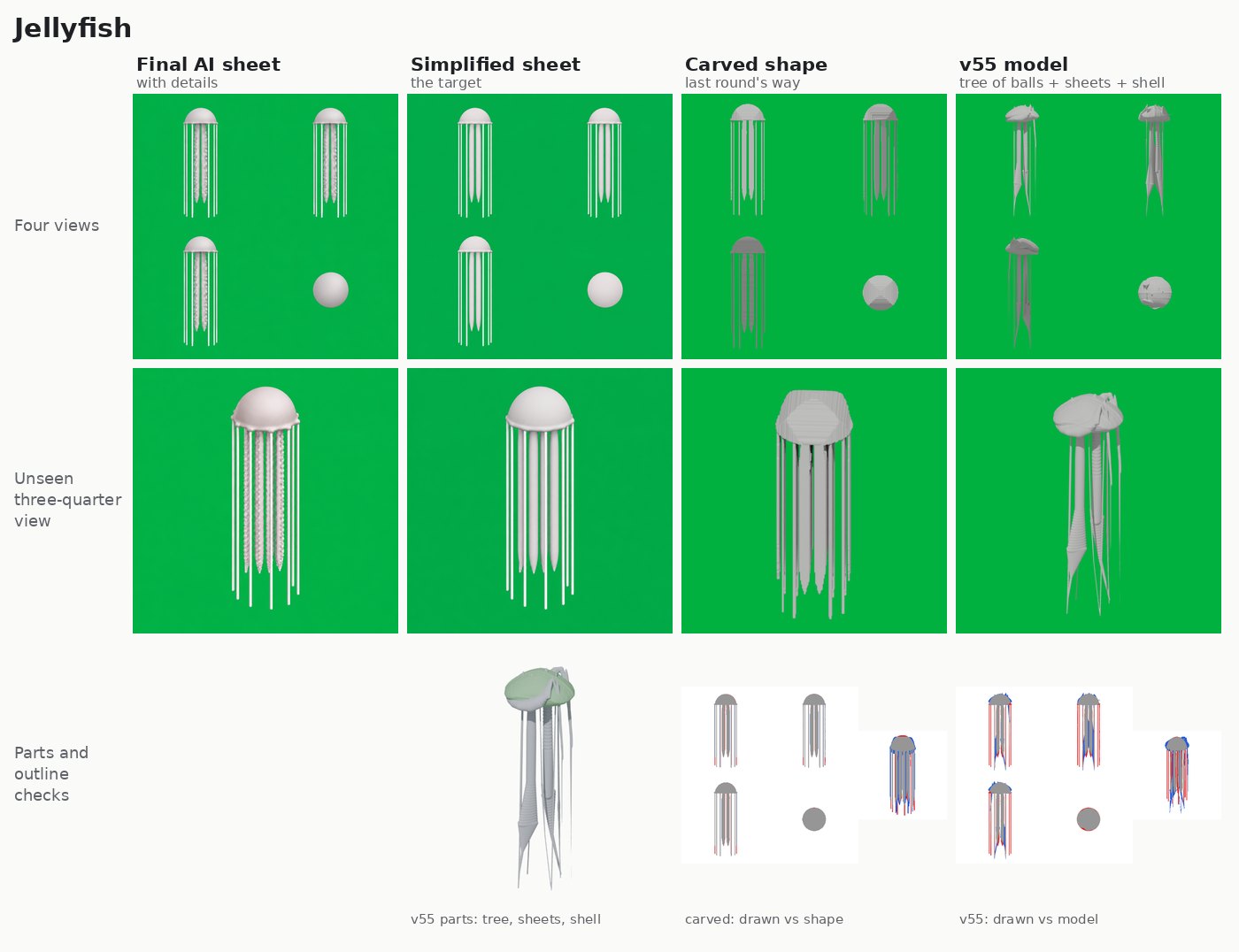
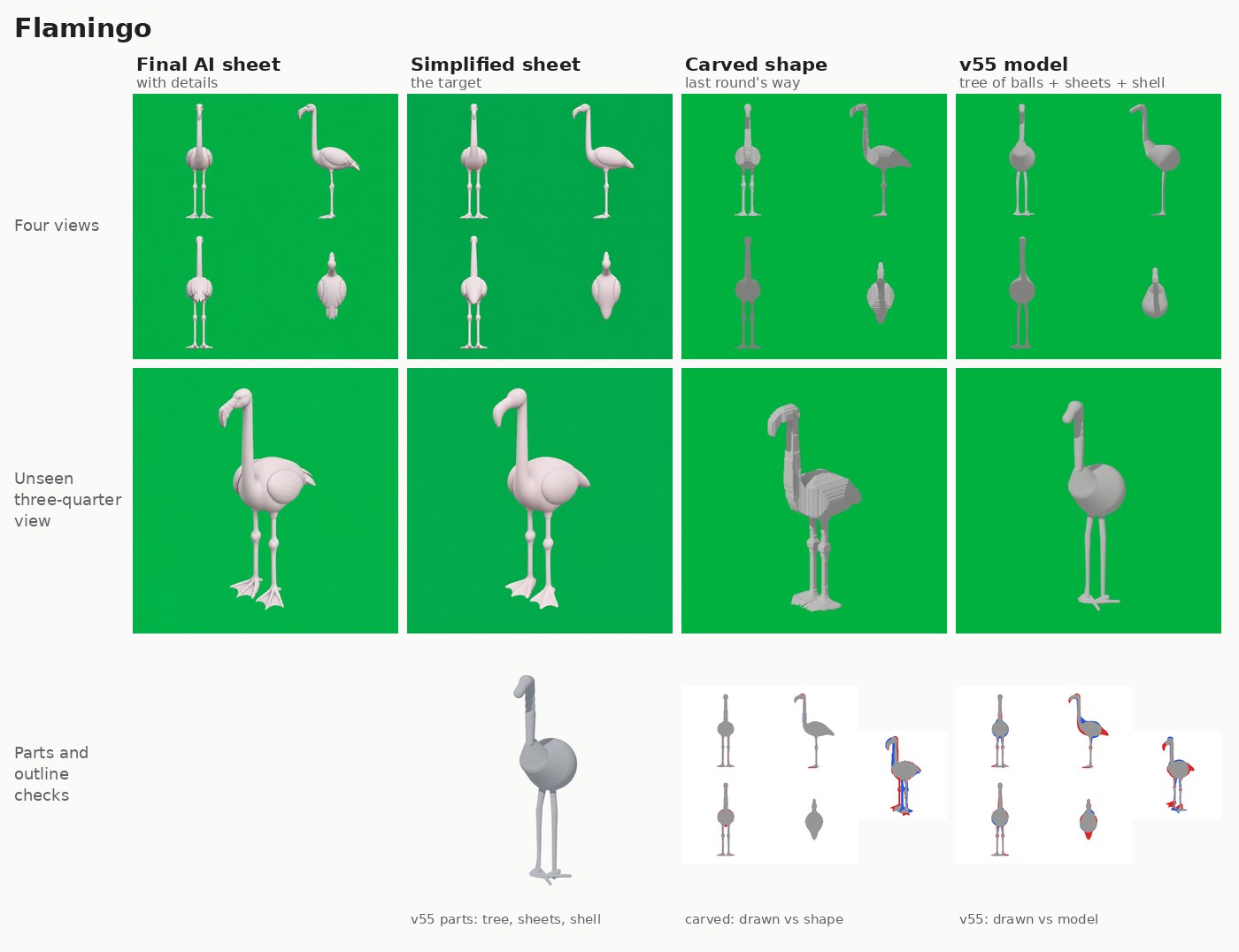
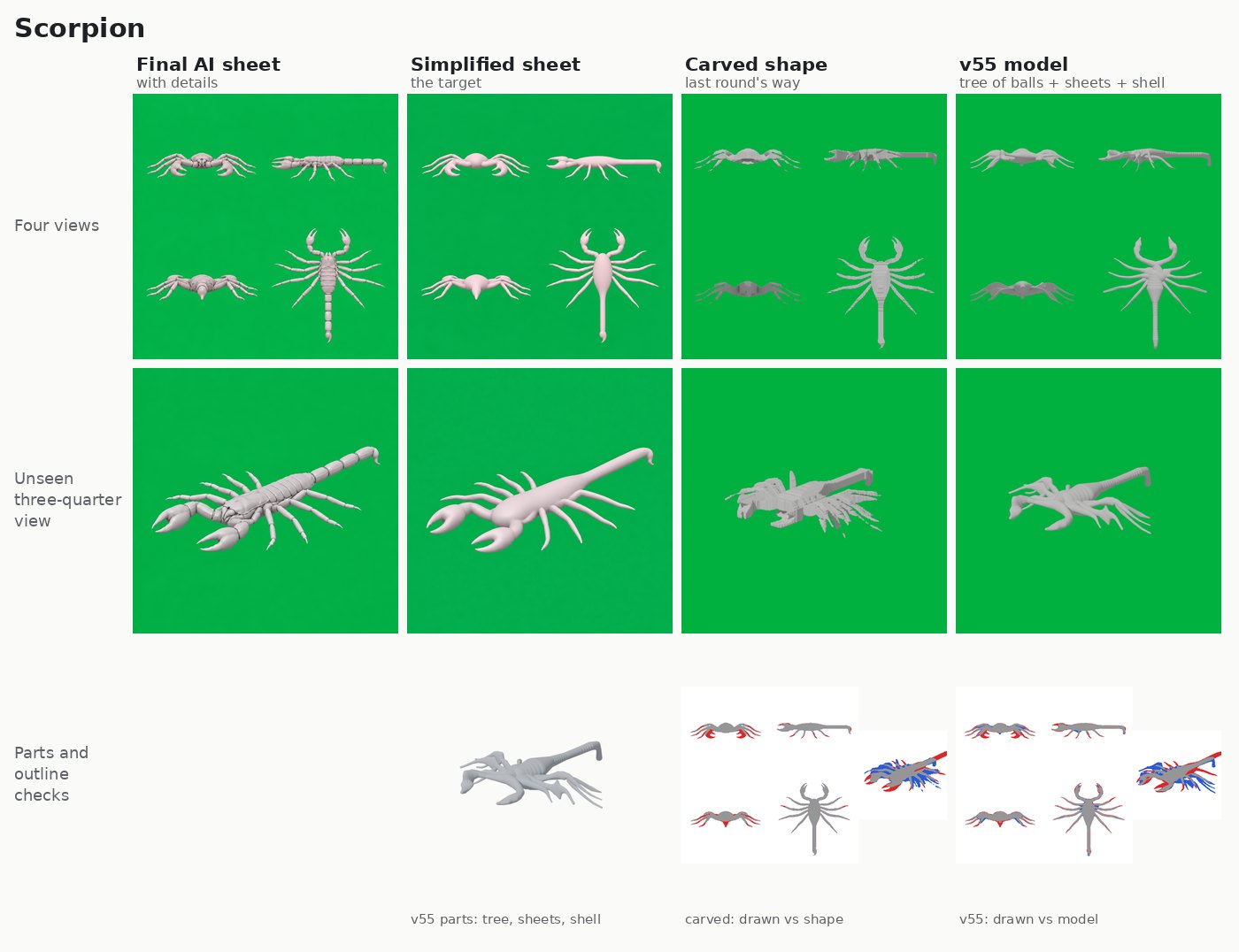
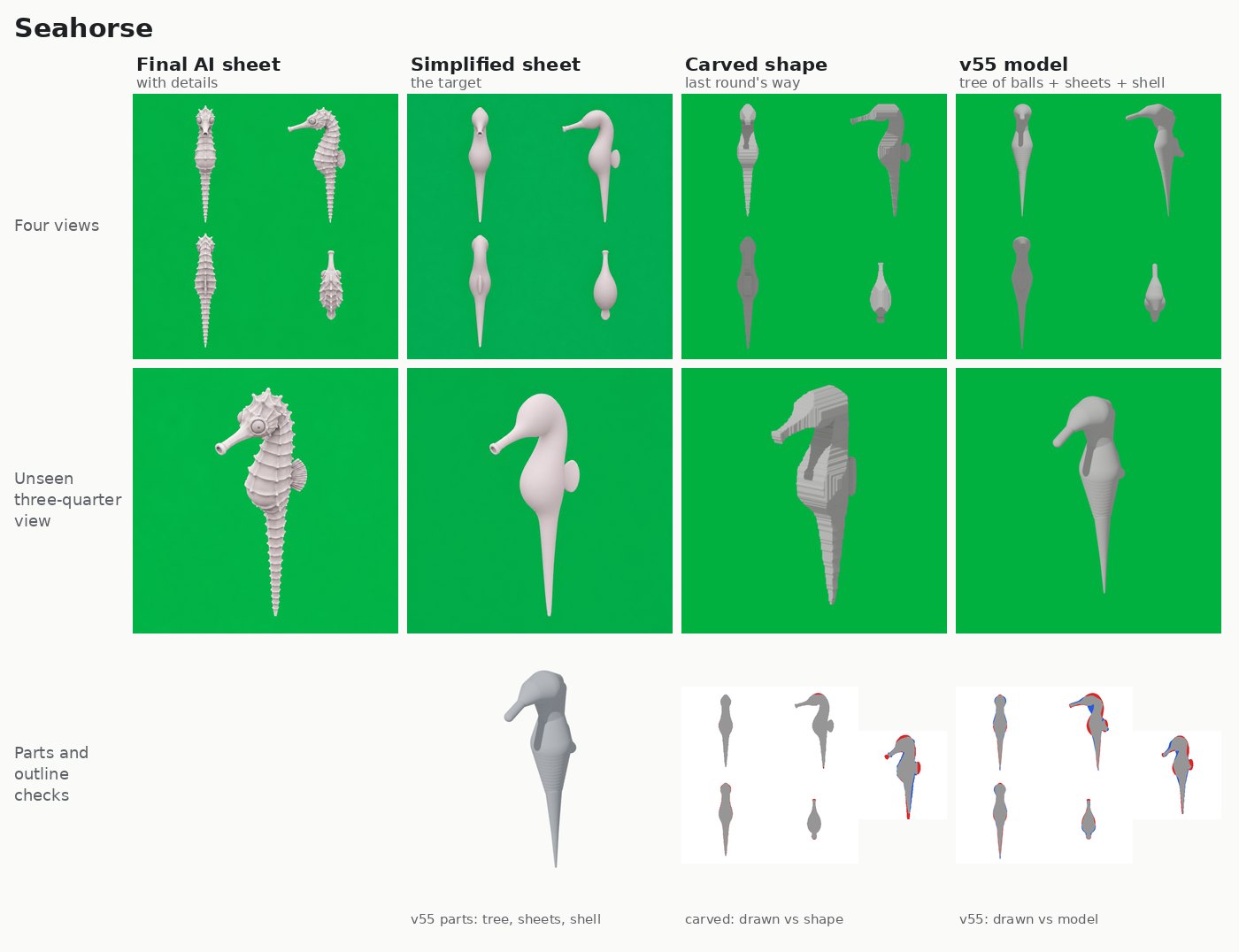
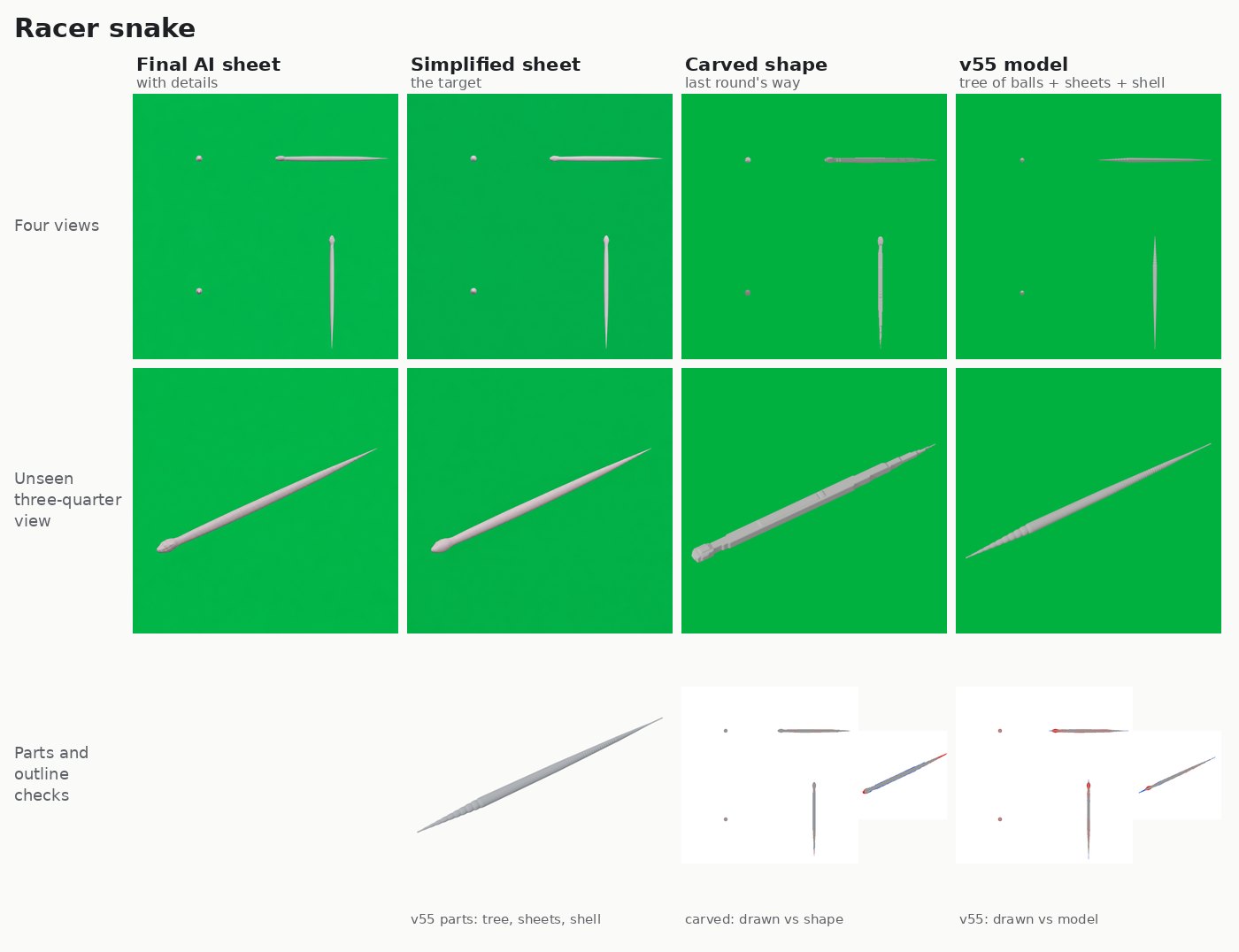
v55 is clearly closer than the carving on 2 (eagle +0.16, flamingo +0.06) and a little closer on 3 (flying fish, snake, bat); level on 2 (sea turtle, octopus); a little behind on 3 (seahorse, agama, scorpion); clearly behind on the jellyfish.
Each animal2 of 113. The four views
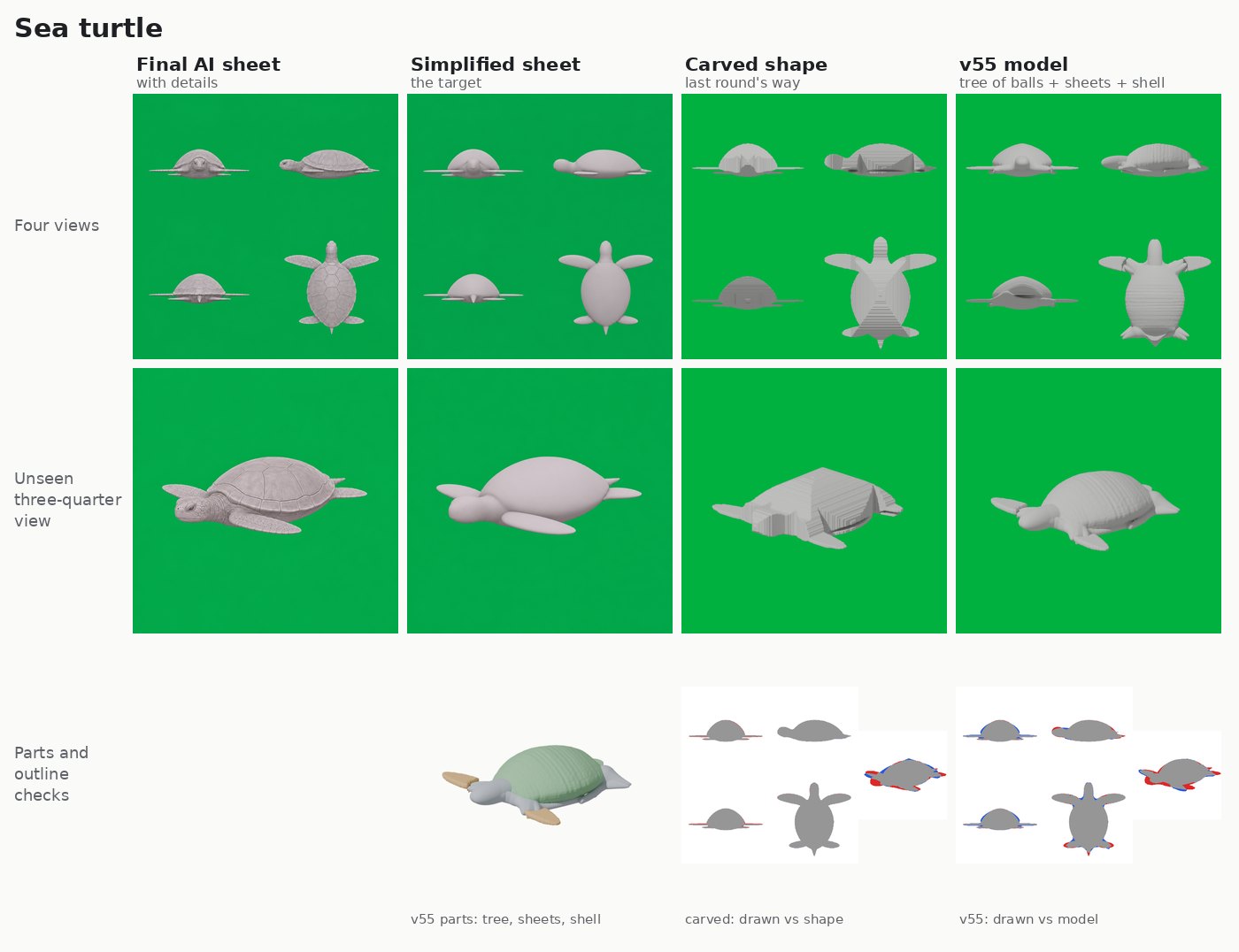
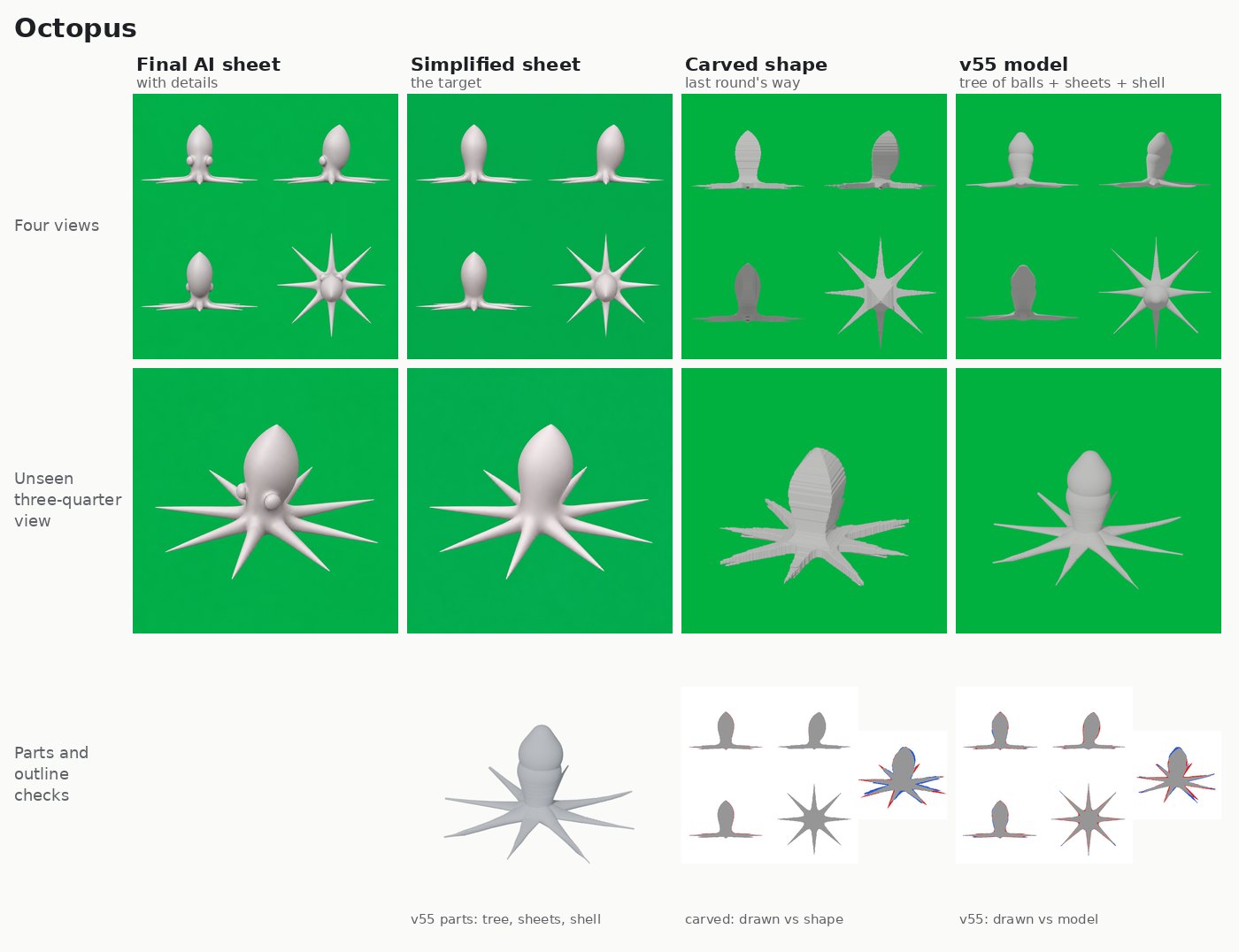
The sea turtle and the octopus reach the line. Most of the gap is thin parts seen edge-on (a wing is a line one or two pixels thick, a snake a dot), where a pixel costs a lot; the carving, cut from those outlines, scores higher there by construction.
Whyyour call4. By eye
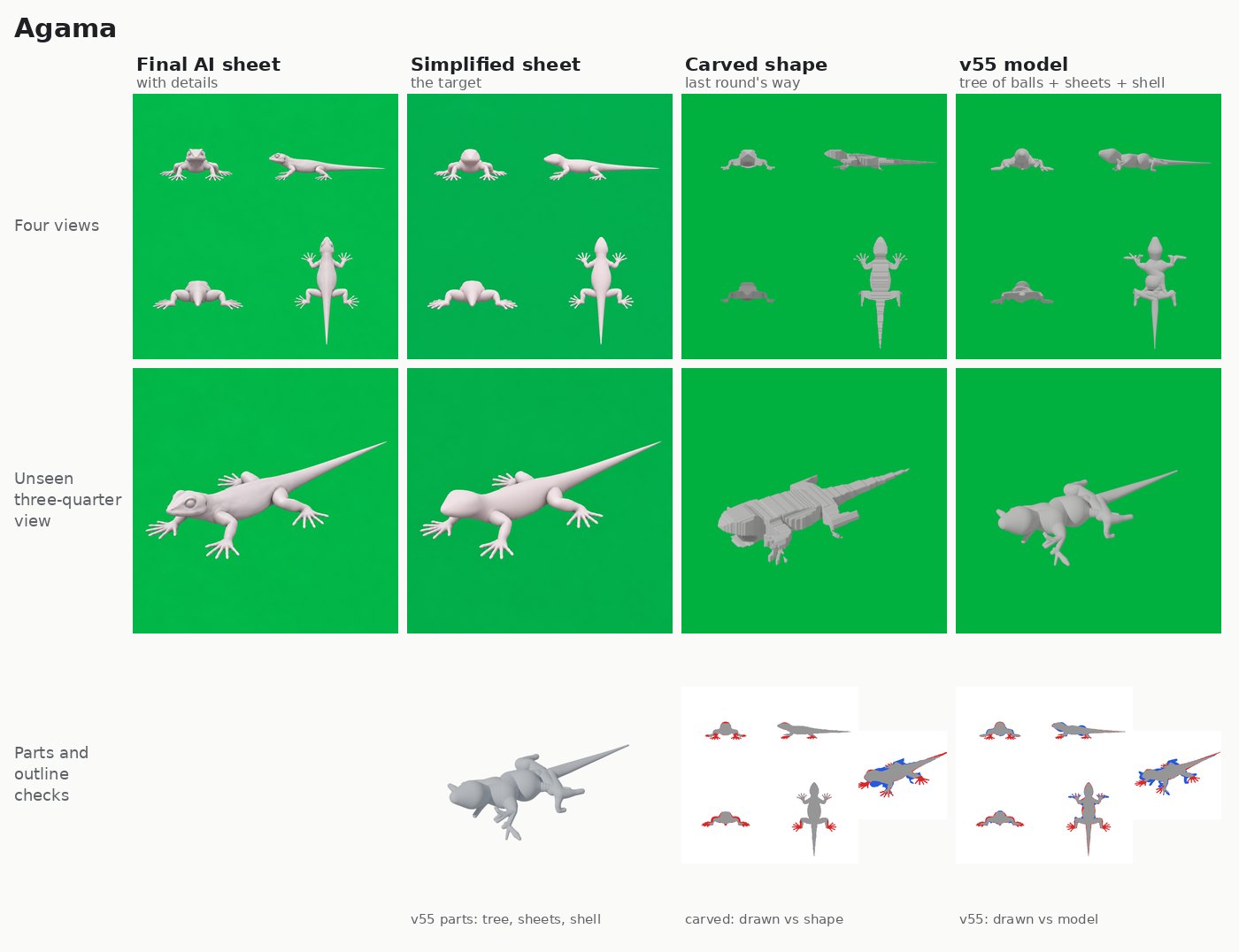
My reading: 7 of 11 look like their simplified sheet, smooth and in one piece where the carving is stacked boxes (octopus, sea turtle, flamingo, snake, seahorse, flying fish, bat). The eagle's wings are right but its fanned tail is lost; the scorpion has every part but a thin body; the agama and the jellyfish are not there.
Turn them in 3Dworking5. Sheets and the shell
The bat's membranes, the eagle's wings, the flying fish's fins and the turtle's flippers came out as flat sheets with the picture's outline, and the turtle's shell as a clean dome, all joined into one surface with the tree of balls.
Howreviewed6. Code review
Four Codex reviews: 10 + 10 + 4 findings, all fixed with a test each; the fourth review found nothing. Codex used 15% of the week (estimate 10 to 20%): 4 image jobs, 4 reviews.
The methodThe eleven animals
Each figure: the final AI sheet, the simplified sheet (the target), the shape carved from it (last round's way) and the v55 model, in the four views it was fitted to and in the unseen three-quarter view; then the v55 model's parts (tree of balls grey-blue, sheets orange, shell green) and the outline checks (grey: both; red: drawn but missing; blue: extra). Click a figure for full size.
| Animal | Unseen view, v55 | Unseen view, carved | v55 +0.03? | Four views, v55 (mean / worst) | Four views, carved | v55 at the line? |
|---|---|---|---|---|---|---|
| Bat | 0.81 | 0.80 | no | 0.81 / 0.72 | 0.92 / 0.86 | no |
| Eagle | 0.83 | 0.67 | yes | 0.78 / 0.58 | 0.72 / 0.47 | no |
| Flying fish | 0.72 | 0.69 | no | 0.78 / 0.66 | 0.89 / 0.83 | no |
| Sea turtle | 0.83 | 0.83 | no | 0.93 / 0.91 | 0.98 / 0.96 | yes |
| Jellyfish | 0.54 | 0.73 | no | 0.72 / 0.61 | 0.94 / 0.89 | no |
| Octopus | 0.80 | 0.80 | no | 0.91 / 0.90 | 0.96 / 0.94 | yes |
| Agama | 0.65 | 0.67 | no | 0.75 / 0.70 | 0.77 / 0.64 | no |
| Flamingo | 0.69 | 0.63 | yes | 0.81 / 0.73 | 0.95 / 0.91 | no |
| Scorpion | 0.50 | 0.54 | no | 0.77 / 0.67 | 0.82 / 0.67 | no |
| Seahorse | 0.80 | 0.82 | no | 0.86 / 0.76 | 0.97 / 0.95 | no |
| Racer snake | 0.85 | 0.83 | no | 0.73 / 0.65 | 0.93 / 0.91 | no |
How the v55 model is built
The model is fitted to the simplified sheet only: the four views front, side, back and top. The three-quarter view is never shown to it; it is kept back to check the result. Each animal's parts are declared once, as an artist would before starting: how many tips the tree may have (the agama 22: head, tail and five toes on each foot; the octopus 9), which parts are flat sheets and which way they lie, and whether there is a shell.
The body, head, neck, legs, tails and tentacles. The tree is read from the carved shape as before, its tips capped at the declared count (the shortest stubs go first), and each tip extended to the surface with a small ball, as artists end a chain. Then every ball's position and its two thicknesses are fitted to the four drawn outlines on the GPU, with a few pixels of slack because the image model's views disagree a little.
Wings, membranes, fins and flippers. A sheet is the part that is thin one way and broad the other. Its outline comes whole from the view that sees it flat (the top view for wings, the side view for a tail fin), its mid-surface and thickness from the carving, and its rim is rounded: a plane given thickness, as artists use Blender's Solidify modifier.
A turtle's carapace or a jellyfish's bell. A dome, lofted from rounded sections whose width comes from the top view and whose height comes from the side view, with its fullness fitted to the front view. Legs, flippers and tentacles are removed from the outlines first, so they do not inflate the dome.
The three kinds are joined into one surface by a smooth union, the equivalent of the merge and remesh artists do at the end of a blockout. There are no separate pieces to stitch.
What artists do (the reading for this round). A bat wing is blocked out as finger bones (ZSpheres or a Skin-modifier chain) with a membrane bridged between them and given thickness; ZBrush's Adaptive Skin even has a "membrane" setting that webs between branches, which is your idea of a web between two branches. Bird wings are flat feather "paddles" on the arm bones, single feathers come much later. Fins are rays with a membrane lofted between them, flippers a flattened box, shells a dome with a rim, a jellyfish bell a profile spun around its axis. All parts are merged and remeshed at the end. v55 follows this, with one shortcut: the finger bones and fin rays are not built separately yet; a membrane is one sheet with its outline taken from the picture.
What did not work, and why
The carved shape is cut from the same four outlines, so on those four views it scores high even when it looks like a stack of boxes. On the unseen view a silhouette cannot show steps or flat faces inside the outline either. So the numbers mostly say whether the parts are in the right places, not whether the surface looks right; that part is your eye, which is why the pass line had three parts.
A wing or fin seen edge-on is a line one or two pixels thick; a snake seen from the front is a dot. A pixel's difference there costs a large share of that view's overlap. This, more than the shape, is why most animals stay under the 0.90 four-view line.
The jellyfish's strands hang behind one another in every view, and the top view sees only the bell. Four views cannot say where each strand is, so the fitted strands merge into blades. The same happens, smaller, where the flying fish's fin pairs overlap in the front and side views, and under the eagle's tail, where the tucked legs make the fanned tail too thick to count as a sheet.
Toes and feet were set aside, as agreed. Finger bones and fin rays are not separate branches yet: each wing or fin is one sheet with the outline from the picture. Teeth, claws and spikes (the second step) are for the next round.
The pictures
Four new animals were drawn for this round, chosen for the new parts: a bat (membrane wings between finger bones), an eagle (feathered wings and a fanned tail), a flying fish (wing-like fins spread flat, a tall tail fin) and a sea turtle (a shell and flat flippers). Each was asked for in a straight modelling pose with wings, fins and flippers spread flat and level, and drawn twice by the image tool: a final clay model with its details, then a simplified clay blockout of it. Each version also has a three-quarter view. The seven earlier animals got simplified three-quarter views, and the seahorse a new simplified sheet (last round's was redrawn as a bottle; the new one is slim again).
How faithful the simplified sheets are (outline overlap with the final sheet, worst view; the line was 0.90): sea turtle 0.91, bat 0.90 (front 0.896), eagle 0.85, flying fish 0.79, seahorse 0.89. The misses are the front views, where a wing or fin is drawn edge-on as a line one or two pixels thick, so a shift of a pixel costs a lot of overlap; by eye all five are faithful. The eagle's and the flying fish's four views also disagree a little in height. The simplified three-quarter views overlap their originals by 0.90 to 0.98. In all, 50 image calls.