A rough dog from four pictures: overnight result
8 Nov 2026, morning. Question: can we get a rough dog, made the way artists start one (a tree, balls on it, a skin over the balls, then shaped to the pictures), from the four reference pictures alone? Step 2 had up to five attempts, each starting from a published method.
Your plan, and how far each step has got
Where we are now
- Built from the four pictures only: the vision model's tree, ball sizes measured from the pictures, a sphere-mesh body (balls joined by smooth tubes, one solid), shaped to the outlines with smooth whole-surface editing.
- Why the bodies used to tear: the junction balls (chest, hips) came out 2 to 2.5 times too big from the pictures (chest 24 cm instead of 10), and Blender's Skin modifier tears where several branches meet. Both are fixed: junction balls are now the largest ball that fits, and the body is a union of balls and tubes, which cannot tear.
- Decision needed from you: what to do next (bottom of the page).
Overnight: a rough dog from the four pictures
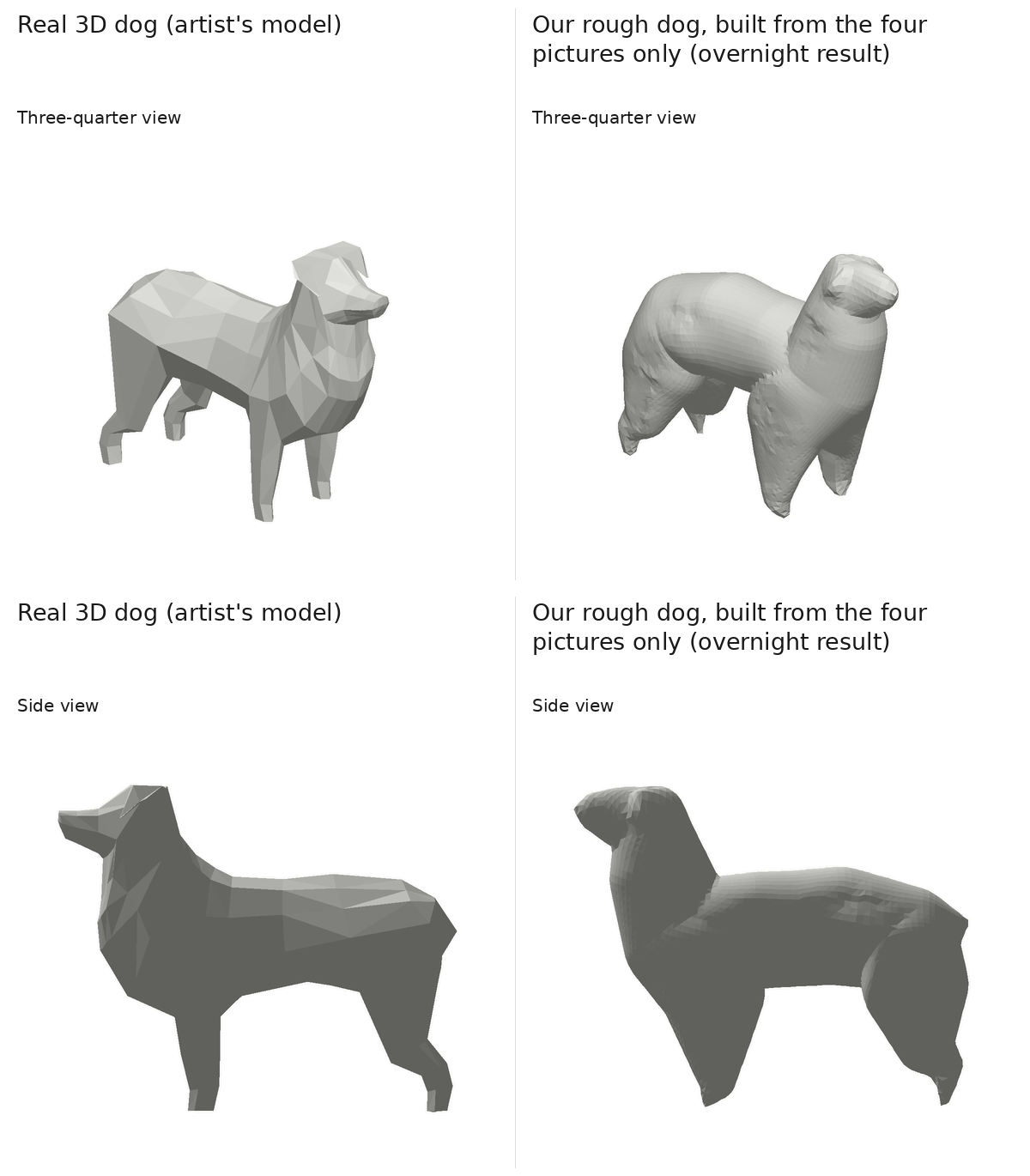
Real dog first. Our dog never saw the real 3D model or the held-back three-quarter picture while it was built; both are used only to check it. CPU clay previews, same camera.
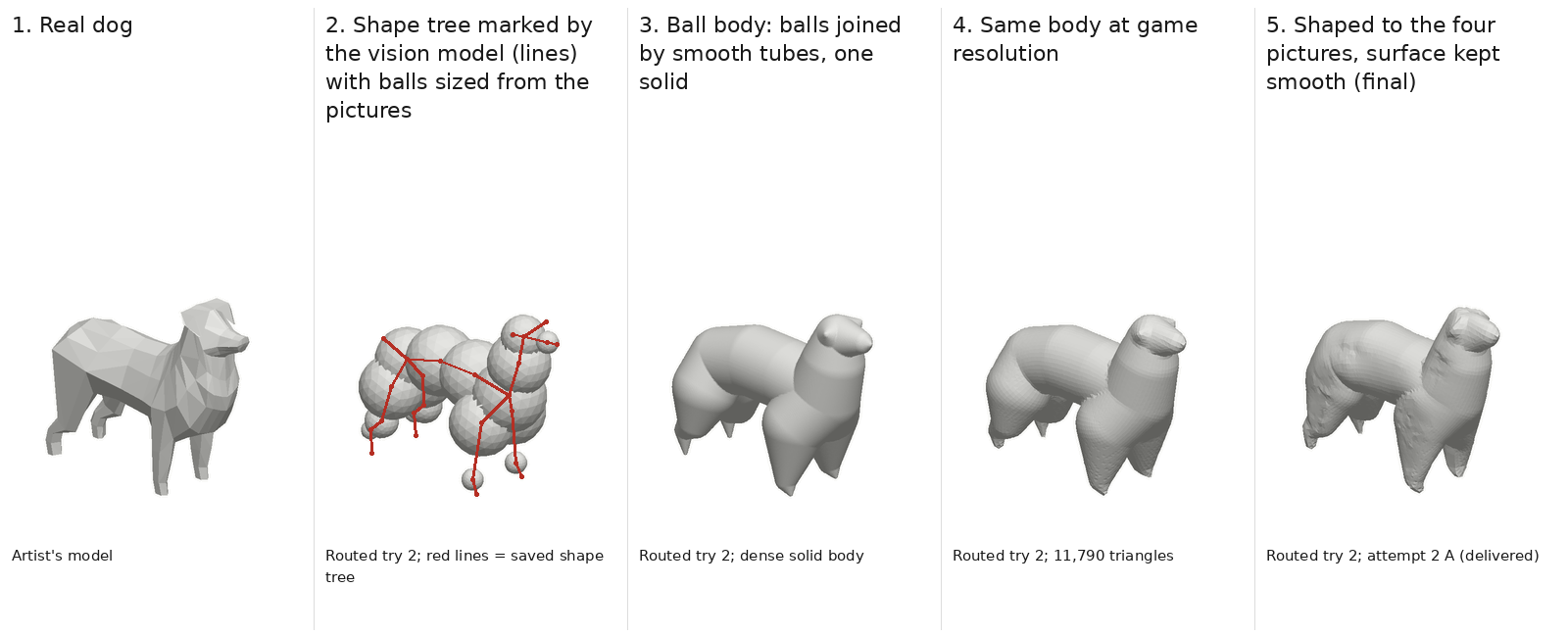
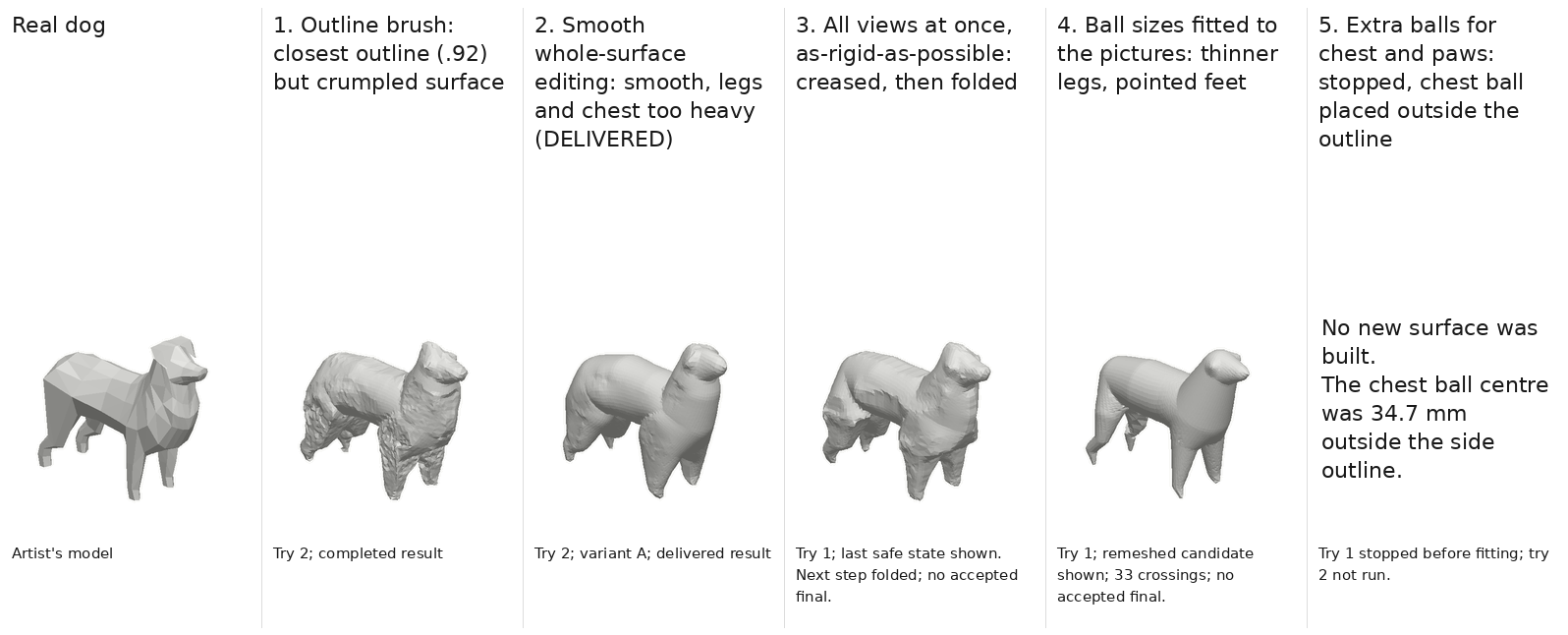
The five attempts (each starts from a published method; up to five, as you set)
| Attempt (published method) | Four-view mean | Worst view | Held-back view | Surface p90, cm (ours to real / real to ours) | Surface roughness (p99) | Outcome |
|---|---|---|---|---|---|---|
| 1. Outline brush on the ball body (sphere-meshes, Thiery 2013) | .918 | .875 | .847 | 1.95 / 2.01 | 1.06 | Closest outline, crumpled surface |
| 2. Smooth whole-surface editing (Sorkine 2004) delivered | .892 | .850 | .823 | 2.57 / 2.57 | .28 | Smooth and whole; chest and legs too heavy |
| 3. All four views at once, as-rigid-as-possible (Sorkine and Alexa 2007) | .905 | .866 | .844 | 2.18 / 2.12 | .51 | Creased, then folded; stopped |
| 4. Ball sizes fitted to the pictures (sphere-mesh calibration, Tkach 2016) | .863 | .851 | .825 | 2.32 / 2.86 | .40 | Thinner legs, pointed feet; game-mesh step made 33 crossings |
| 5. Extra balls for chest and paws (sphere-triangles, Thiery 2013) | - | - | - | - | - | Stopped: the chest ball was placed 3.5 cm outside the outline (a placement-rule error) |
Independent check of the delivered dog (a second Codex agent, given the code, not the conclusions)
- Confirmed: nothing from the real 3D dog or the held-back picture was used to build it; one closed shell, no crossings, 11,790 triangles; its scores recomputed exactly; a full rebuild gives the identical file.
- Found faults in attempt 2's code that explain part of what is wrong: the paw and muzzle ends were not recognised as ends on the coarse mesh (6 of 8), so feet could not lengthen; each view's solve pulled the depth back toward the ball body (up to 2.4 cm), so later views undid earlier ones; left and right differ by up to 1.25 cm because symmetry was not enforced at acceptance; the fold check and the roughness measure can miss some local defects (the delivered mesh itself has none).
Pass line: four-view mean at least .90, worst view at least .85, held-back view at least .85, surface p90 at most 2.014 cm both ways. Tonight's floor: one whole closed body, held-back view at least .755 (dog b). Roughness: how much neighbouring faces turn; the smooth ball body is .28. All bodies shown are one closed shell; attempt 1 and 2 rebuild byte for byte. Earlier best on these pictures: dog b (true tree, picture sizes) .765 mean, .755 held-back.
What I got wrong on the way here
- Using the animation skeleton as the shape tree. The rig's points sit where joints bend, not in the middle of the flesh, and stop short of the muzzle and paws. Now: a separate shape tree, marked by a vision model; the rig stays for motion.
- Junction balls measured across several parts. The picture rule measured chest, neck and front legs together (chest ball 24 cm instead of 10), which tore the skins. Now: the largest ball that fits, as the real-tree reader does.
- Two of my own test gates stopped attempt 2 for the wrong reason overnight (comparing a reshaped sphere's smoothness with a perfect sphere). Fixed before the attempt ran on the dog; it did not use up an attempt.
Earlier versions (6-7 Nov) and their numbers: Dog model: what we tried.