Dog model: what we tried and where we are
Updated 8 Nov 2026. The goal is a game-ready dog with the right shape that moves right, built by a repeatable script from four reference pictures and the artist's skeleton, then the same method on an elephant and a turtle.
Newer: a rough dog from four pictures, overnight result (8 Nov). This page is the record up to 7 Nov.
Your plan, and how far each step has got
Where we are now
- Current method (v61): build the dog the way artists build a low-poly game animal (box modelling: extrude loops from a cube, place each corner on the reference outlines), written as a script. Only the body, neck and head exist so far; the body reads like an artist's blockout, the chest and head do not yet.
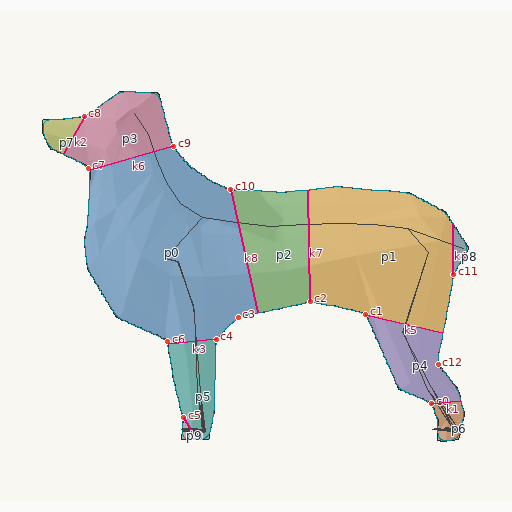
- The blocker: knowing where each part is in the reference pictures (where the chest ends and the neck begins, where legs meet the belly, where the muzzle starts). An artist sees this; our attempts to work it out from outlines alone keep getting it wrong.
- Decision needed from you: how to supply those part outlines (choices at the bottom).
What each version looked like (same three-quarter angle)
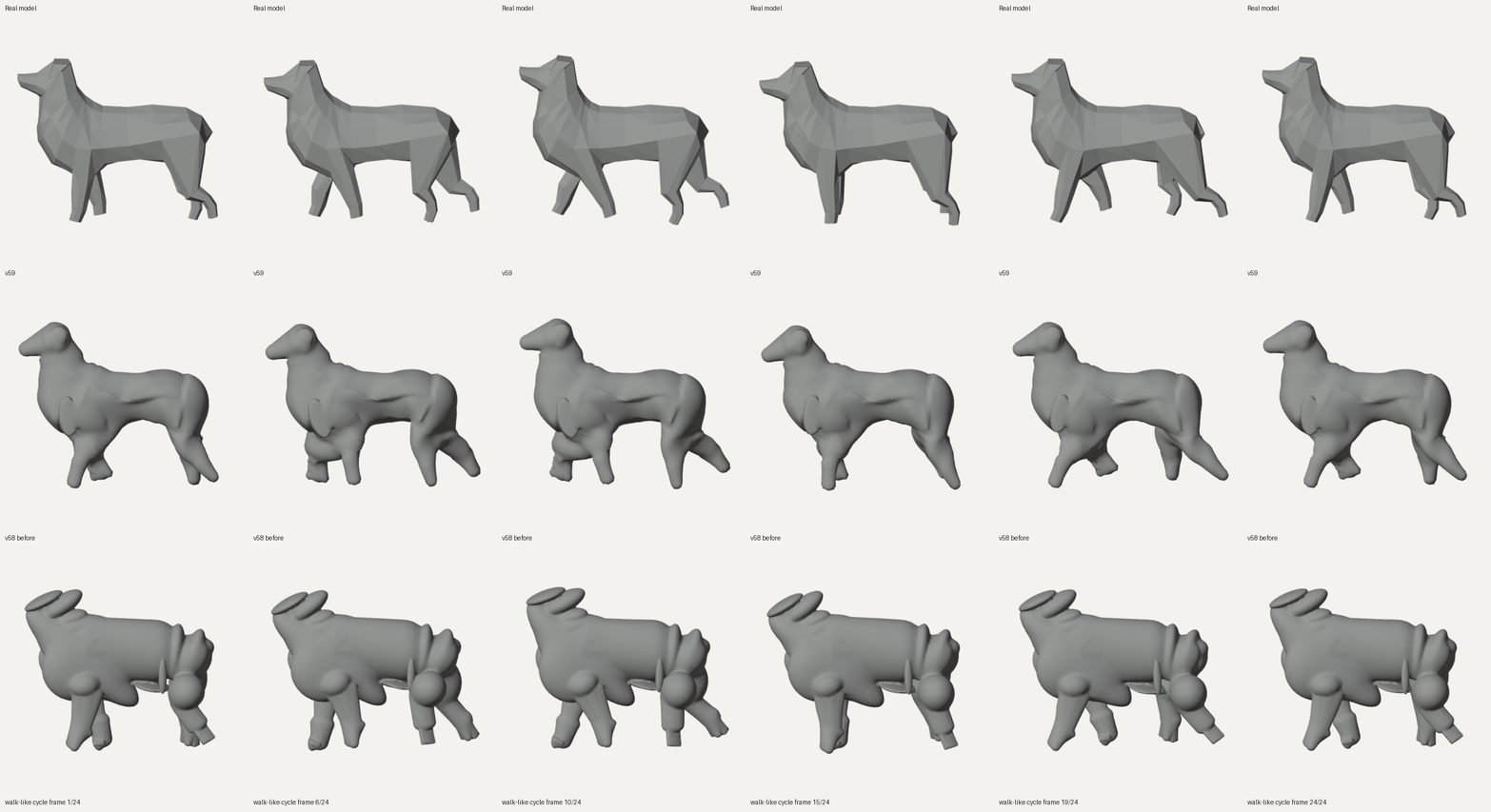
Real model first. The three-quarter picture is never used for building, only for checking. v61 pictures are partial models and use a wider camera.
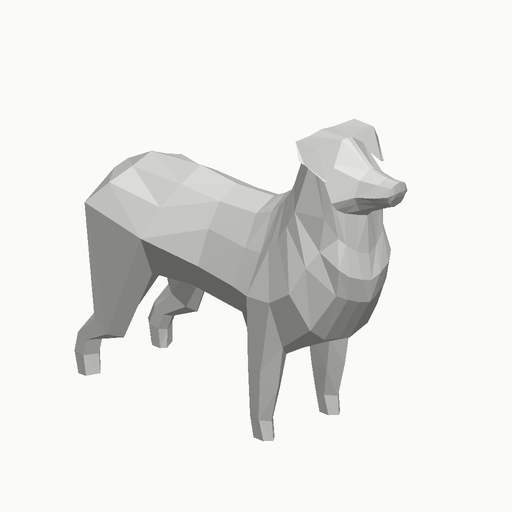
Real model
The artist's low-poly dog (faceted, a few thousand triangles). This is the target.
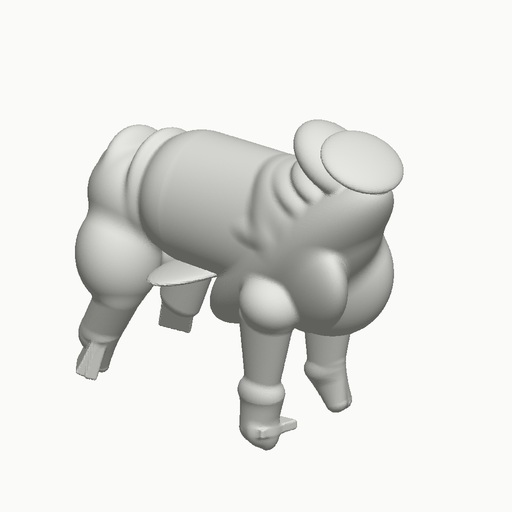
v58 shape fails
Did: one oval or tube per bone, blended into one skin. Result: lumpy, no muzzle, flat ear discs. Motion already worked.
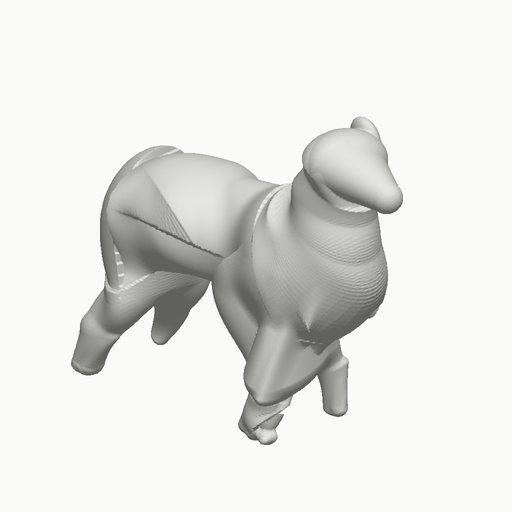
v59 round 1 closer
Did: one smooth tube per chain of bones. Result: muzzle appears, clean mesh, motion passes; still creased, no tail, numbers below the line.
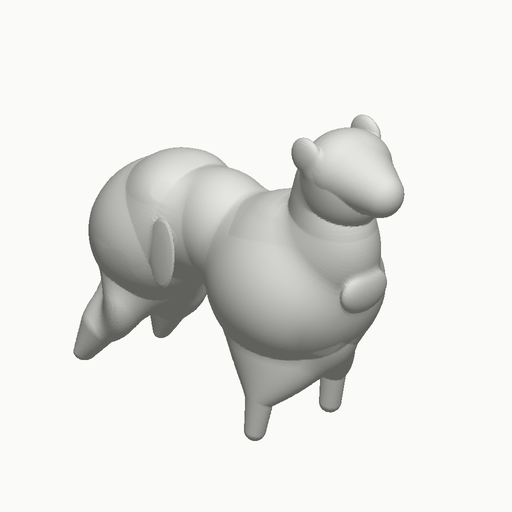
v59 round 2 worse
Did: chains chosen by left/right symmetry. Result: a row of beads, too wide; a fault in how the tube was computed.
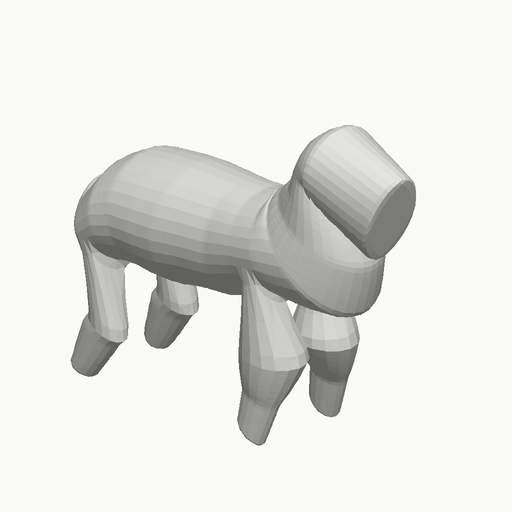
v60 1b clean, blocky
Did: one skin built directly on the skeleton (your "skin on" idea). Result: closed and symmetric, but a blunt head and crossings where the head meets the neck.
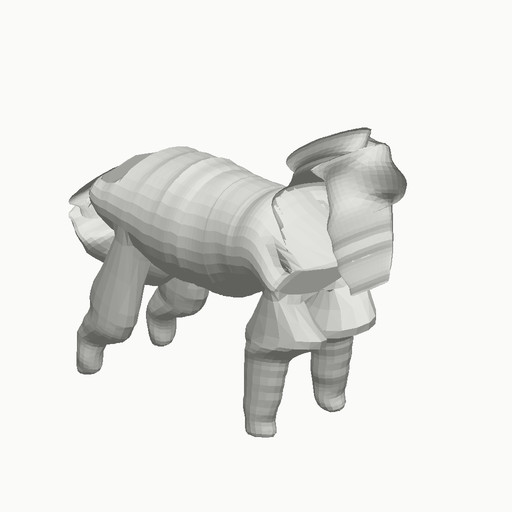
v60 1c folds
Did: head and parts at their own angles. Result: better outline, but folded joins at neck, shoulders and rump. Steps 1d-1f (a published mesher, a computed skeleton) also failed at the joins.
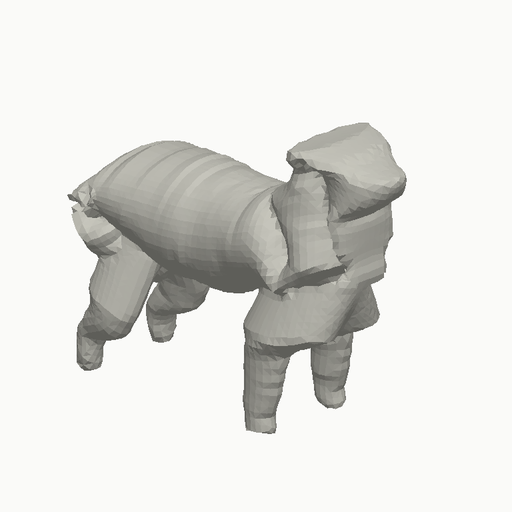
v60 1g clean, ridged
Did: gave up the continuous skin: separate measured parts merged, then rebuilt. Result: first clean mesh with good numbers, but ridges and clefts at the joins. You rightly said this broke continuity.
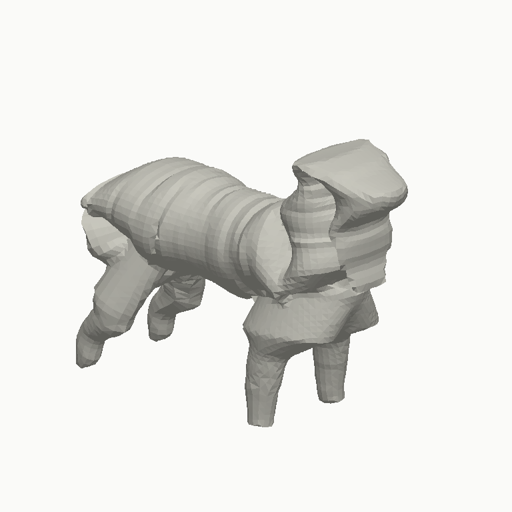
v60 2a numbers up, look down
Did: corrected the sizes and let a fitter push the outline match up. Result: passes 3 of 4 shape lines, yet looks like stacked slabs with a blade under the jaw. You rightly said this was chasing numbers with a method nobody uses.
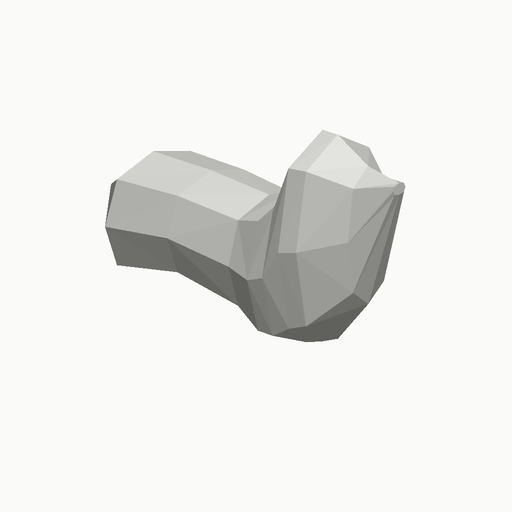
v61 step 1 right method
Did: box modelling the artist's way (body, neck, head only; 156 triangles, faceted). Result: the body reads like an artist's blockout; throat and muzzle merge into a slab.
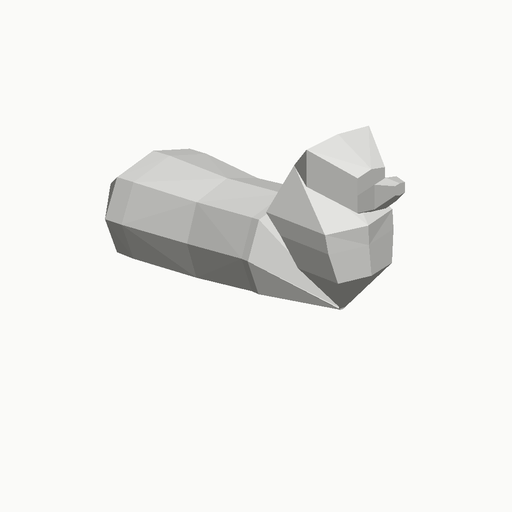
v61 1d (latest) parts wrong
Did: neck from the upper chest, muzzle from the lower head, boxes sized by part areas. Result: the structure is right, the proportions are not, because the part areas were wrong.
The numbers (the pass line checks; it no longer steers)
Pass line, fixed before any result: outline match with the four reference views, mean at least 0.90 and worst view at least 0.85; held-back three-quarter view at least 0.85; 90% of our surface within 2.0 cm of the real one. Green passes, orange fails. v61 is a partial model (no legs yet), so it is not in this table.
| Version | Four-view mean | Worst view | Three-quarter | Surface (90%) | Mesh | Motion |
|---|---|---|---|---|---|---|
| v58: one shape per bone | 0.798 | 0.775 | 0.769 | 4.07 cm | 186 crossing faces | bends pass |
| v59 round 1: one smooth tube per chain | 0.878 | 0.840 | 0.839 | 2.56 cm | clean | pass |
| v59 round 2: chains by left/right symmetry | 0.818 | 0.800 | 0.842 | 3.83 cm | not built | - |
| v60 1b: our own skin on the skeleton | 0.842 | 0.805 | 0.819 | 2.84 cm | 154 crossing faces | - |
| v60 1c: parts at angles | 0.863 | - | 0.862 | 3.43 cm | 918 crossing faces | - |
| v60 1g: measured parts merged, then rebuilt | 0.885 | 0.868 | 0.862 | 2.51 cm | clean | - |
| v60 2a: unbiased sizes + small fit | 0.930 | 0.920 | 0.888 | 2.49 cm | 2 holes | - |
Motion: proved early
What I got wrong, and what changed
- Chasing numbers. v59 and v60 built the dog from hundreds of measured rings and let a fitter raise the outline match. The numbers rose while the dog looked worse. Now: copy how artists actually build the model; the pass line only checks.
- Giving up continuity. When the skin-on-skeleton joins failed, I switched to merging separate pieces, which is exactly where the remaining faults sat. Now: box modelling extrudes everything from one piece, so the surface stays continuous.
- Skipping an input our own rules require. Our model-from-reference skill says every reference view needs a part map and named points (throat, chest front, armpit, groin, muzzle start, ear tips). I tried to derive them from the outline instead (last picture below), and every box step inherited the wrong parts.
- Your rules now in the project instructions: short trials first; solve the challenge behind the mistakes, not each mistake.