Views Per Part
Your hypothesis, tested on the seven true models: more views, the views that agree picked part by part, a special angle per part, and shading to choose the tool. The true model's own renders stand in for the drawings, painted from its own parts, so only the views are under test, and every result is checked against the true model.
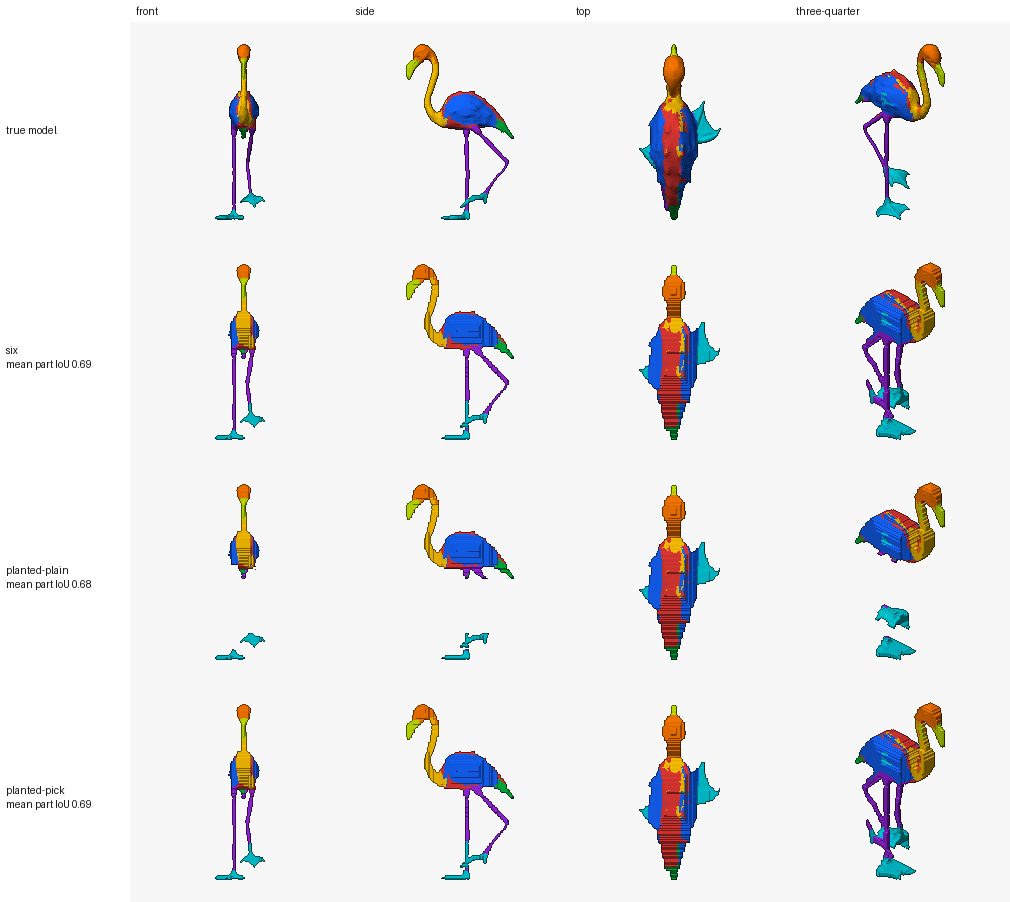
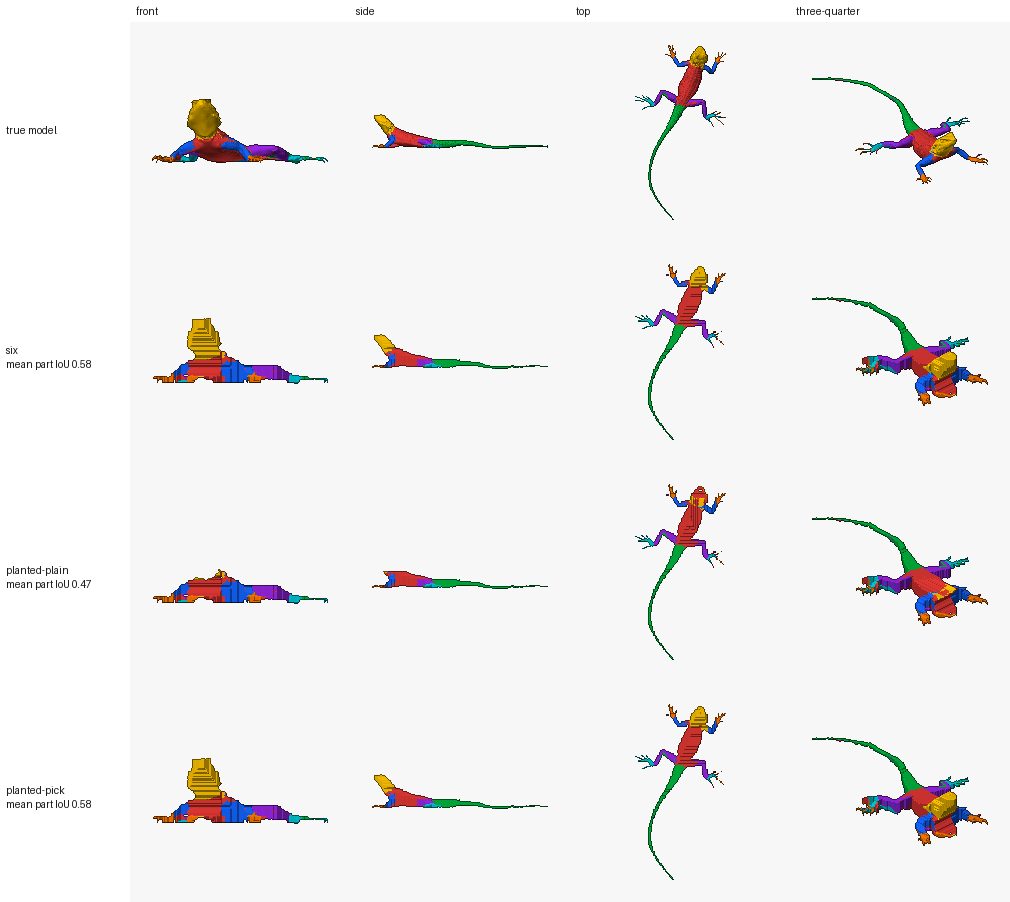
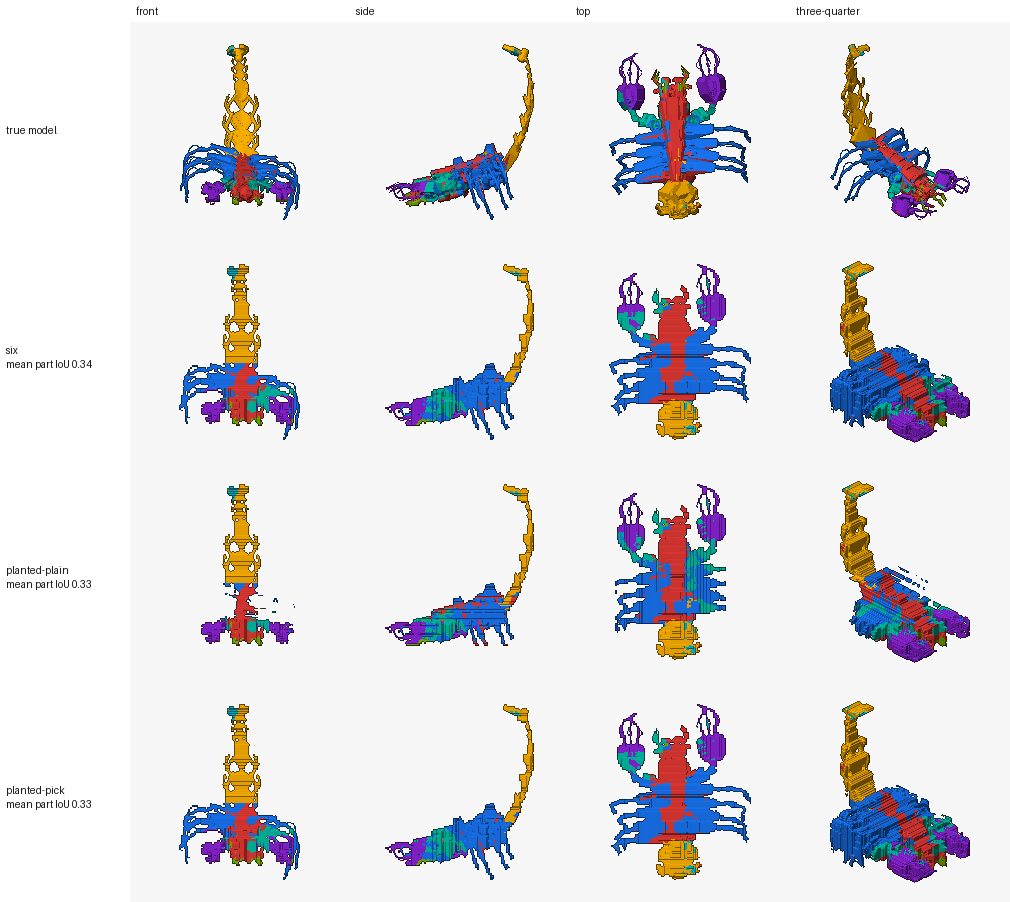
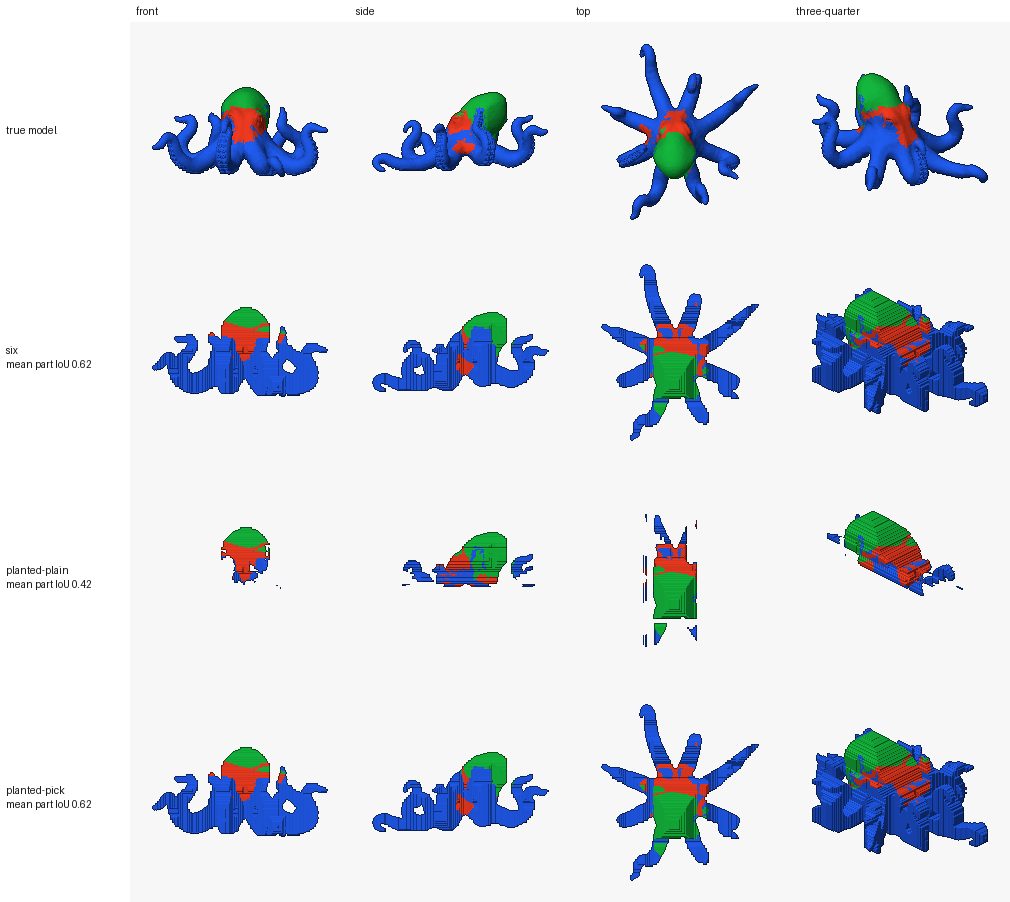
What the night's runs say about your four ideas (still running: the jellyfish fits and one wrong-view fit; this page fills in when they finish)
- More views: yes, as long as they are angled. Six straight views carve exactly the same shape as four, because opposite views show mirror-image outlines. Adding four angled views brings the carved parts closer to the true parts in every animal (section 1). Parts the fit gets right, out of 56 in six animals: 5 from four views, 7 from six, 14 with the angled views, and 18 if the best tool were chosen (section 3).
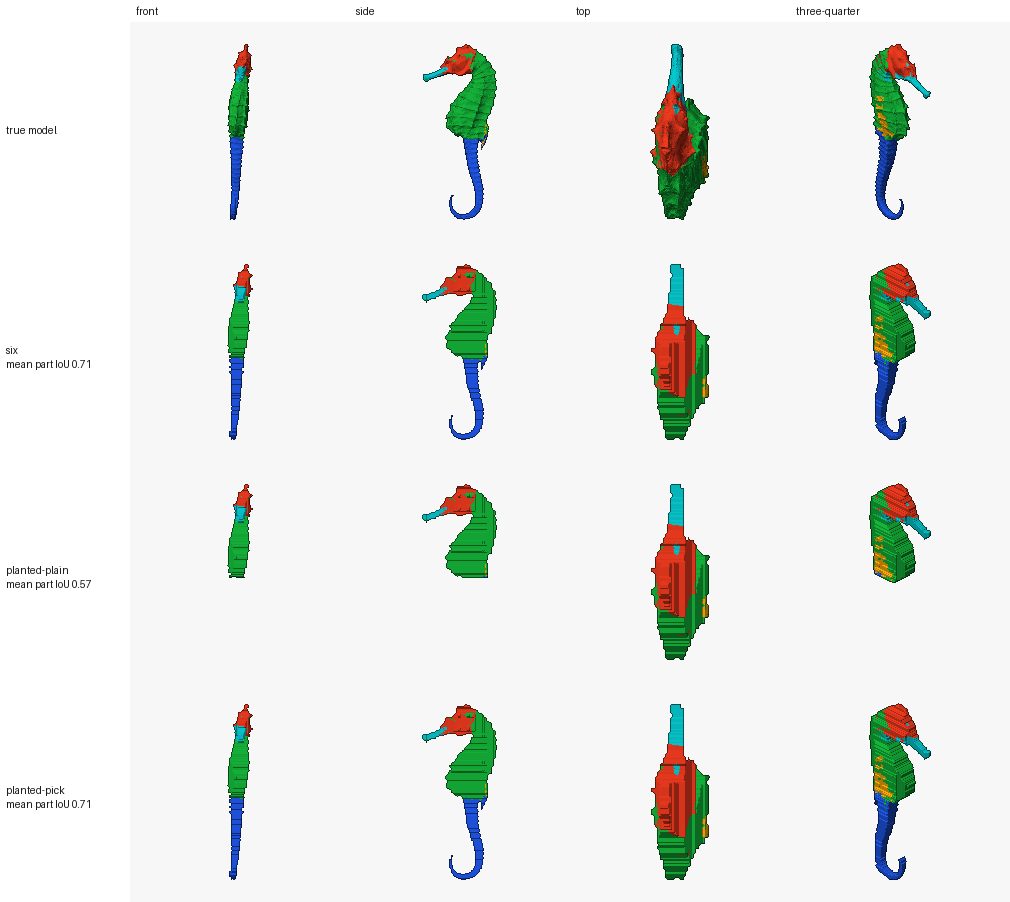
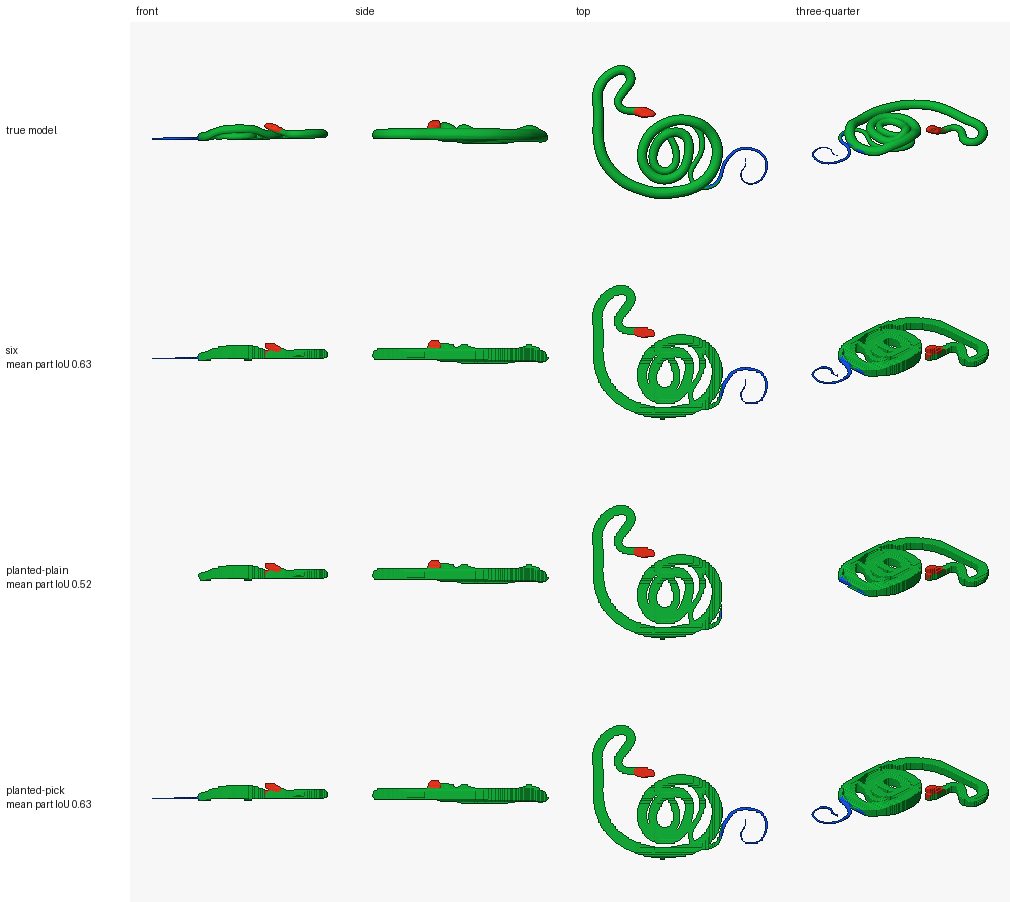
- Picking, part by part, the views that agree: yes. When one view leaves a part out, plain carving cuts away 35–99% of that part. With the pick it loses 2% or less in six of seven animals, and 15% for the racer snake's tail (section 2).
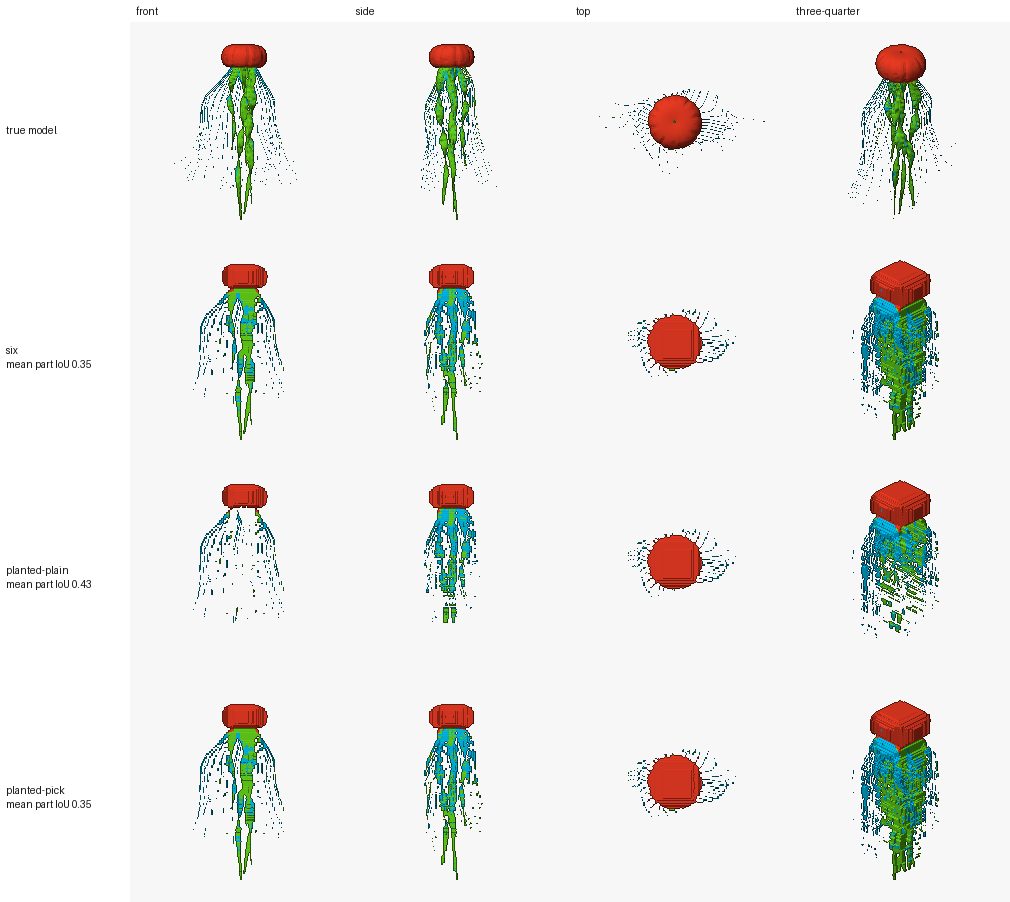
- A special angle per part: helps, but only a little over any angled view. The special angles beat 48 of 70 random sets of four angles. The gain over random angles is small next to the gain from having angled views at all. The jellyfish is the exception: its thin tentacles break up in the angled pictures, so the pick drops those views.
- Shading to choose the tool: a small gain so far. Matching the shading as well as the outline picks the best of the five tools a little more often than distance to the carved part does (97 against 88 of 224 parts, pooled over the arms). It brings two more parts within the pass line with the angled views (16 against 14), and one fewer with four views (section 4).
- The main loss is still the carved shape. Fitted on the true 3D model, 35 of the same 56 parts come within the pass line; the best from views is 18.
1. More views: does the carved shape get closer to the true one?
Mean part overlap with the true model (1 = identical): every part of the carved shape against the same part of the true model, each part counted once. The special angles beat every one of the 10 random draws for 1 of 7 animals and fall among them for 5.
Opposite straight views (front and back, the two sides, top and bottom) show mirror-image outlines, so six straight views carve the same shape as four: they add a second opinion, not shape. Angled views add shape.
flamingo
Mean part overlap with the true model: 4 straight views 0.69 · 6 straight views 0.69 · 6 straight + 4 special angles 0.83 · 6 straight + 4 random angles 0.83
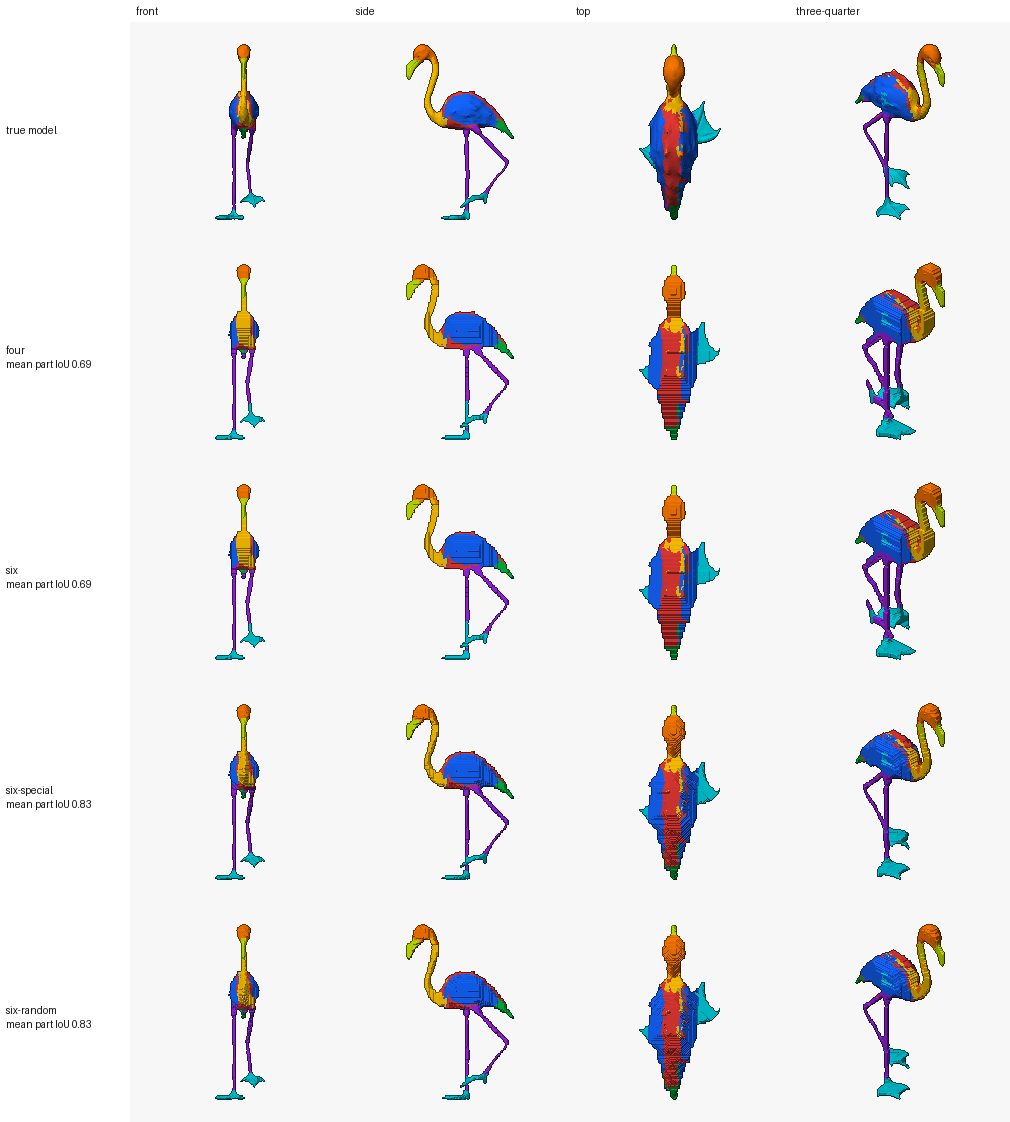
The special angles, in the order chosen, and the parts each one mostly serves (share of what it pinned down):
- front side: legs 28%, bill 20%, tail 14%
- front other side: legs 28%, bill 17%, neck 15%
- other side above: tail 22%, head 16%, feet 16%
- back other side below: bill 20%, feet 15%, legs 15%
agama
Mean part overlap with the true model: 4 straight views 0.58 · 6 straight views 0.58 · 6 straight + 4 special angles 0.76 · 6 straight + 4 random angles 0.75
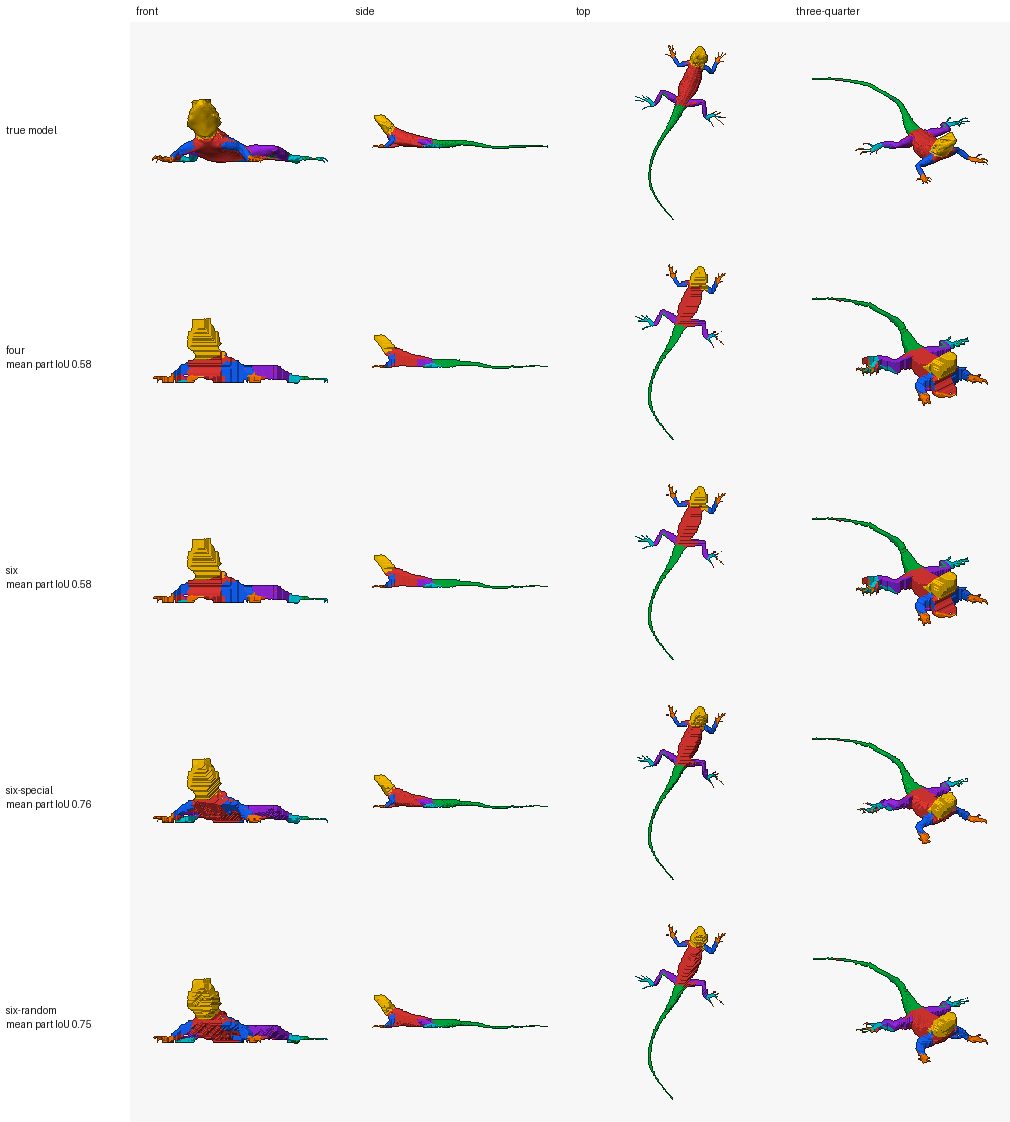
The special angles, in the order chosen, and the parts each one mostly serves (share of what it pinned down):
- back side below: forefeet 29%, tail 17%, hindfeet 17%
- other side below: tail 29%, hindfeet 17%, forefeet 15%
- front below: hindlegs 23%, forefeet 18%, forelegs 18%
- front above: hindfeet 22%, forelegs 20%, forefeet 19%
scorpion
Mean part overlap with the true model: 4 straight views 0.34 · 6 straight views 0.34 · 6 straight + 4 special angles 0.50 · 6 straight + 4 random angles 0.50
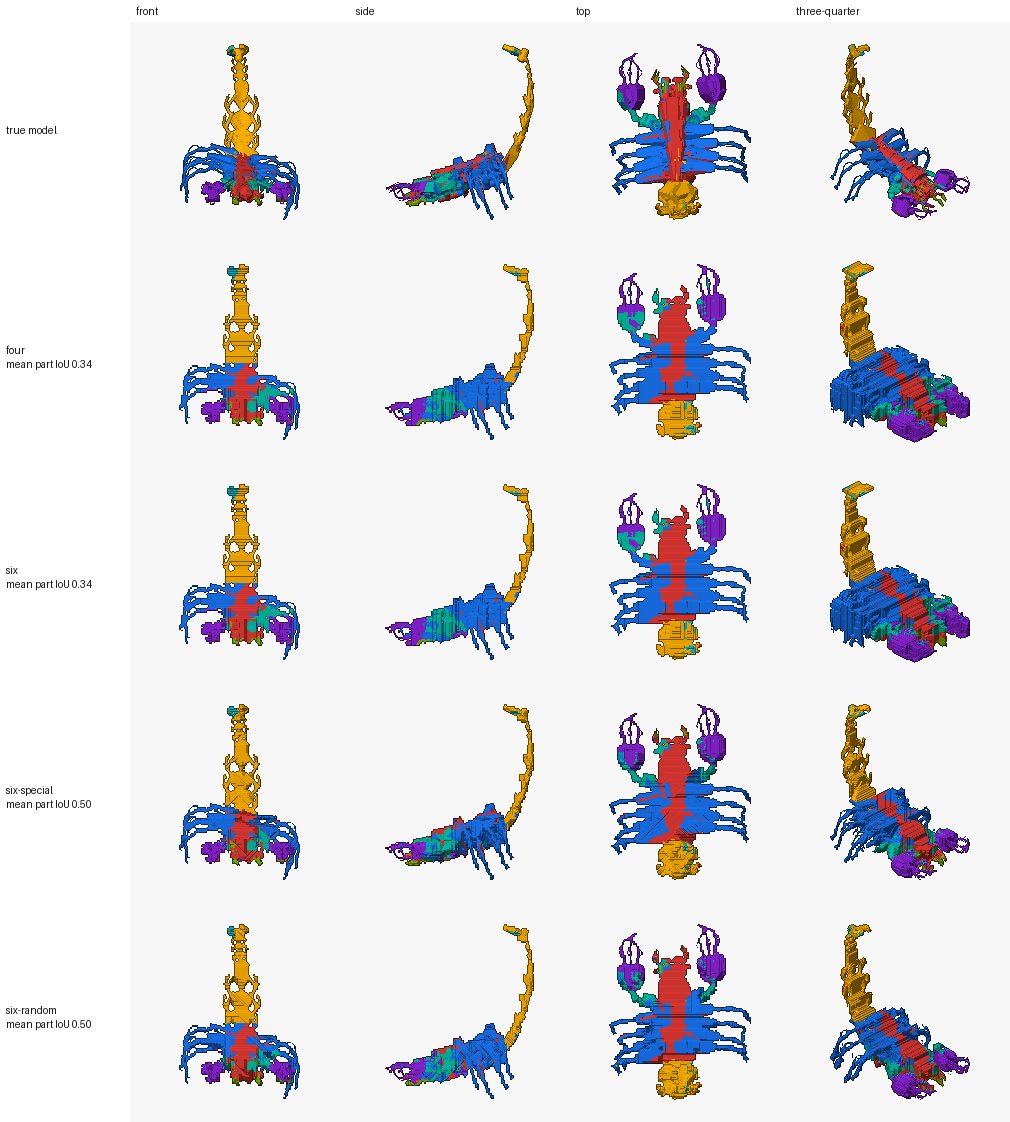
The special angles, in the order chosen, and the parts each one mostly serves (share of what it pinned down):
- other side below: stinger 48%, tail 13%, pincers 11%
- other side above: stinger 35%, chelicerae 15%, pincers 14%
- front side: stinger 33%, tail 26%, chelicerae 17%
- front other side: stinger 31%, tail 26%, chelicerae 15%
octopus
Mean part overlap with the true model: 4 straight views 0.62 · 6 straight views 0.62 · 6 straight + 4 special angles 0.78 · 6 straight + 4 random angles 0.79
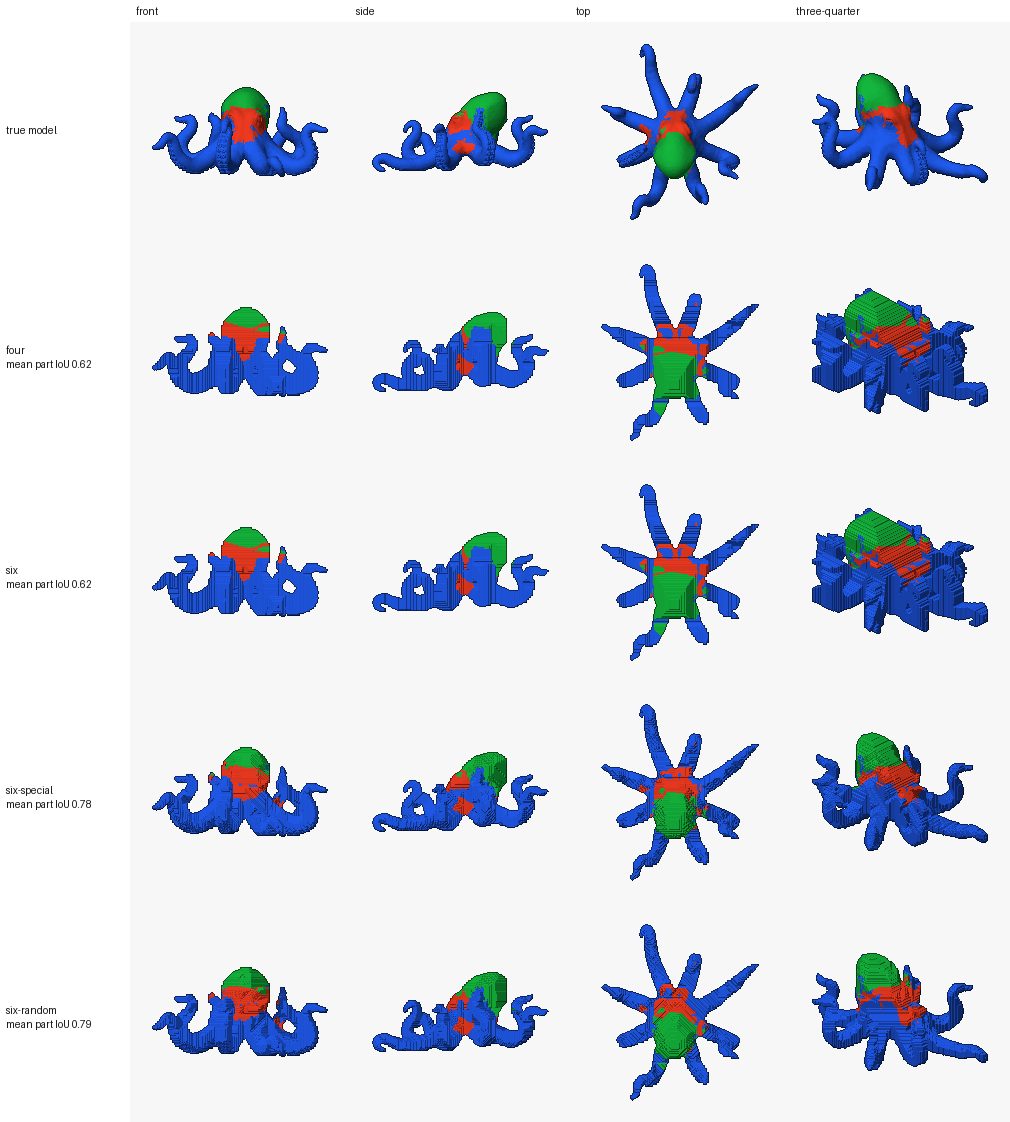
The special angles, in the order chosen, and the parts each one mostly serves (share of what it pinned down):
- front below: head 49%, arms 38%, torso 14%
- back other side below: arms 50%, torso 38%, head 12%
- side below: arms 41%, torso 40%, head 20%
- back side below: arms 44%, torso 34%, head 22%
seahorse
Mean part overlap with the true model: 4 straight views 0.71 · 6 straight views 0.71 · 6 straight + 4 special angles 0.81 · 6 straight + 4 random angles 0.77
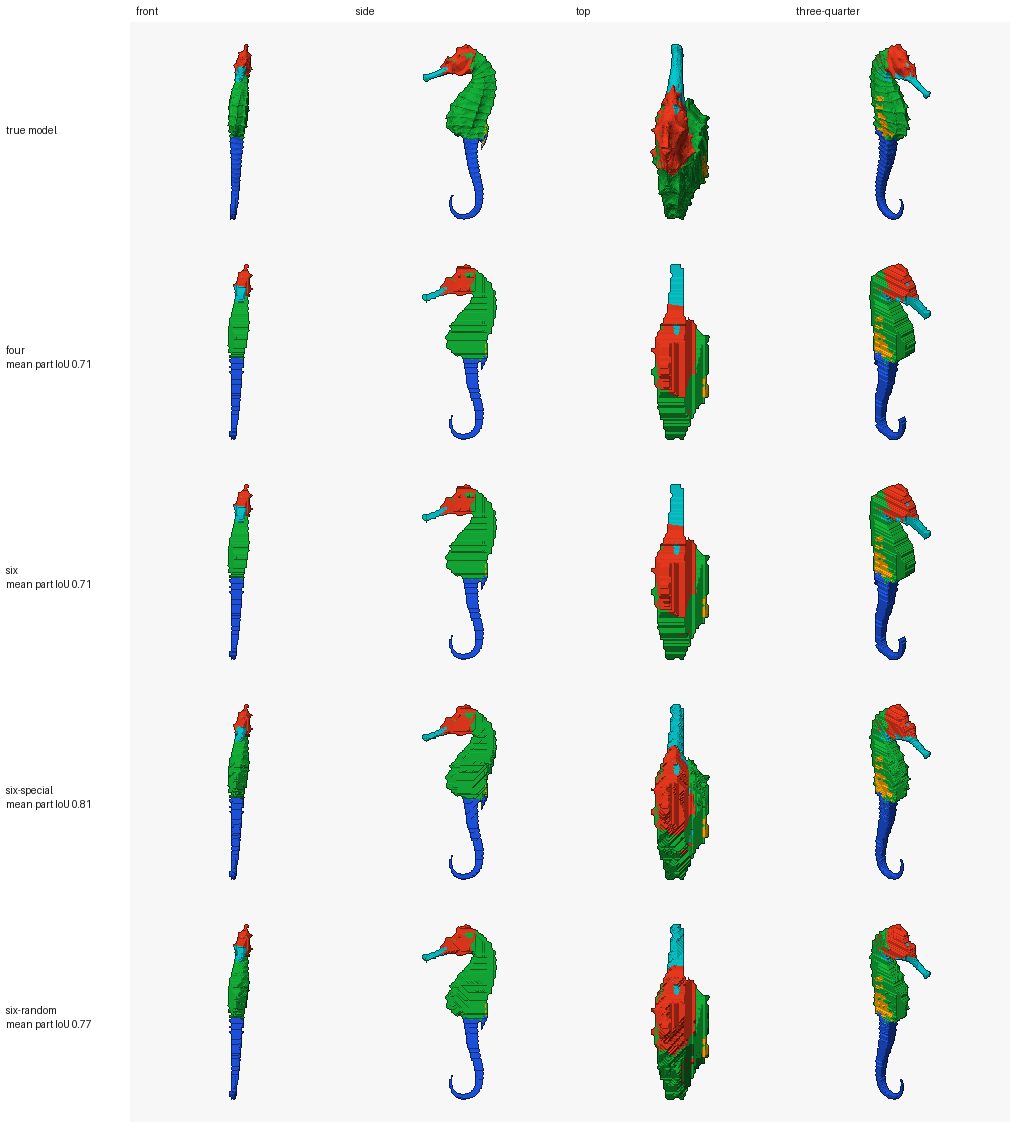
The special angles, in the order chosen, and the parts each one mostly serves (share of what it pinned down):
- front other side above: snout 37%, tail 32%, torso 15%
- back other side below: snout 40%, tail 34%, head 14%
- front below: snout 31%, head 24%, tail 20%
- back side: snout 41%, tail 30%, torso 14%
racer snake
Mean part overlap with the true model: 4 straight views 0.63 · 6 straight views 0.63 · 6 straight + 4 special angles 0.78 · 6 straight + 4 random angles 0.79
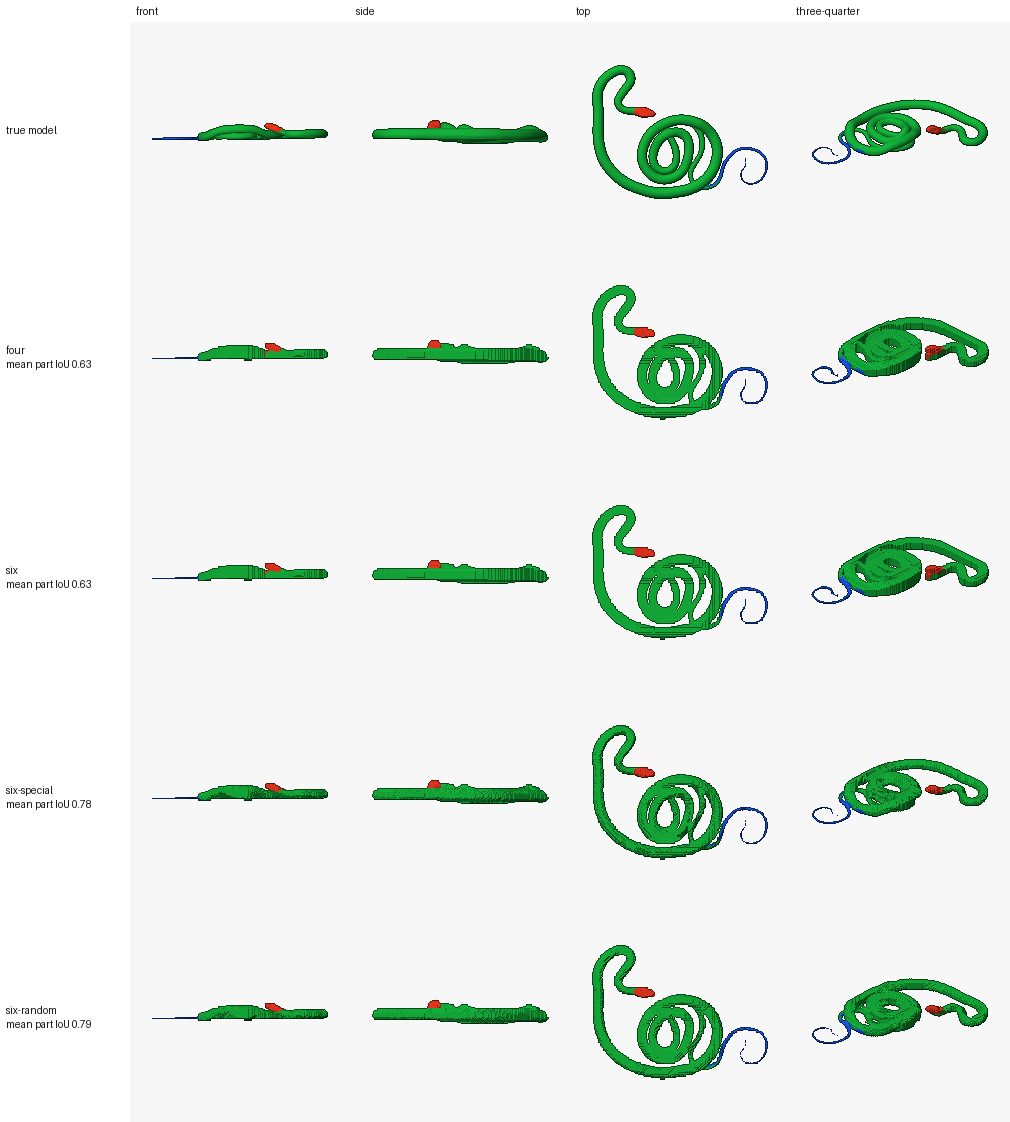
The special angles, in the order chosen, and the parts each one mostly serves (share of what it pinned down):
- back side above: tail 50%, head 34%, torso 15%
- front other side above: tail 56%, head 28%, torso 16%
- back other side above: tail 60%, head 28%, torso 13%
- back below: tail 50%, head 30%, torso 21%
jellyfish
Mean part overlap with the true model: 4 straight views 0.35 · 6 straight views 0.35 · 6 straight + 4 special angles 0.39 · 6 straight + 4 random angles 0.39
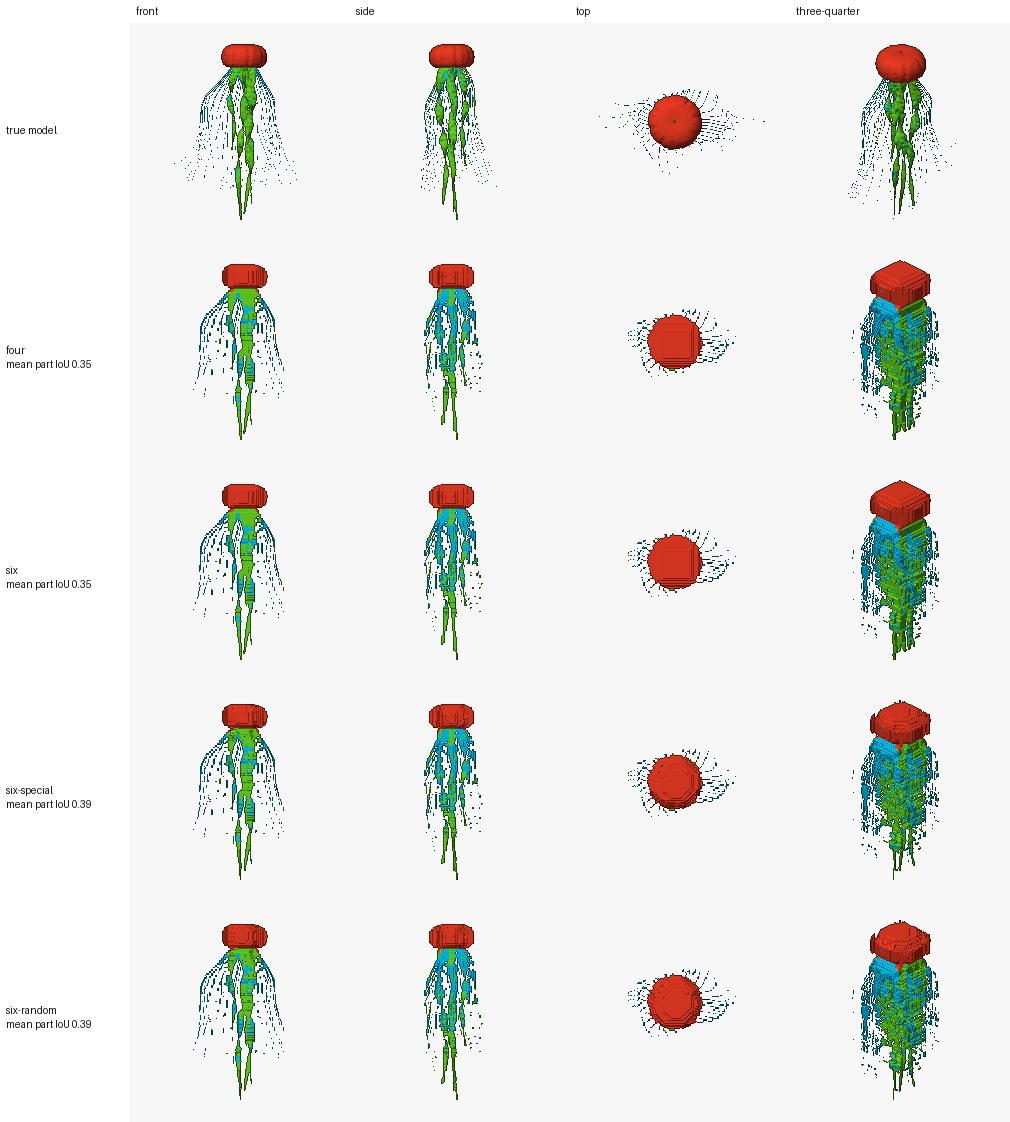
The special angles, in the order chosen, and the parts each one mostly serves (share of what it pinned down):
- back above: marginal tentacles 55%, bell 24%, oral arms 21%
- back below: marginal tentacles 54%, oral arms 24%, bell 23%
- front side: marginal tentacles 41%, oral arms 31%, bell 28%
- front other side: marginal tentacles 47%, oral arms 32%, bell 22%
2. A wrong picture: does the pick catch it?
One part erased from the front view, as an image model that left a part out would draw it. Plain carving trusts every view; the pick lets each part use only the views that agree on it.
Share of the erased part's true volume that the carving cut away.
- flamingo: erased legs from the front view. The pick used legs without front.
- agama: erased head from the front view. The pick used torso without front; head without front.
- scorpion: erased walking legs from the front view. The pick used trunk without back; walking legs without front.
- octopus: erased arms from the front view. The pick used torso without front; head without front; arms without front.
- seahorse: erased tail from the front view. The pick used tail without front; dorsal fin without front.
- racer snake: erased tail from the front view. The pick used tail without front.
- jellyfish: erased oral arms from the front view. The pick used marginal tentacles without front; oral arms without front.
flamingo
agama
scorpion
octopus
seahorse
racer snake
jellyfish
3. The fits: does the tool get closer to the true part?
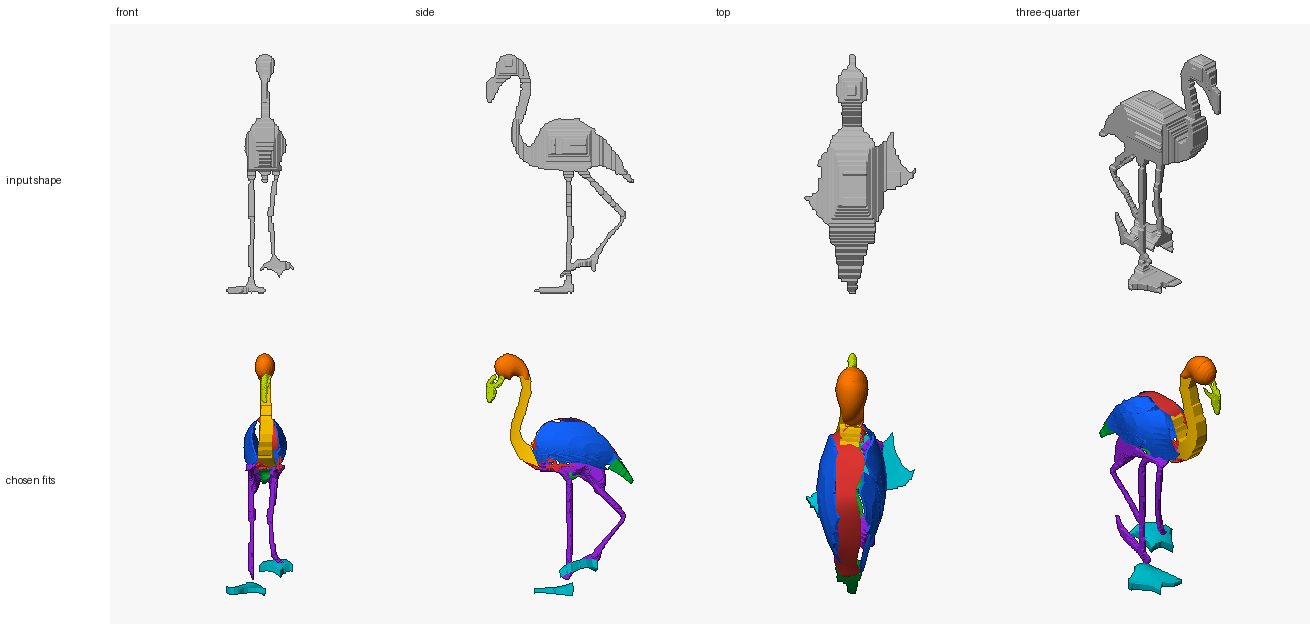
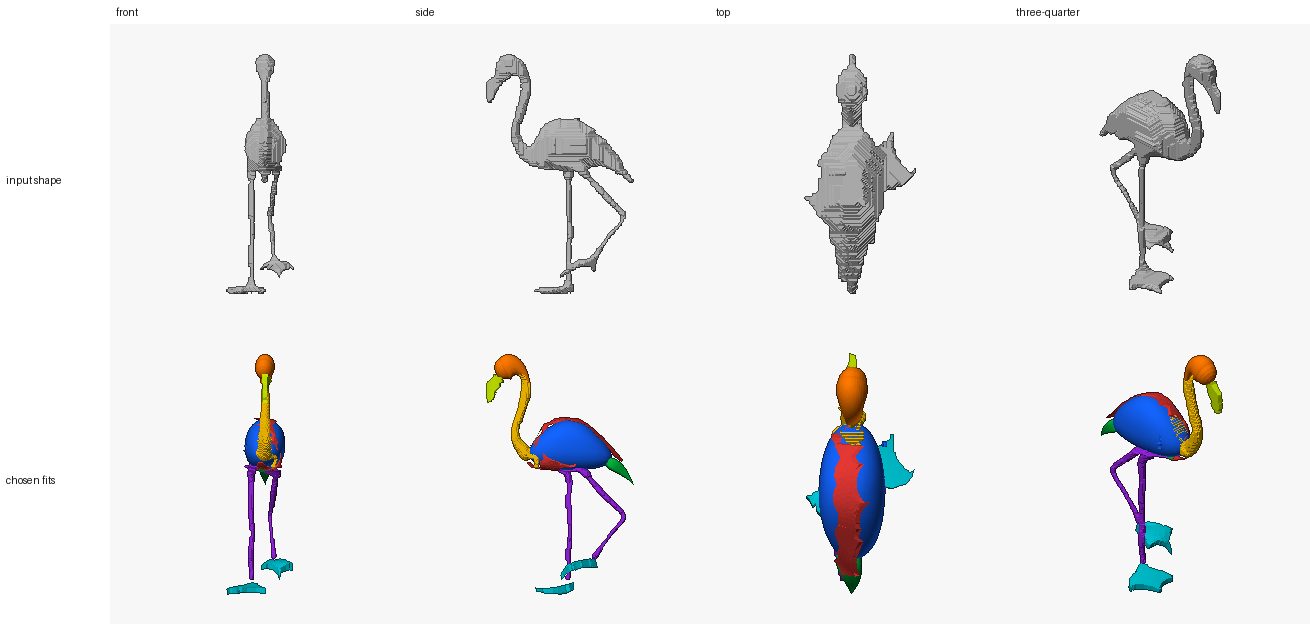
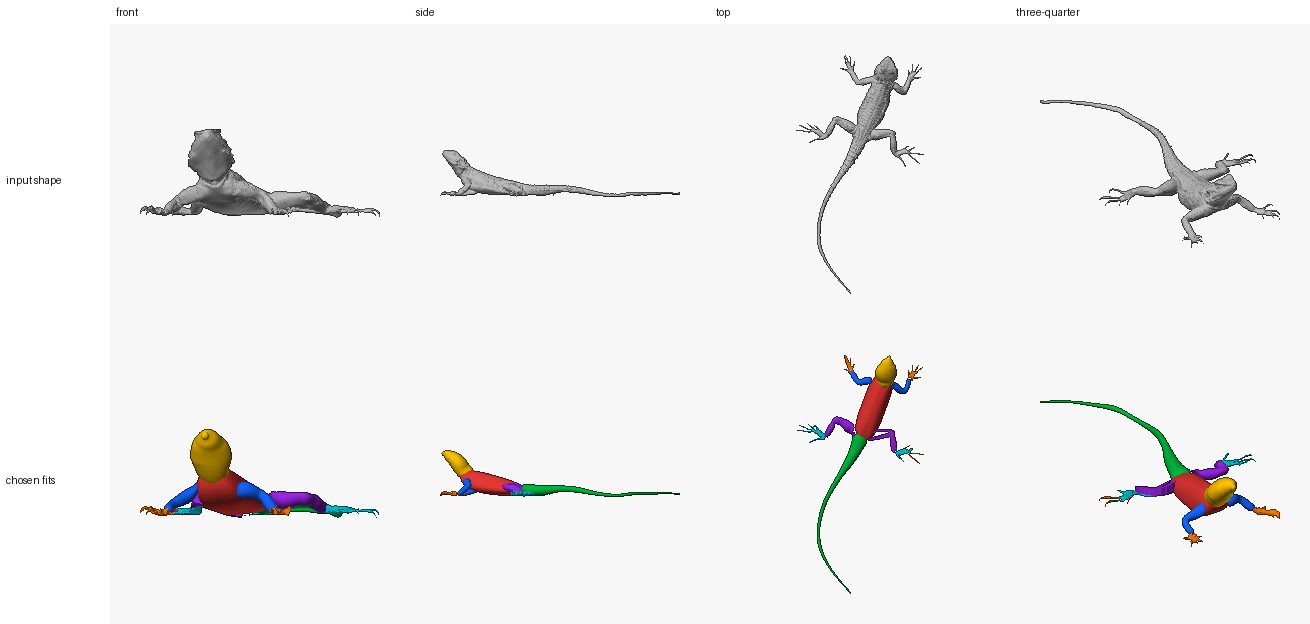
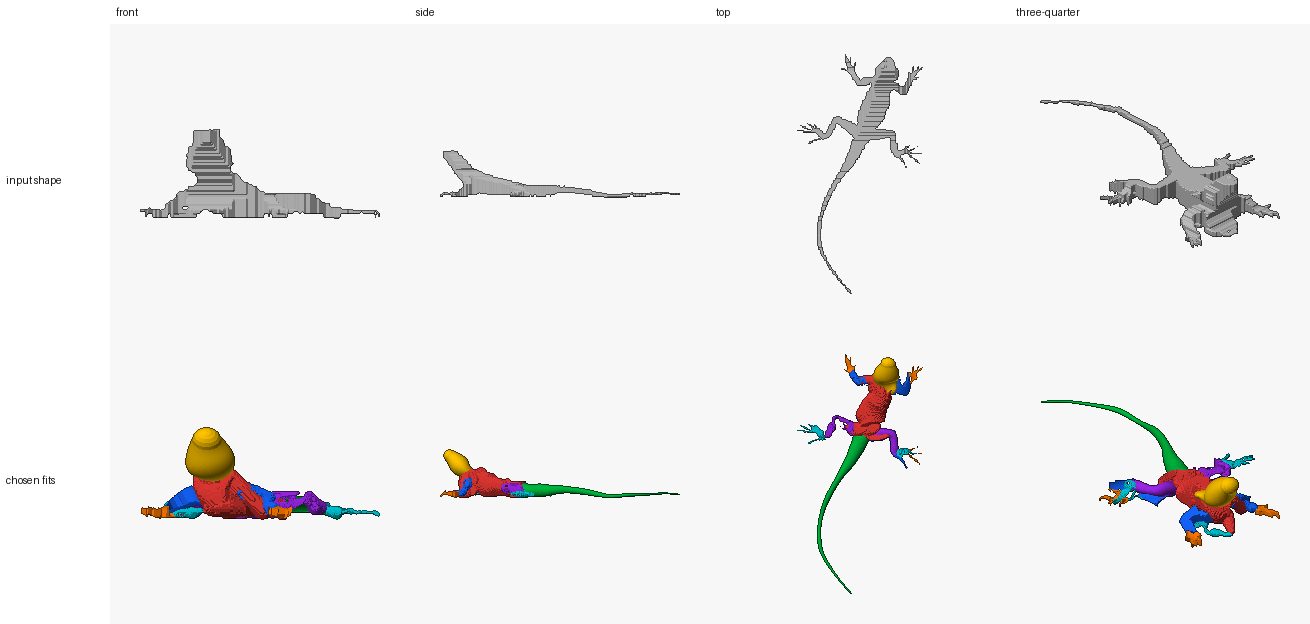
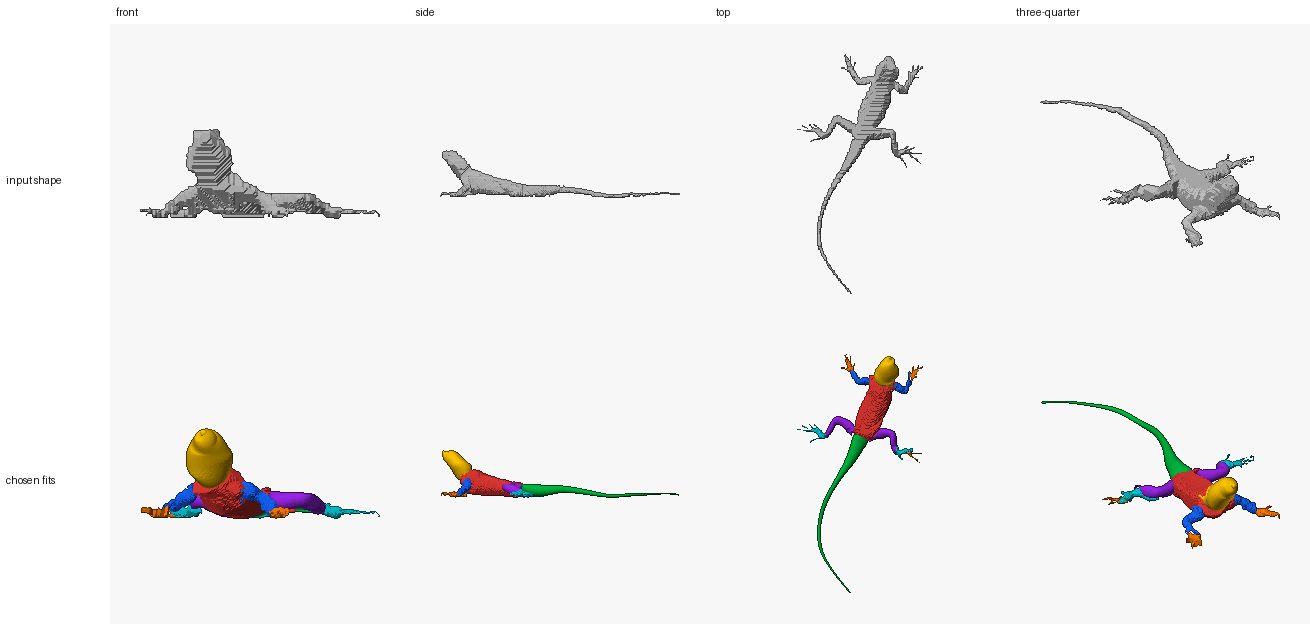
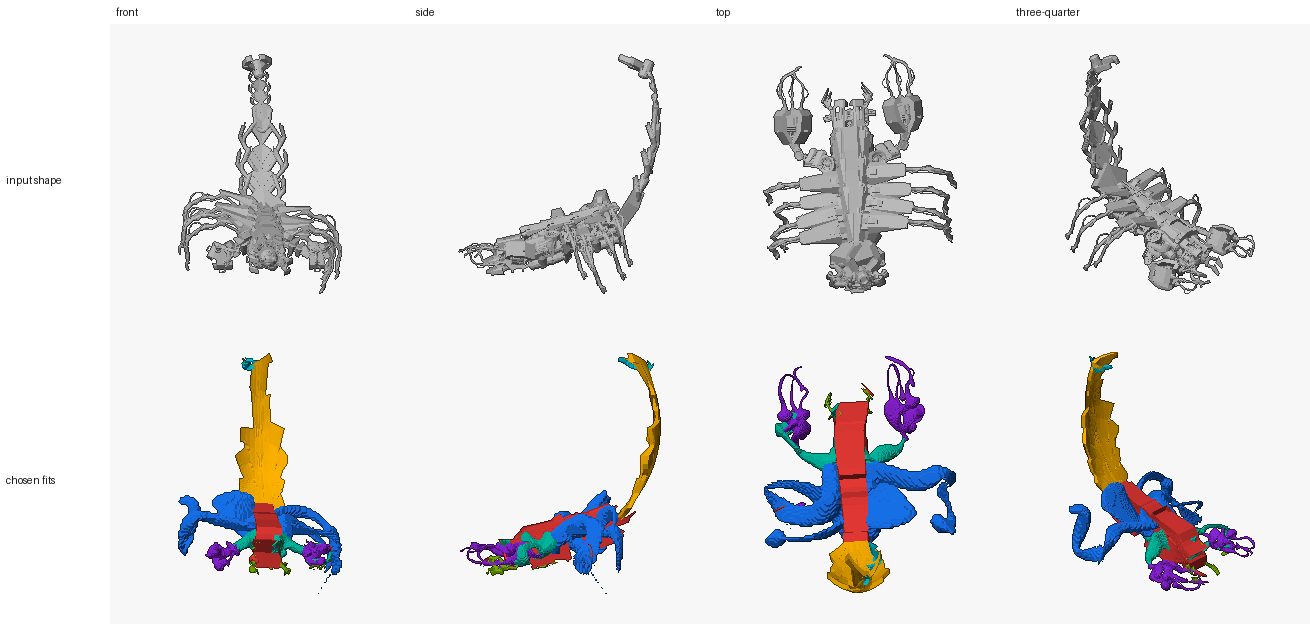
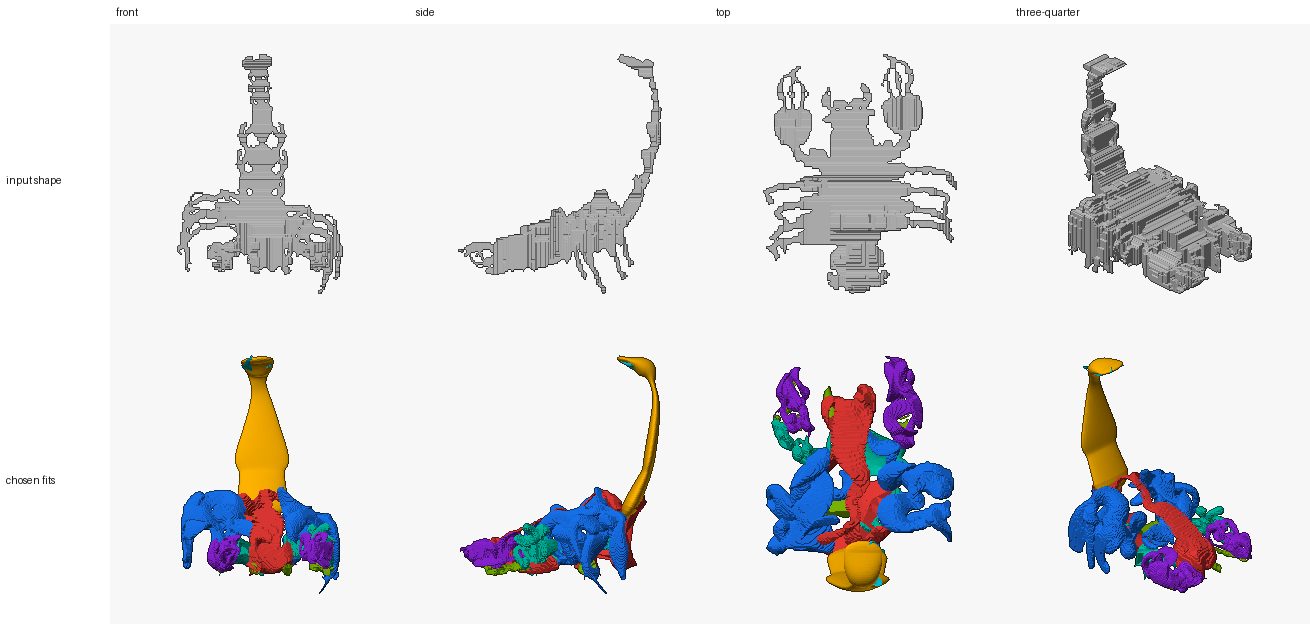
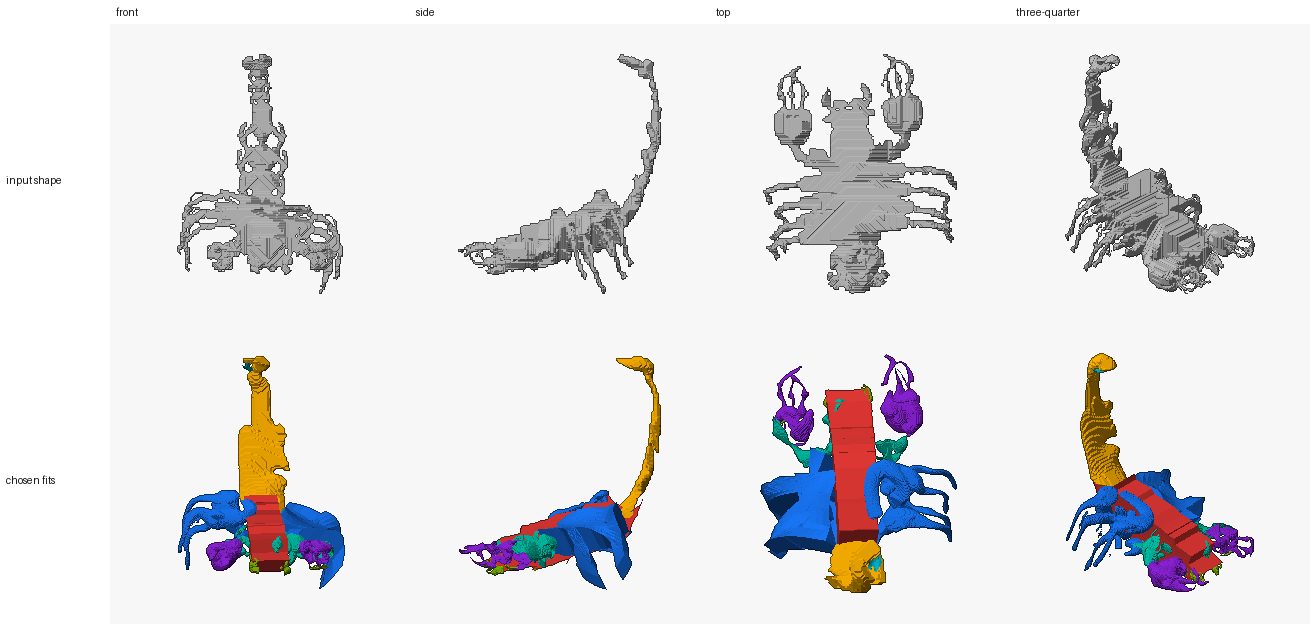
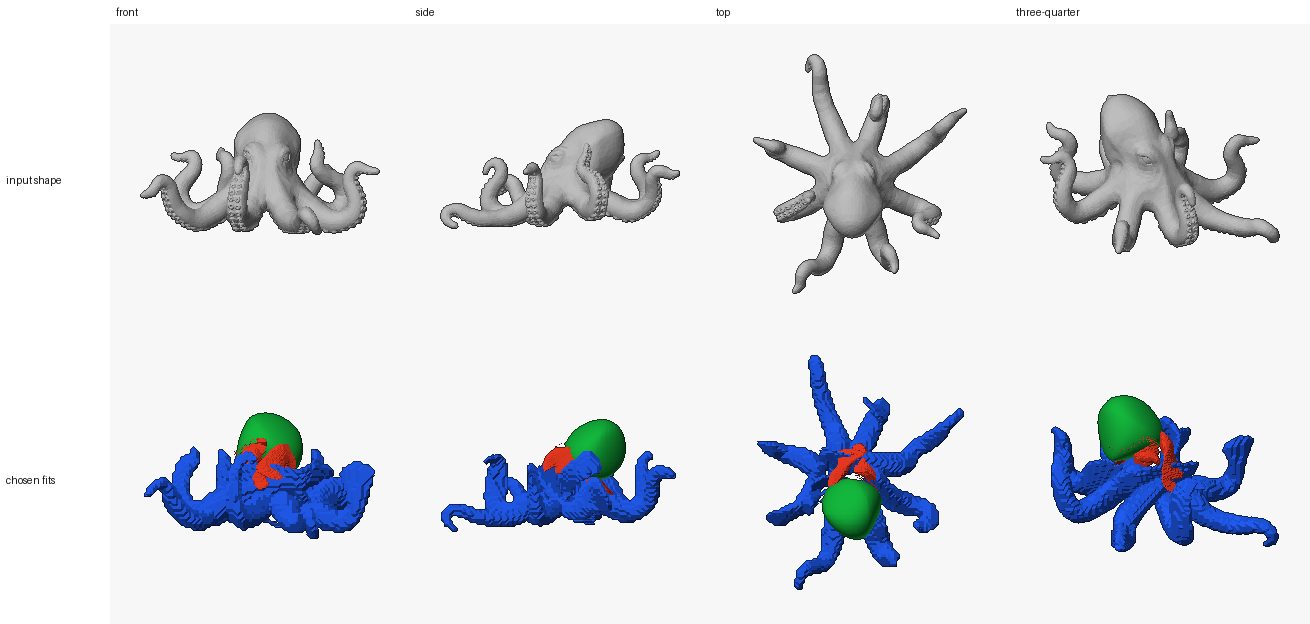
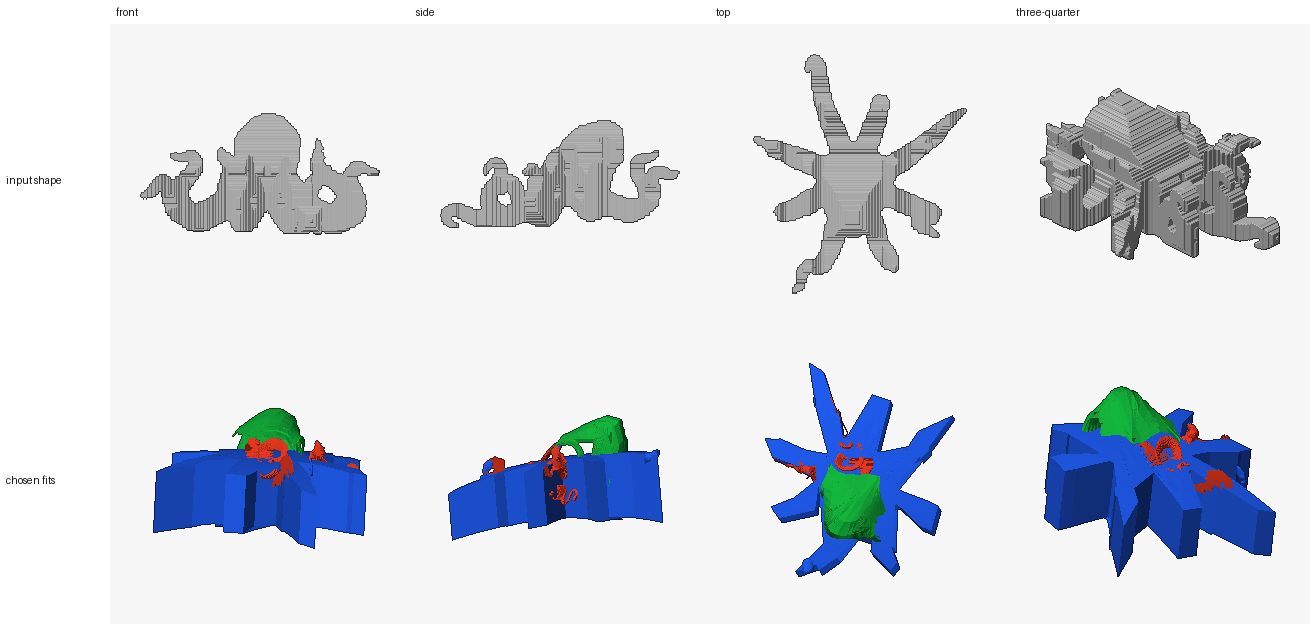
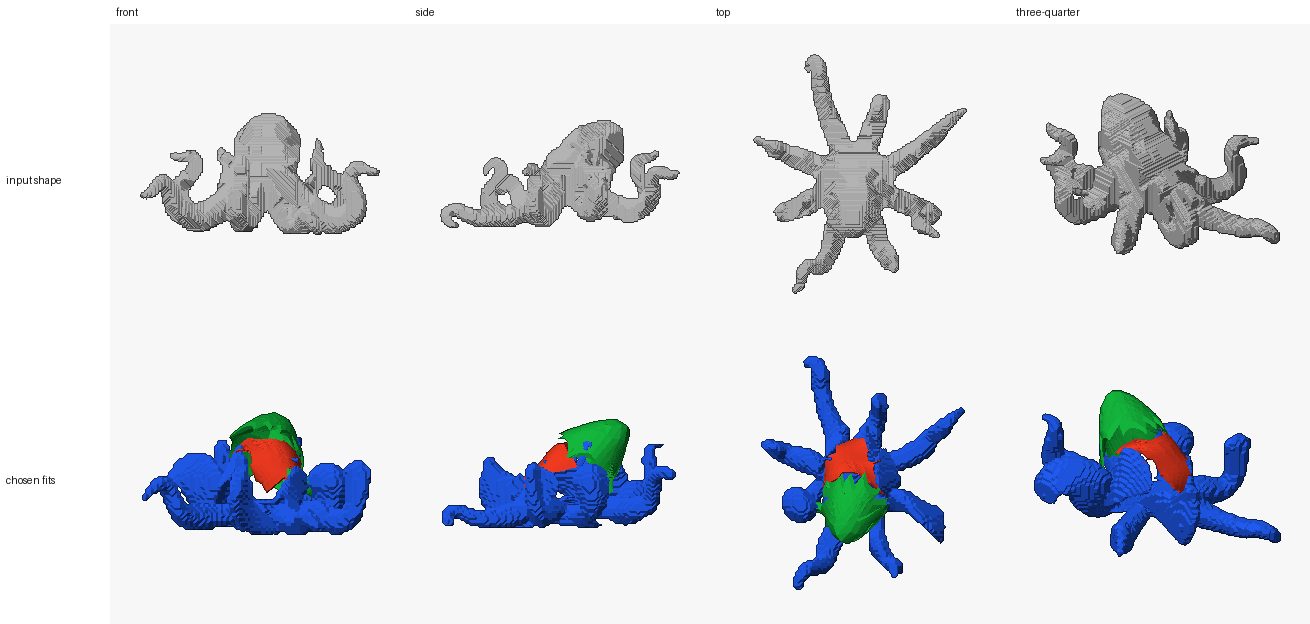
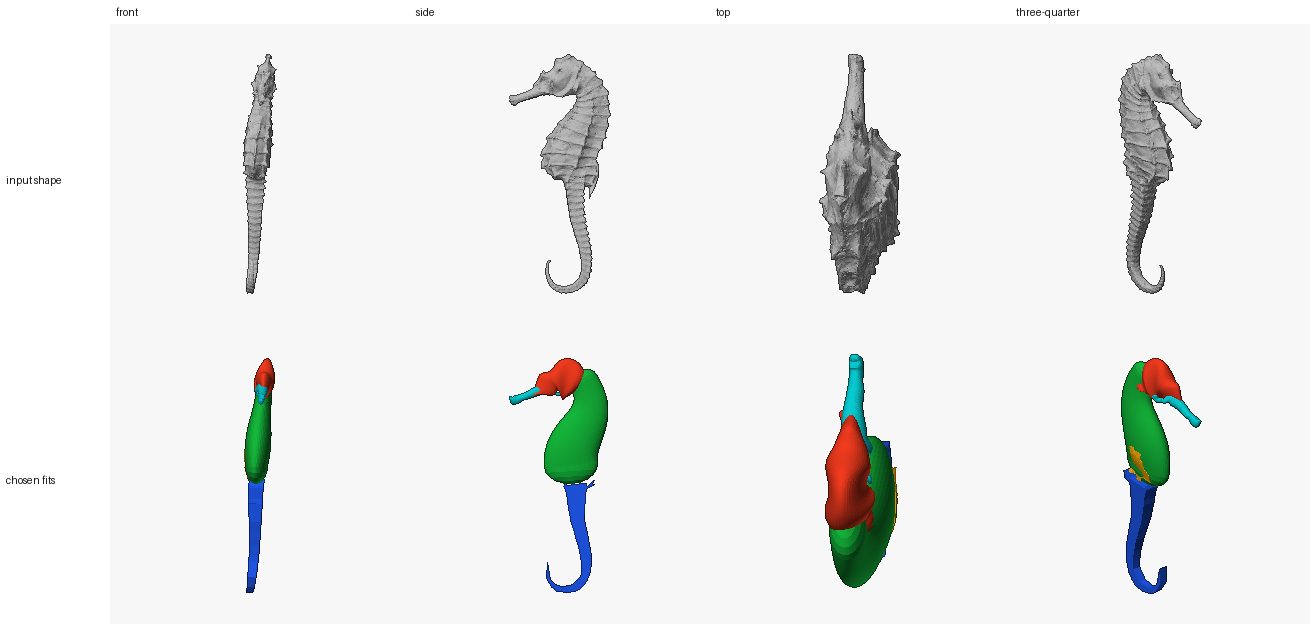
56 parts of 6 animals (agama, flamingo, octopus, racer snake, scorpion, seahorse). Arms not listed are still fitting. Each part's fits are scored against the true part. "Script's tool" is the one the script picks without the truth; "best tool" is the best of the five, chosen afterwards against the truth.
Parts within the pass line (provisional 0.5)
Typical error of the script's tool (median r2; lower is better)
flamingo
agama
scorpion
octopus
seahorse
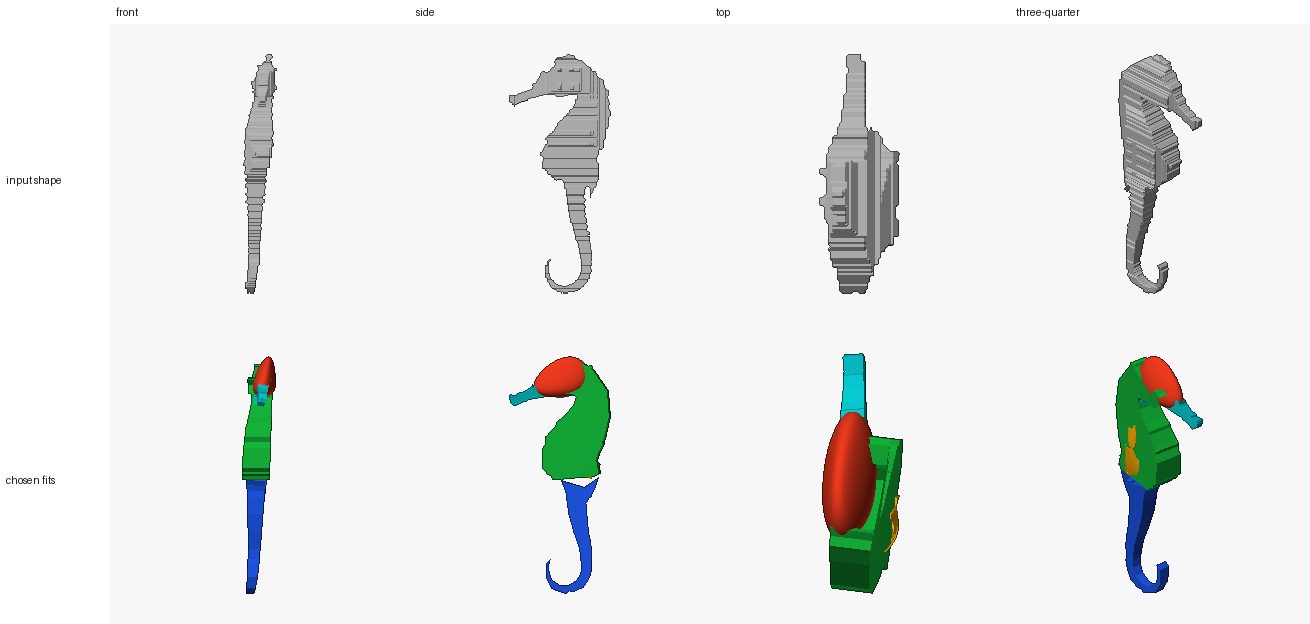
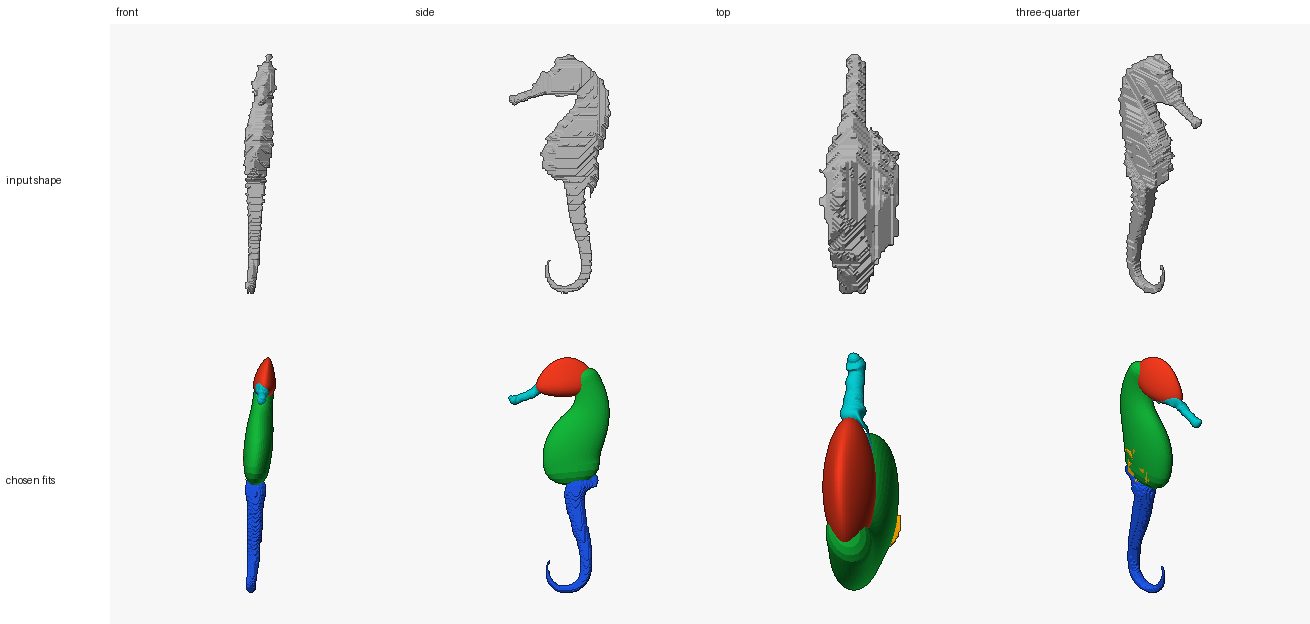
racer snake
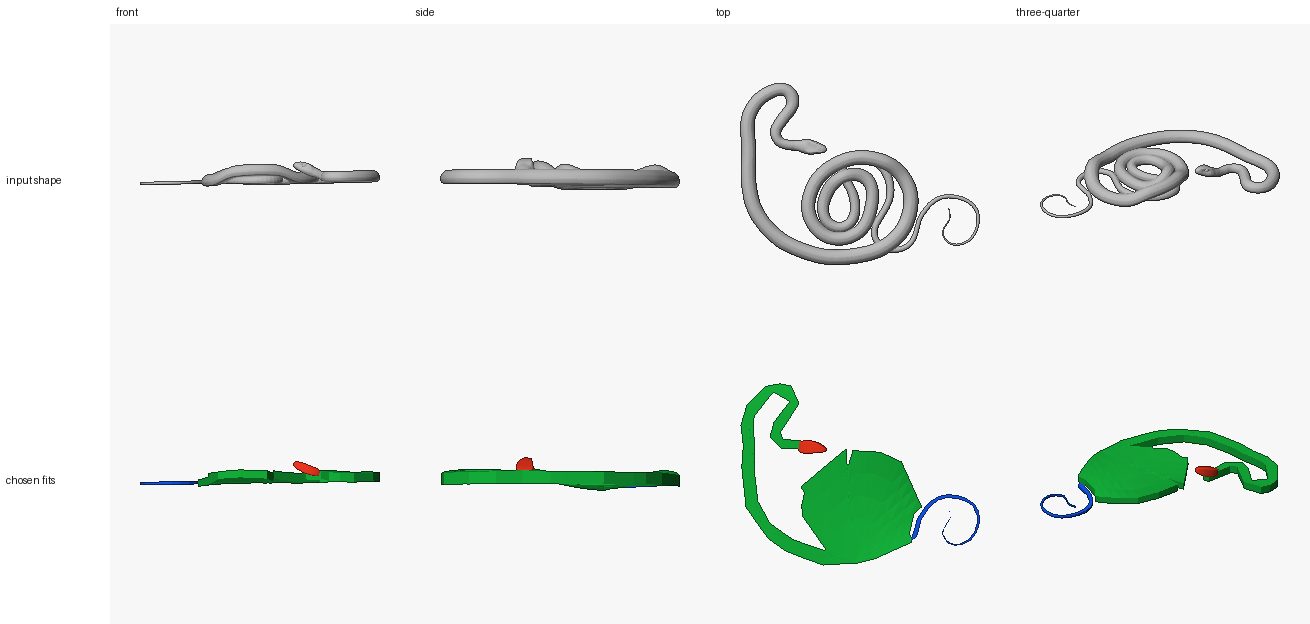
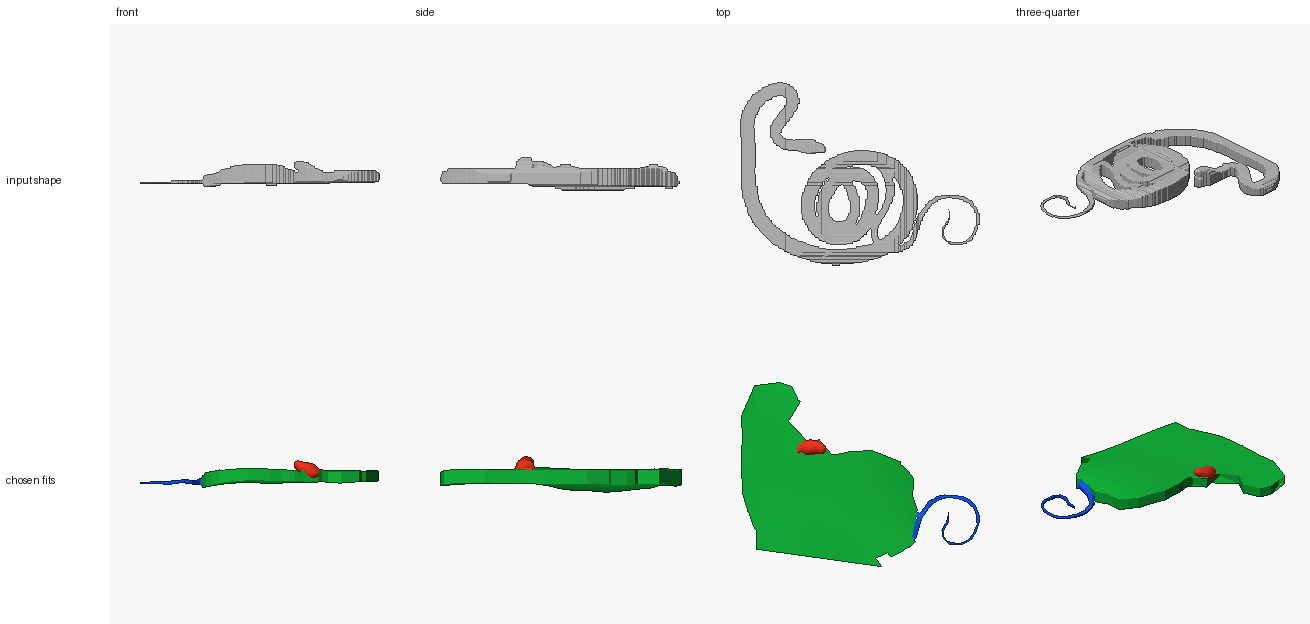
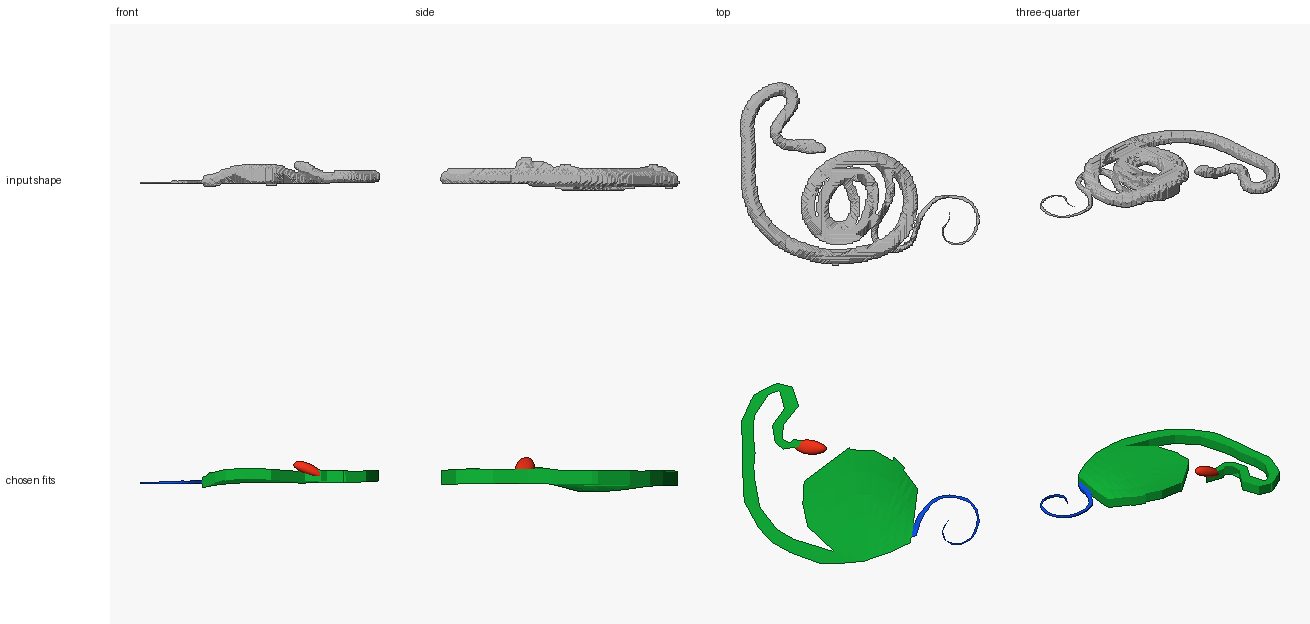
jellyfish
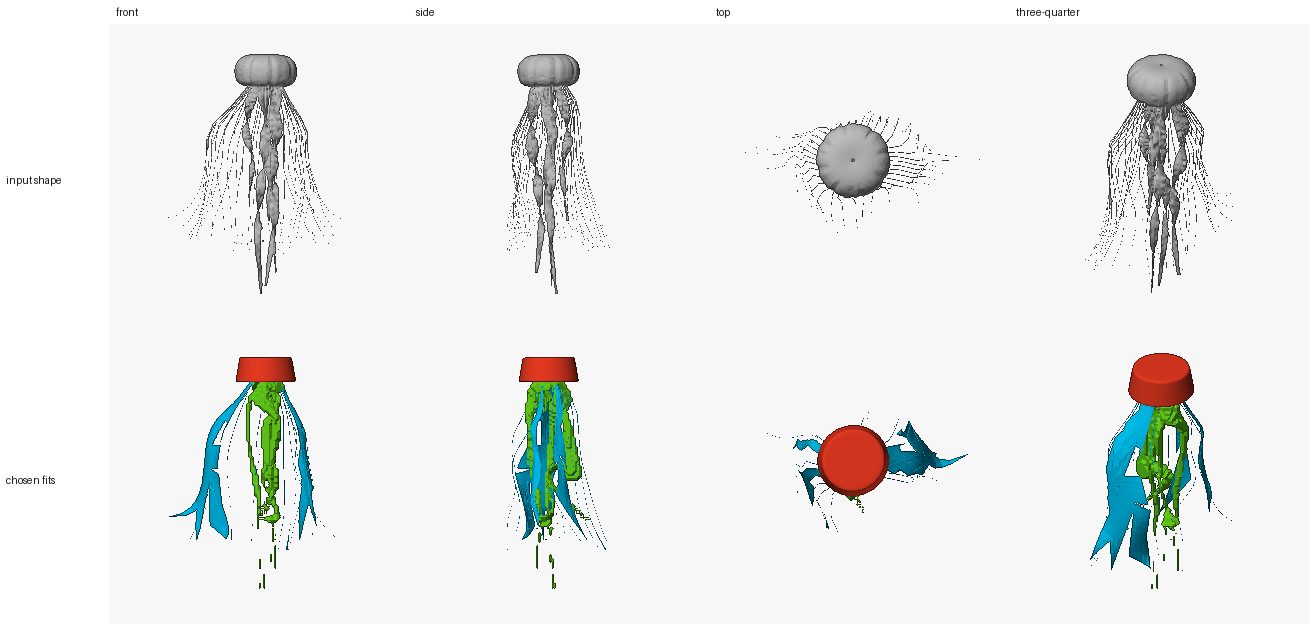
Still fitting.
Still fitting.
4. Shading: does it pick the better tool?
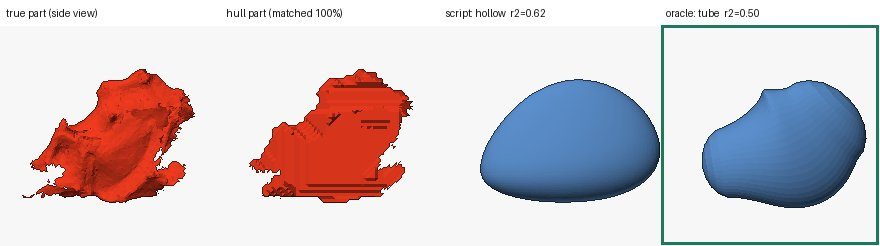
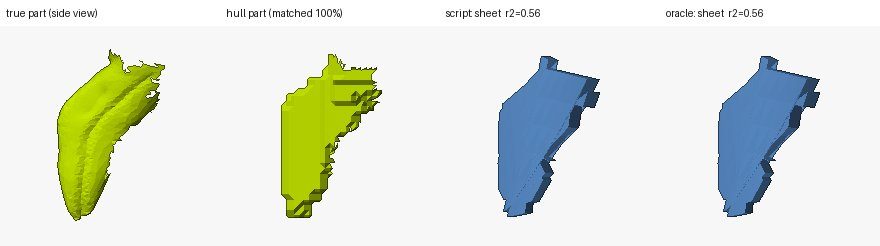
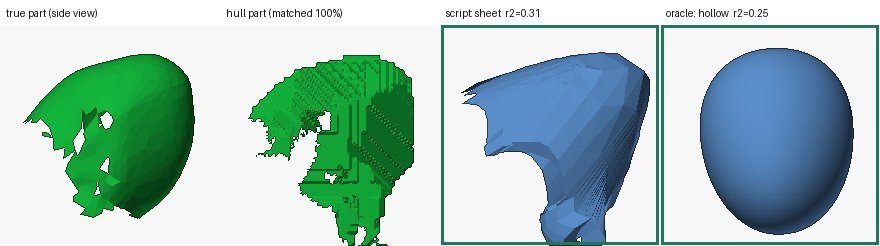
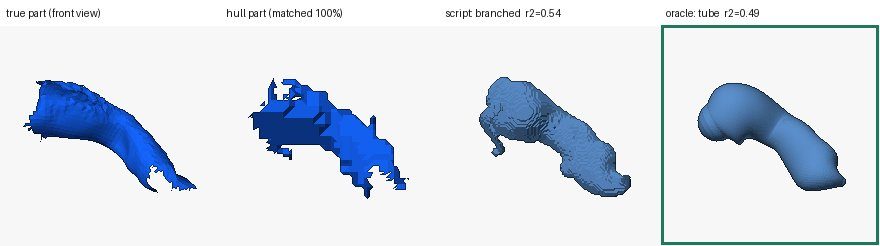
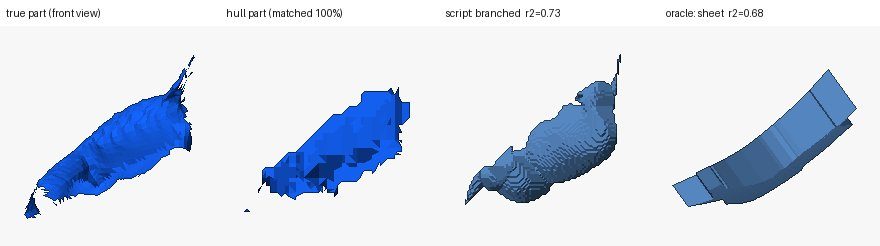
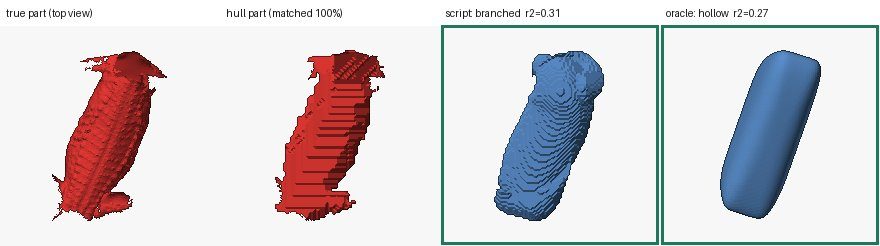
Three ways to choose among the five fits without the true model: closest to the carved part (what the script does now); best match to the outline in the pictures; best match to the outline and the shading (surface direction) inside it. 224 parts, pooled over the arms fitted so far (four, six, six-random, six-special). Where the two choices differ near the pass line (9 parts with the special angles), shading chose the closer fit 6 times.
How often the choice is the best of the five
Parts within the pass line
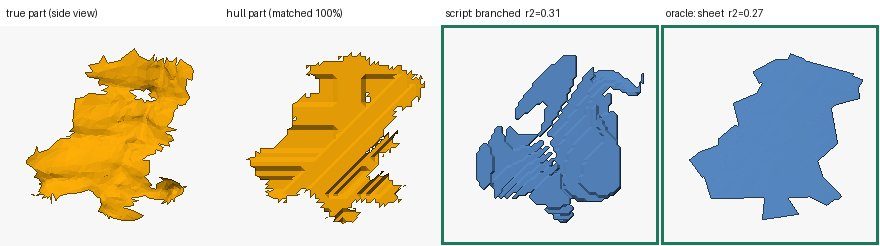
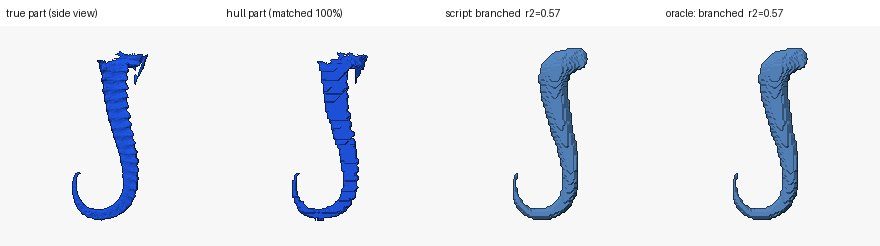
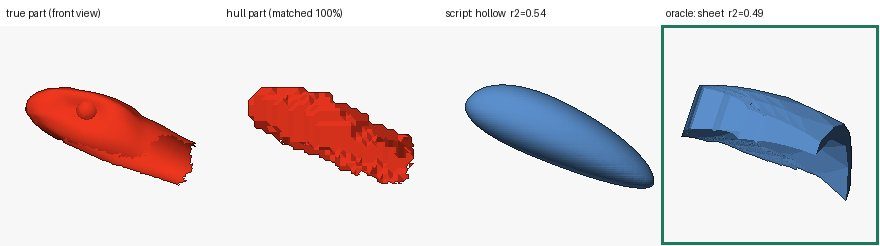
Parts where shading and distance chose differently, near the pass line. Each strip shows the true part, the carved part, the fit chosen by distance, and the best of the five against the true part (framed). The number is the fit's error against the true part (r2, lower is better); green marks the closer of the two choices.
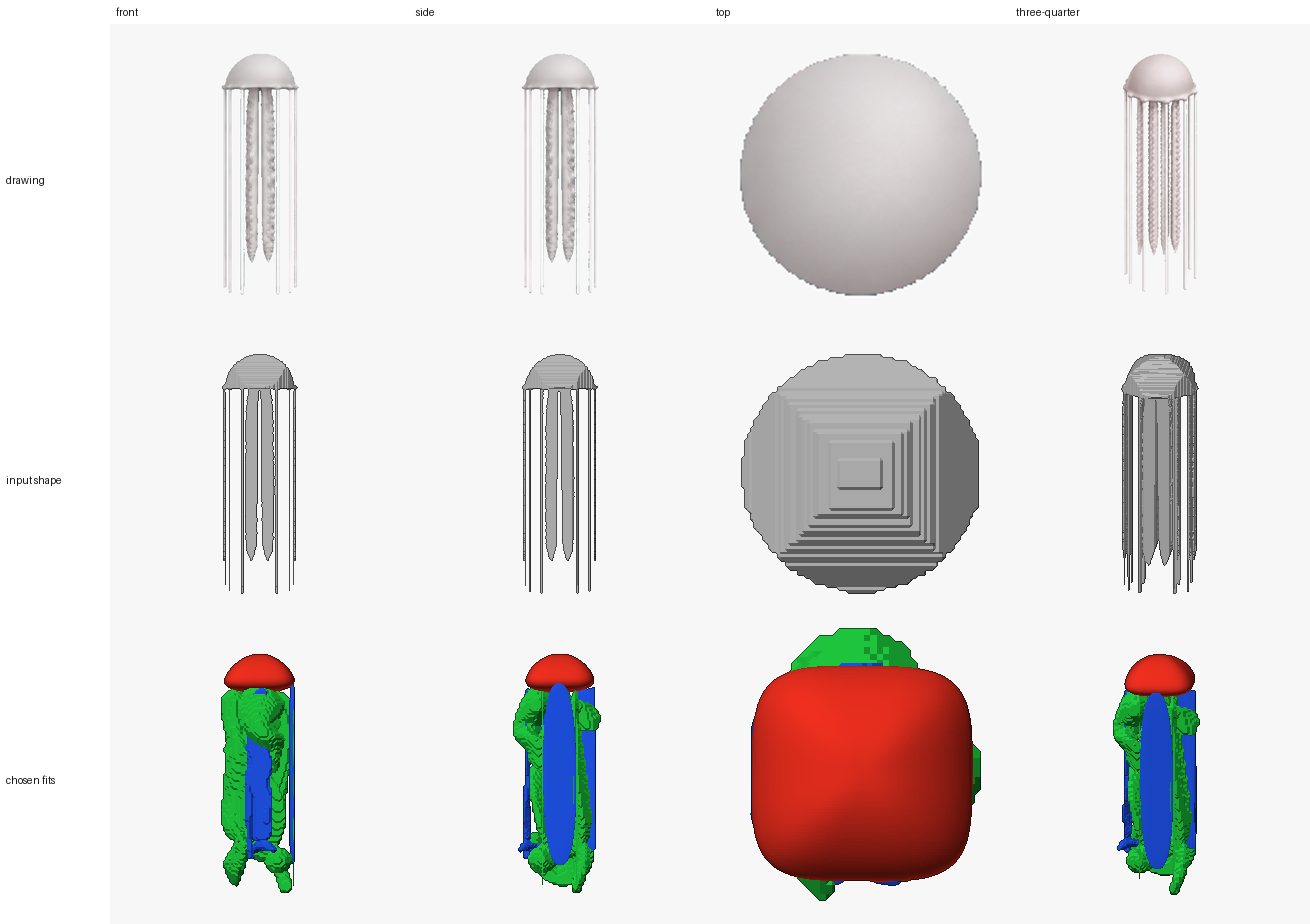
5. AI drawings, four views (yesterday's run)
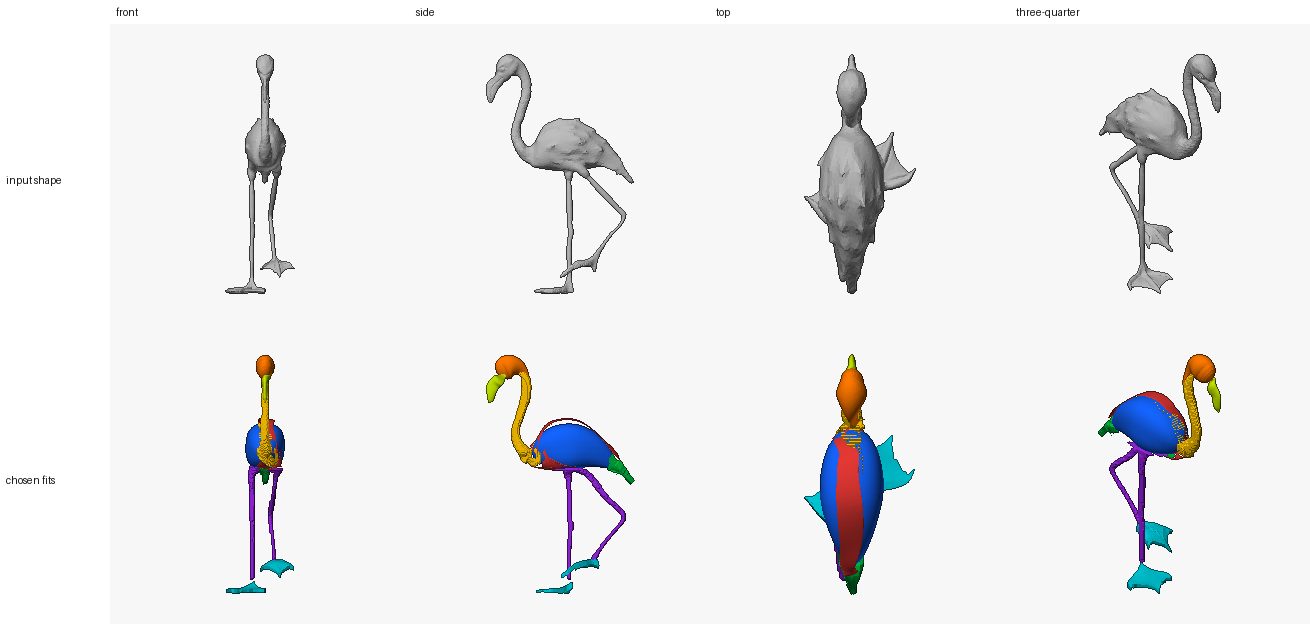
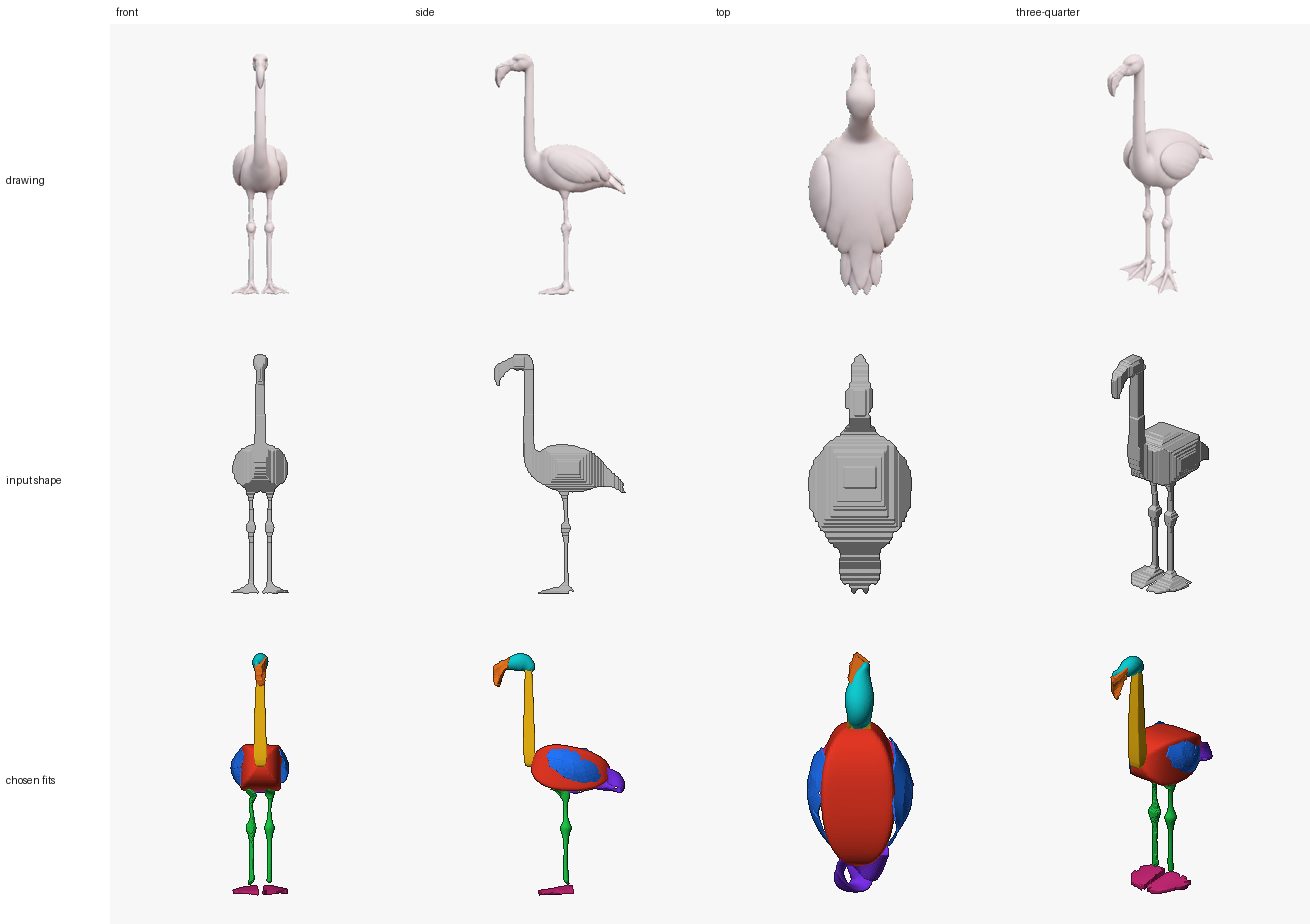
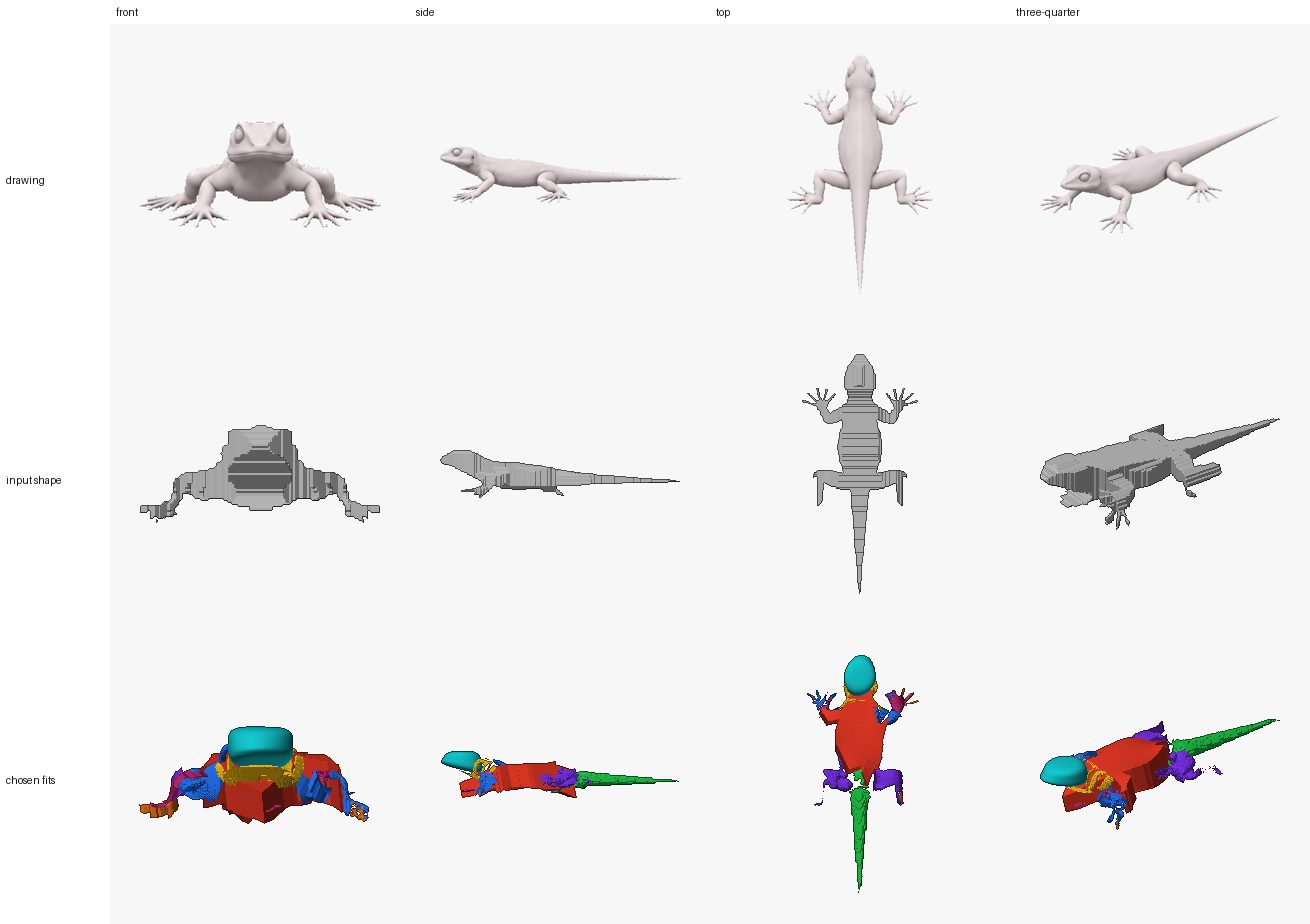
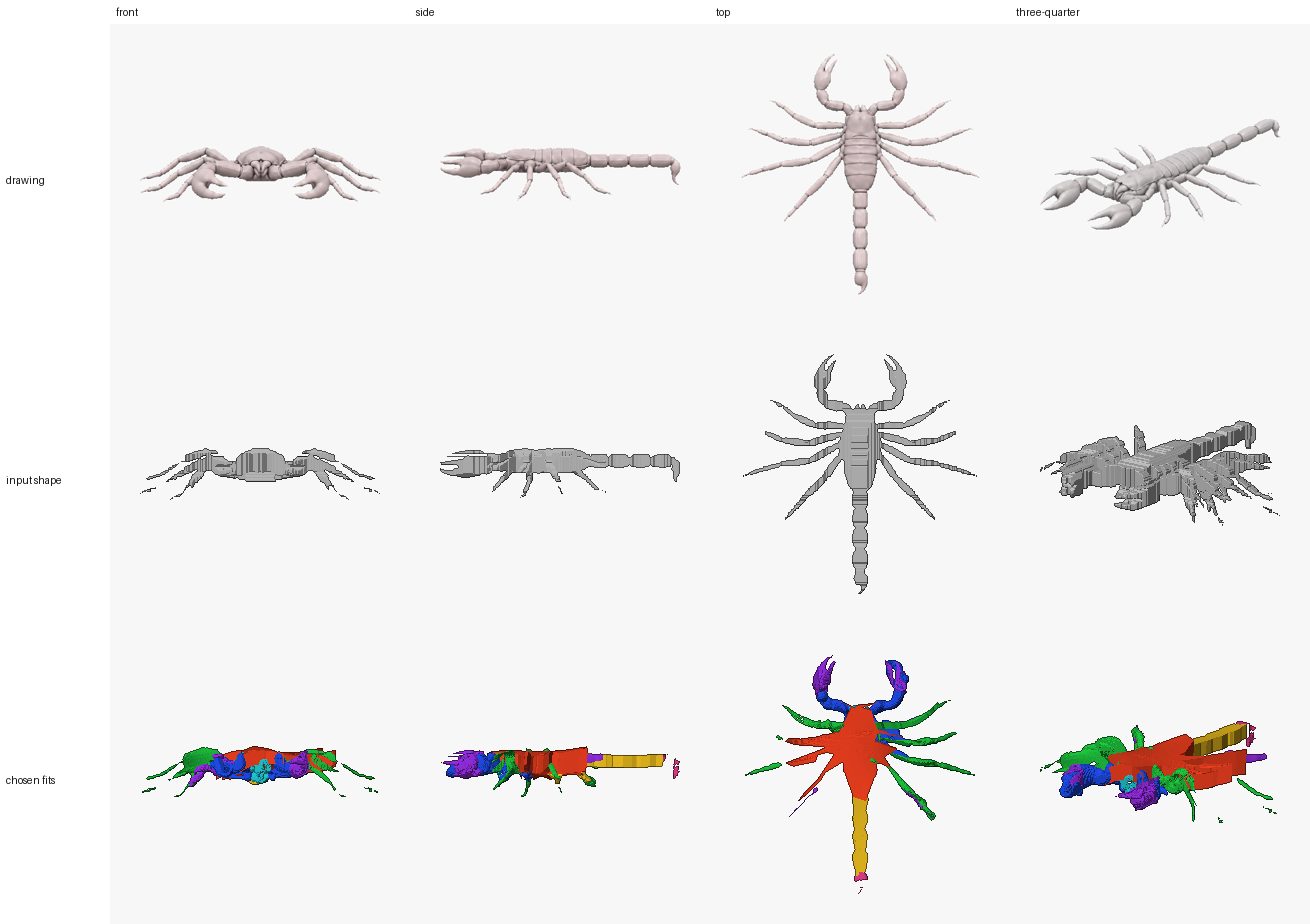
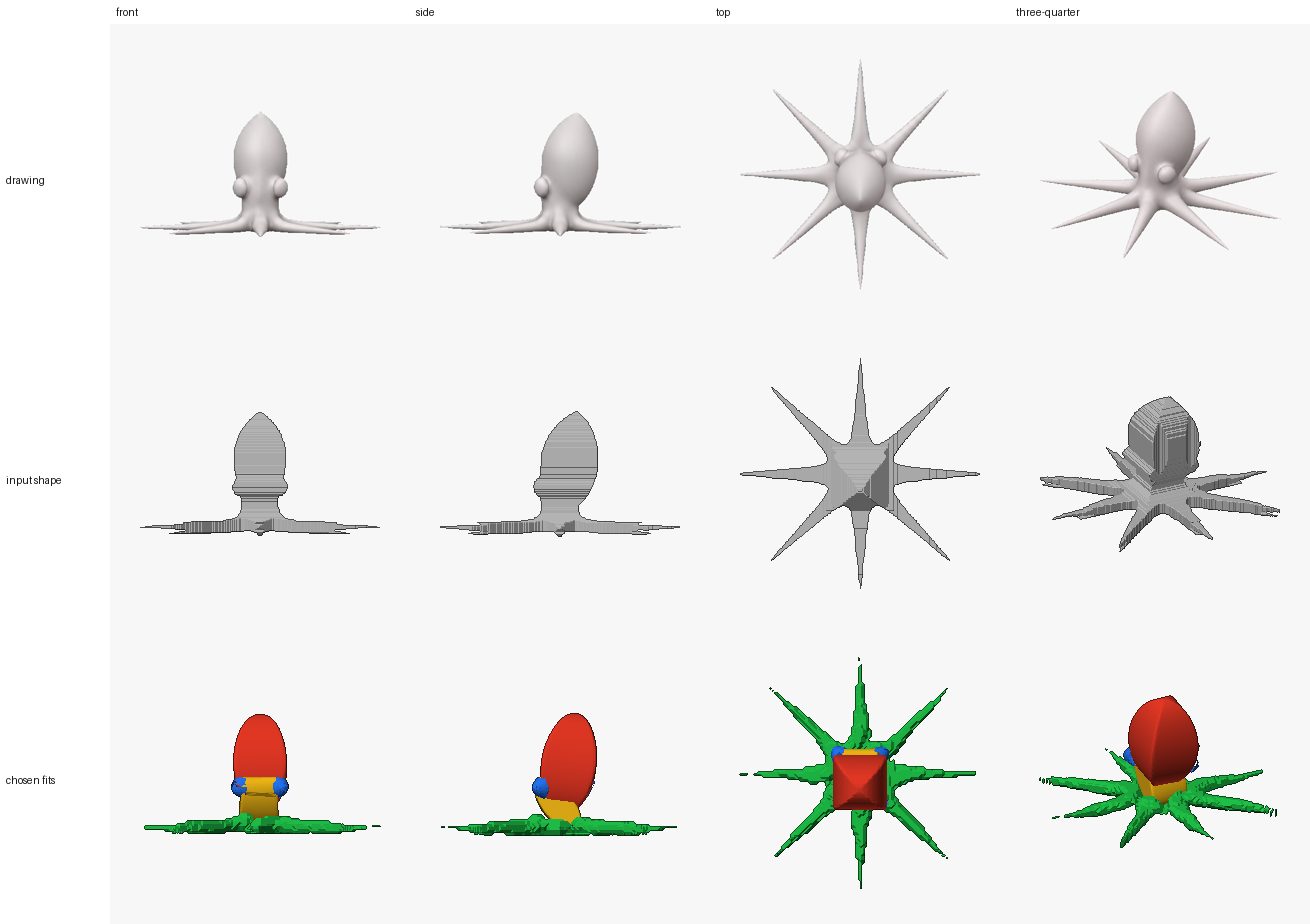
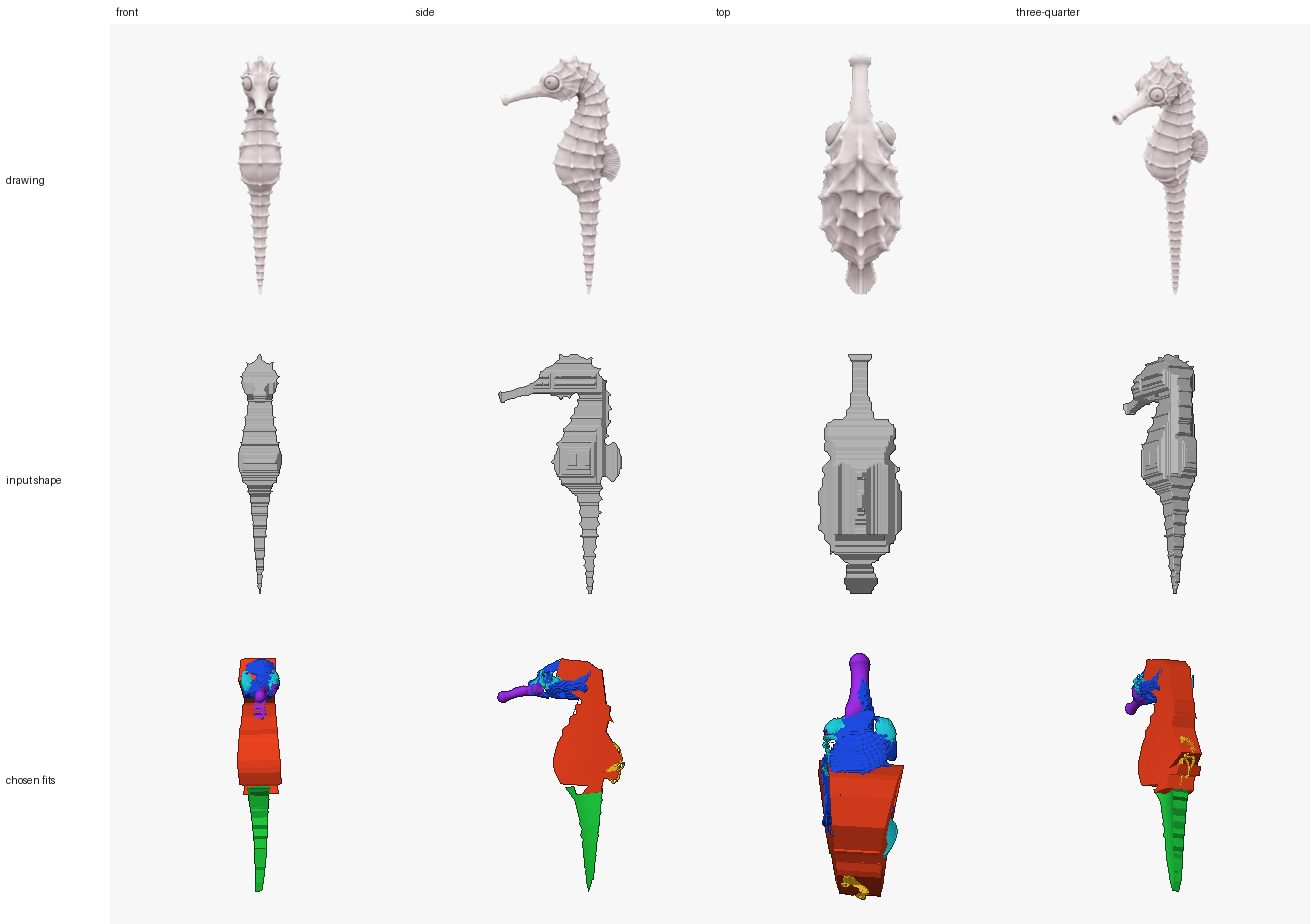
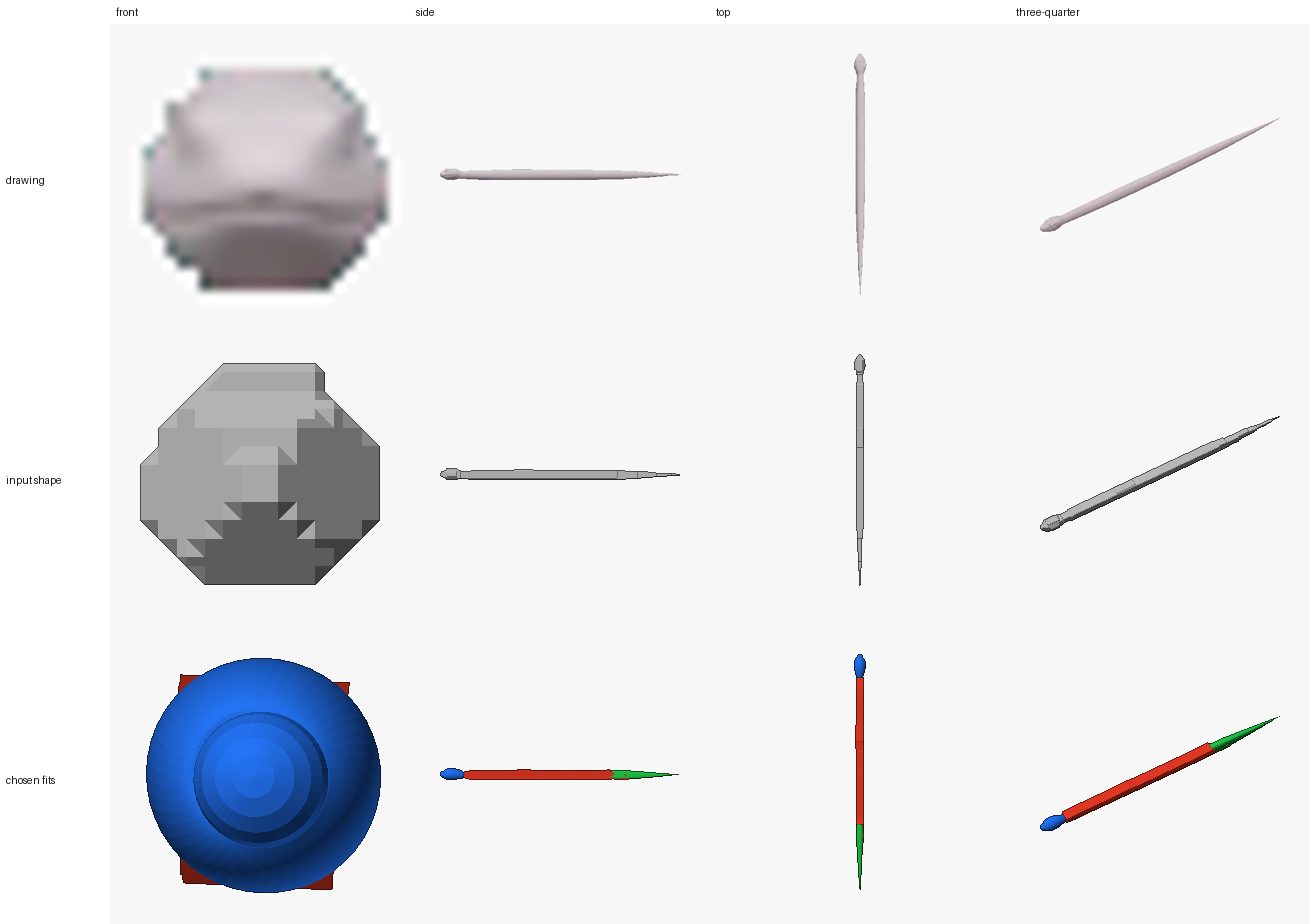
Drawings, the shape carved from them, and the chosen fits. Next: ask the image model for six straight views and the special angles, and read the shading from the drawings.
flamingo
agama
scorpion
octopus
seahorse
racer snake
jellyfish