Scene Loop Trial
What each step of the new scene-building skill contributed in this run, with the proof, and where the skill (or my use of it) fell short. The run: the launch tower's lighting (rounds BAKE2 to BAKE8) and the painted backdrop (MATTE3, MATTE4). Goal: a launch tower and pad that look real from the cabin.
The steps find causes instead of retrying; the tower is not finished yet
- Worked: the review sheets turned "looks fake" into numbers, lighting on grey isolated the cause of the peach steel, the AI lighting options became precise targets, the two-round rule forced a method change twice, and calibrating the score stopped a wrong score from blocking good work.
- Fell short: two lighting rounds were wasted because nothing checked the steel paint before lighting; the paint was as dark as asphalt. Part of that was my briefs: I judged lighting rounds with final-material scores, which the skill's own Stage 5 gate says not to do.
- Update, BAKE9 and MATTE5 (31 Oct): the new "check before you bake" gate stopped a failing fit before any bake was spent. A known-answer control (a white plane lit by one lamp) found that every earlier rebuild of the lights applied each colour twice, which squared it: much of the orange came from that bug, not only from fitting on grey. On the backdrop, the seam is fixed, but the AI tool's output cap (about 1254 pixels) blocked the sharper repaint, so the method changes (and your partial-image idea is being tested).
- Result so far: each round removed one cause: the light layout, the paint brightness, the map layout that lost the pools, the speckle. But the steel is still brown where the targets show grey, and BAKE8 proved that this is already true in the ray-traced render, before the engine. So the current lighting method is exhausted, and the skill's stop rule ended it after two failed bakes. BAKE2 stays installed: nothing worse has shipped.
- Cost: 7 tower rounds and 2 backdrop rounds of 2–3 worker hours each, plus reviews; about 7% of the weekly Codex quota (69% → 76% used).
| Skill step | What it did in this run | Proof | Contribution |
|---|---|---|---|
| Review checks (value sheet) | Compared the tower with the concept as numbers | Brightness 0.030 → 0.066 (concept 0.083); warmth +0.10 → +0.26; showed the warmth sat in the steel | helped |
| Stage 5: light on grey first | Rendered each light group alone on grey steel | Work lights 45.7%, banks 27.9%, keys 17.7%, sky 0.6%; 150° cones with no falloff | helped |
| AI images: lighting design | Two AI lighting options painted over our grey render | Option A and B (your question 3) | helped |
| Align check | Proved the AI options kept our tower's exact layout | Edge recall 0.913, shift ≤ 0.16%, scale 1.00: usable as pixel targets | helped |
| Two rounds, then change method | Stopped hand-tuning after 2 failures; switched to solving the lights by least squares | Error in an unseen view 1.96 → 0.54 | helped |
| Stage order: light, then materials | Separated the light from the paint | Same lights: grey 0.090, real paint 0.016, so the paint reflected about 0.09 (asphalt) | helped late |
| Stage 6: materials | Fixed the paint | Paint 0.146 → 0.495, non-metallic; brightness now on target | helped |
| Bake fidelity check (BAKE6) | Traced where the ray-traced pools disappear on the way to the screen | Not the encoding (−0.7% energy); the map layout gives each grating triangle 0.2 of a map pixel, and the probe evens out the light. My 9 MB cap had forced the coarse maps | helped |
| Pin the inputs between rounds | BAKE7 used the wrong light rigs; BAKE8 checked every input by hash before and after baking | BAKE7's scores could not count; BAKE8's inputs verified twice | learned the hard way |
| Stop after two failed attempts | BAKE8 baked both lighting options once each, both failed, and it stopped | No third bake with tweaked colours; a control render named the cause instead | helped |
| Control render (light vs pipeline) | Measured the steel in the ray-traced render before it reaches the engine | Already too warm there: 0.28 against the target's 0.09–0.17. The cause is upstream of the engine | helped |
| Measure before choosing a new method | DISPLAY1 put both sides through one tone curve and split the steel's light by light group, on the real paint | The tone curve explains 6–12% of the gap; the fitted work lights give 66–74% of the front steel's light and are strongly orange | helped |
| Keep the best round as the baseline | Nothing replaced BAKE2 unless it passed every gate | Seven rounds tried, none installed, the show never got worse | helped |
| Check before you bake (new gate) | BAKE9 summed the per-light renders and tested the predicted picture against every gate before baking | Front wall failed on paper (warmth off by 0.087, pools 25% too strong), so no bake was spent; left wall passed | helped |
| Known-answer control | BAKE9 lit a white plane with one lamp of known colour | [1, .5, .2] came out [1, .25, .04]: every rebuild had squared the light colours. A brightness clamp also broke the sums. Both fixed | helped |
| Change method at a tool limit | MATTE5's AI repaint for a sharper backdrop | The tool returns at most about 1254² pixels, and only 1 of 8 tiles kept the layout; MATTE6 switches method (detail from our own renders, and your partial-image completion) | caught late |
| Calibrate the score first | Tested the backdrop score against my judgements before using it | Old score ranked the better backdrop worse; new score 14/14 pairs and all stress tests | helped |
| The owner's part | Three decisions asked with pictures | You answered 1B and size; question 3 was unclear (fixed below) | first use |
| Stages 0–4 for the tower | Skipped: the tower and its concept existed before the skill | No evidence either way | not tested |
| Stage 4: paint-over + align check | The backdrop: 54 AI tiles checked against the renders they came from (MATTE4) | Only 29 of 54 kept the layout; the drifted 25 were kept out of the show. The leftover patchwork looks worse than round 1 | caught drift; method failed |
| Improve or change method | Backdrop rounds 2–4 each changed method | Each looked worse than round 1; the rule never said to go back | gap |
| Stages 7–9 | Not reached | — | not tested |
The proof, step by step
A failing fit stopped on paper, and a hidden bug found
helped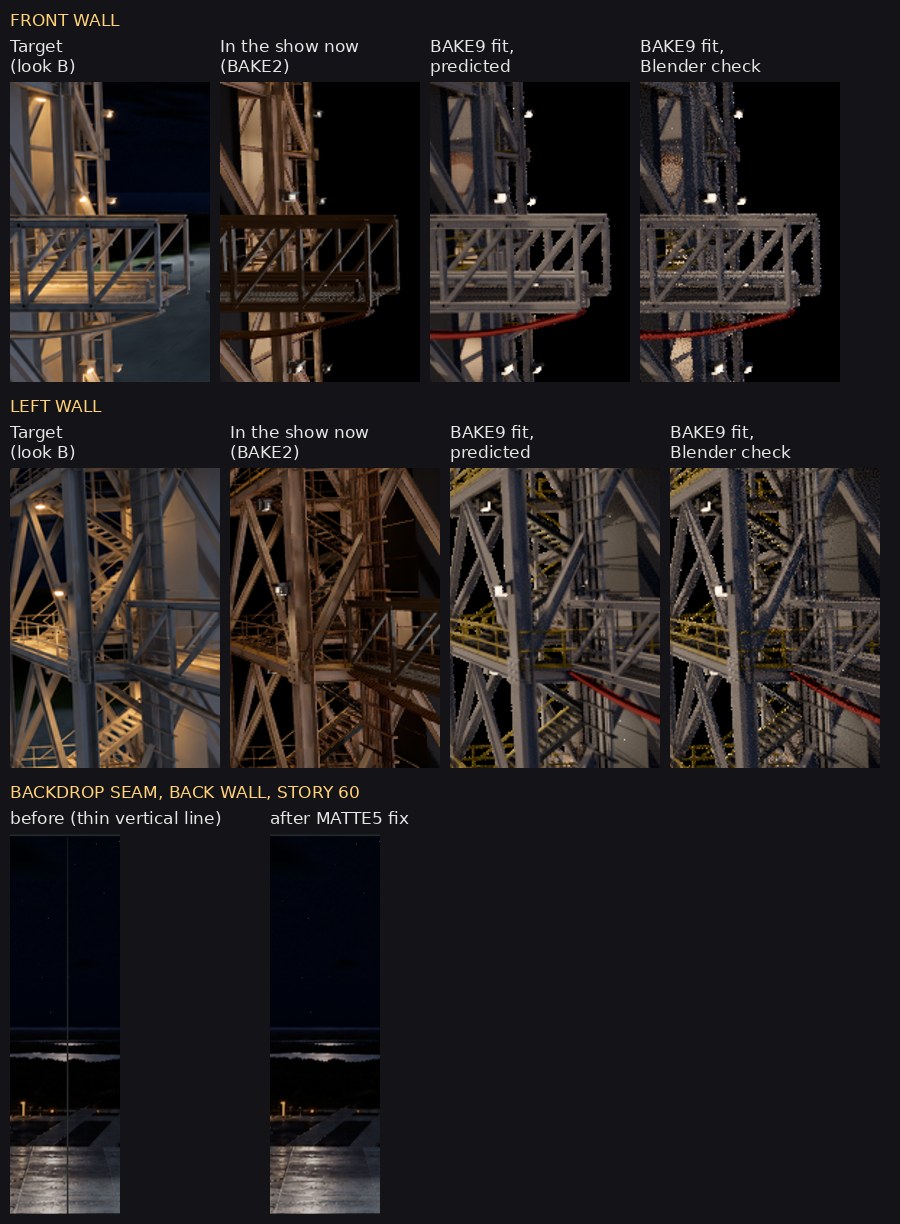
BAKE9 refitted the lights on the real paint and, before baking, tested the predicted picture against the gates. The left wall passed; the front failed (warmth off by 0.087 against ±0.05, pools 25% too strong), so it stopped without spending a bake. Its known-answer control found that the light colour had been applied twice in every rebuild, squaring it. With that fixed the steel is neutral, but the amber pools went too: one colour per light group cannot be both a neutral wash and a warm pool. BAKE10 splits the lamps by role.
MATTE5 fixed the back-wall seam in the engine (a sampling fault, not the painting). Its sharper repaint failed on the AI tool's size limit, which the skill had not asked anyone to measure up front.
The new gate saved a bake; a control found a bug three rounds had carried; my earlier explanation (fitting on grey) was only part of the cause.
Two clean bakes failed, so the method ends here
helped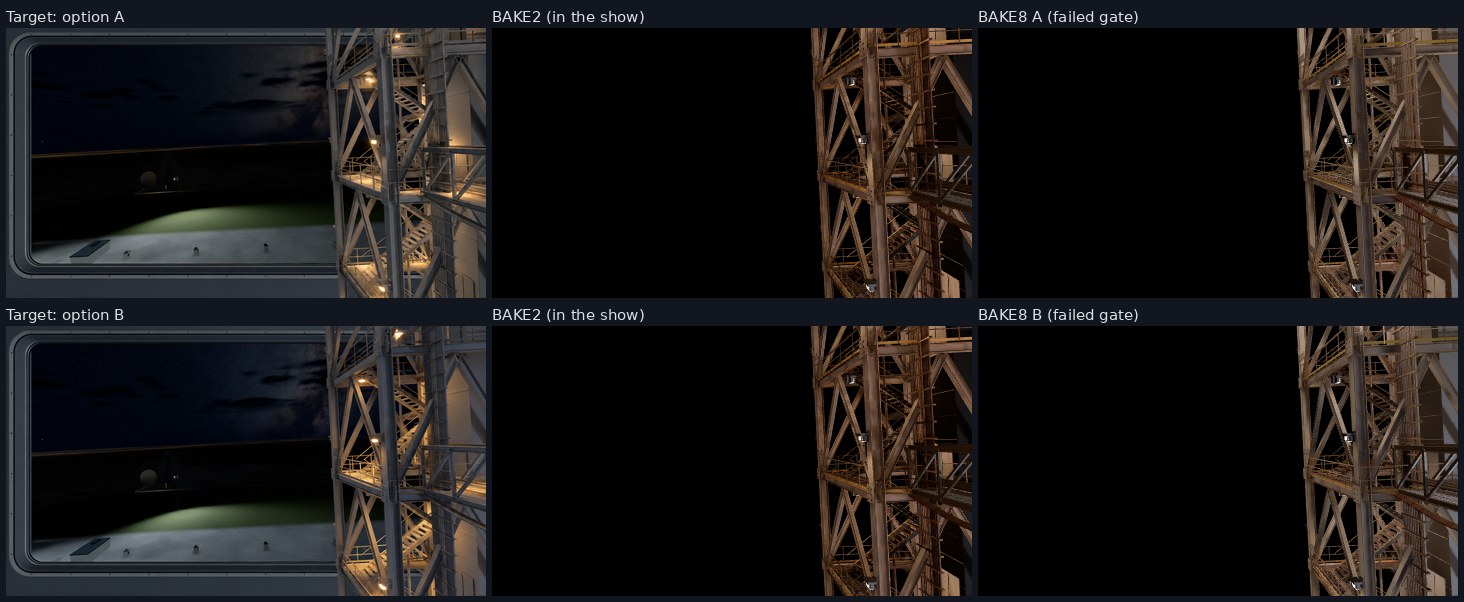
BAKE7 gave every deck enough map pixels to hold a pool of light (20+ per pool, up from 0.2 per grating triangle), but it baked with the wrong light rigs, so its scores could not count. BAKE8 re-baked both options with the right rigs, checked by hash, and with the speckle removed. Both still failed: similarity 0.55 and 0.54 against a floor of 0.63, and the steel too warm by 0.12–0.21.
The skill then asks for a cause, not a third try. BAKE8's control render measured the steel in the ray-traced picture itself, before the engine touches it: it is already 0.28 warm against the target's 0.09–0.17. So no amount of work on the engine side can fix it. Two candidates remain, and DISPLAY1 is measuring both now: the colour curve (Blender's and the engine's tone curves differ by up to 0.13 on a warm grey card), and the steel's paint and grime colour (the targets show clean grey steel).
Stopped a dead-end method after two rounds and narrowed the cause to the scene's lights, paint or colour curve, not the engine.
The tone curve was not it; the fitted lights are too orange
helped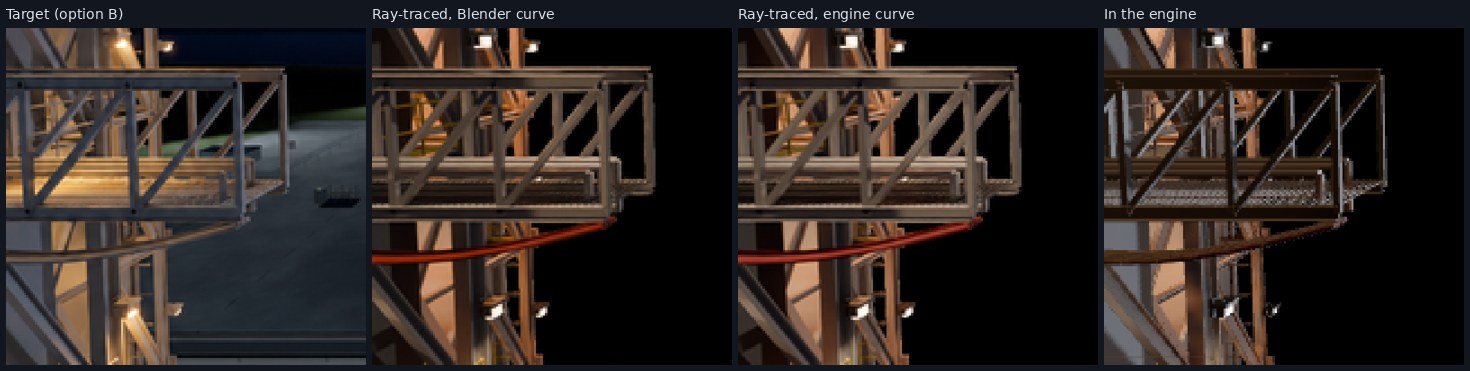
Before picking a new method, the skill asks for a measurement rather than a guess. Through one shared tone curve, the two middle pictures are almost identical: the curve closes only 6–12% of the warmth gap. Splitting the steel's light by group on the real paint shows where the rest comes from. The front work lights alone give 66–74% of it, and the colour BAKE4 solved for them is a deep orange that washes over every member, where the target keeps the steel grey and the warmth inside each pool.
Named the cause (the fitted light colours, chosen while the steel was grey) and priced three ways forward, so the method choice is yours with numbers instead of another round.
The value sheet: "looks fake" becomes a measurable diagnosis
helped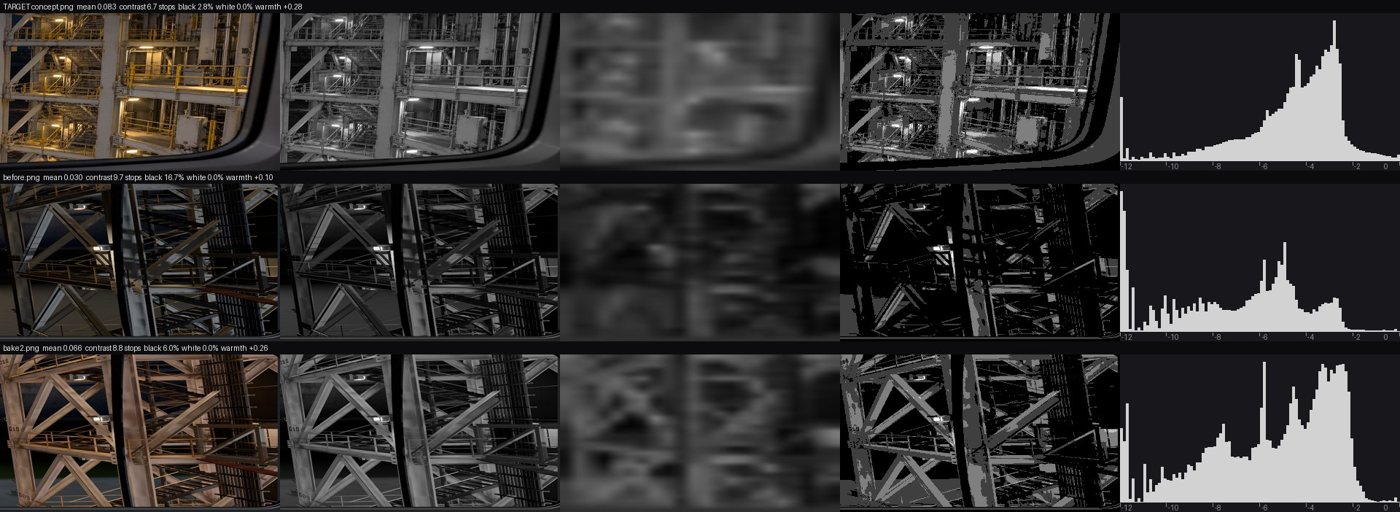
Before the skill, a round's verdict was "still not real". With the sheet, BAKE2 was measured against the concept: brightness 0.030 → 0.066 (concept 0.083), warmth +0.10 → +0.26 (+0.28), crushed black 17% → 6% (3%). The squint column showed the defect the numbers hid: the concept has separate bright pools, ours an even glow, and the colour column shows the warmth sitting in the steel, not in the lamps.
Turned one vague verdict into three numbers and one named defect, which became BAKE3's brief.
Light on grey steel first: the cause of the peach tint, measured
helped
The skill's rule is to judge lighting on flat grey materials, one light group at a time. That showed the sky gives 0.6% of the tower's light and the warm work lights 45.7%: 171 lamps with 150° cones and no falloff, whose pools overlap until no dark gaps are left. Without this step the next round would have been another guess at colours.
Cause found in one round, with a number per light group.
AI lighting options that match our tower exactly
helped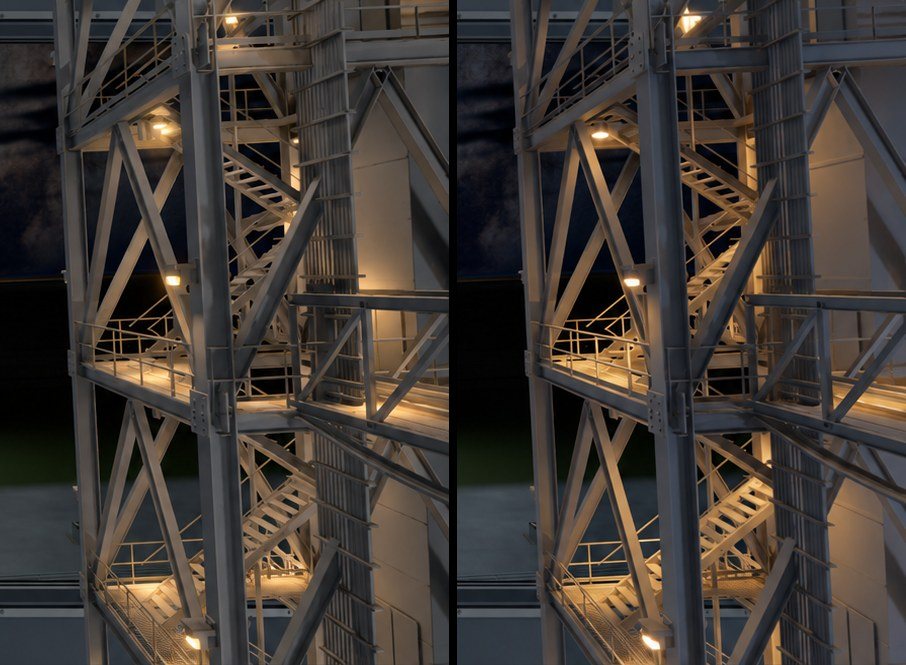
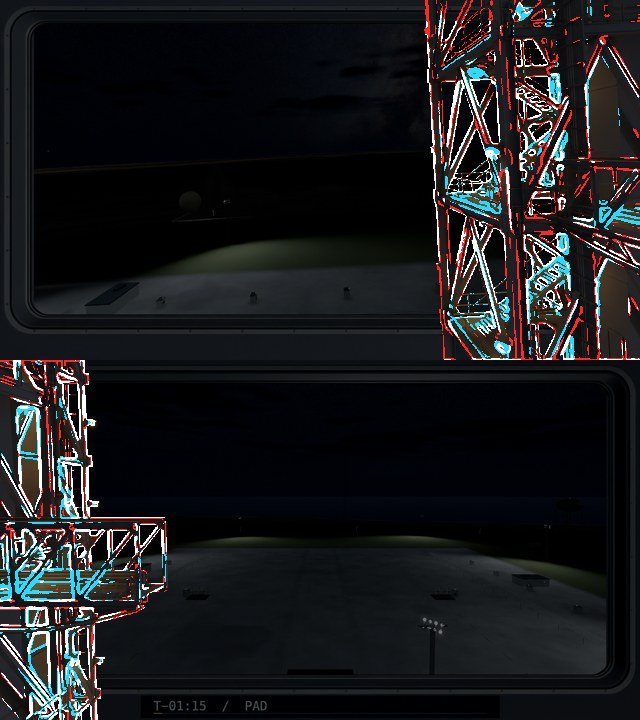
The skill says AI does the painting, from our own renders, and only an image that passes the align check may be used as an exact target. Both options passed (edge recall 0.913, shift at most 0.16%, scale 1.00), so the next round could fit to them pixel by pixel instead of comparing against a concept with a different layout.
An exact target for lighting in one step, and a picture-based choice for you.
Hand-tuning stopped; the lights were solved instead
helped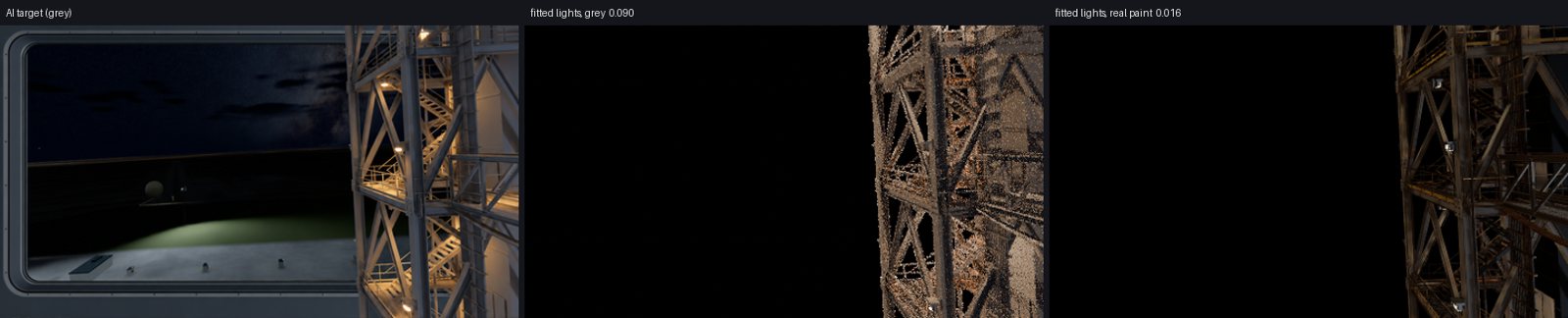
BAKE3 hand-tuned two light rigs; both failed, so it stopped, as the skill requires. BAKE4 changed method: render each of 29 light groups alone, then solve for the brightness and colour of every group that best reproduces the chosen option. Checked in a window it was not fitted on, the error fell from 1.96 to 0.54.
The rule prevented a third and fourth round of guessing, and the new method matched the target on grey.
Light and paint separated: the steel was as dark as asphalt
helped late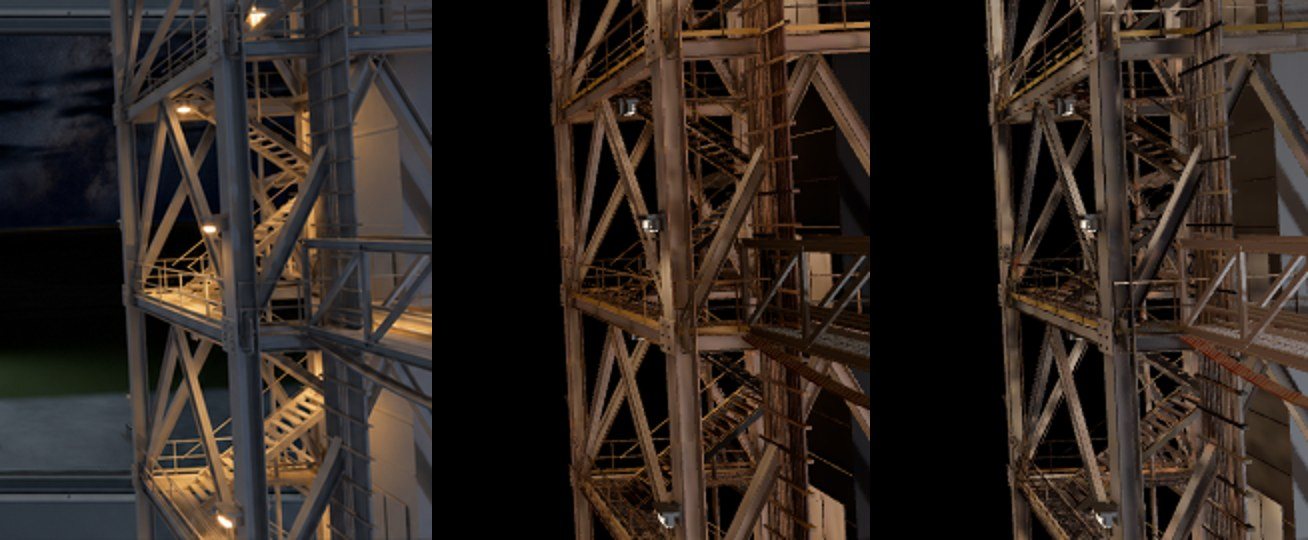
Because lighting had been matched on grey, the drop to 0.016 with real materials could only come from the materials: an effective reflectance of about 0.09, where painted grey steel is about 0.45–0.55. BAKE5 traced it to the paint colours and weathering, fixed the paint (0.146 → 0.495, non-metallic) and brought the brightness onto target.
Still wrong and now being fixed (BAKE6): the pools that the ray-traced render has are lost in the baked version (similarity 0.51 against 0.63 before), the lamp heads do not glow, and brown grime streaks remain.
Found the real blocker. But only after two lighting rounds: see the gaps below.
Calibrate the score before it decides anything
helped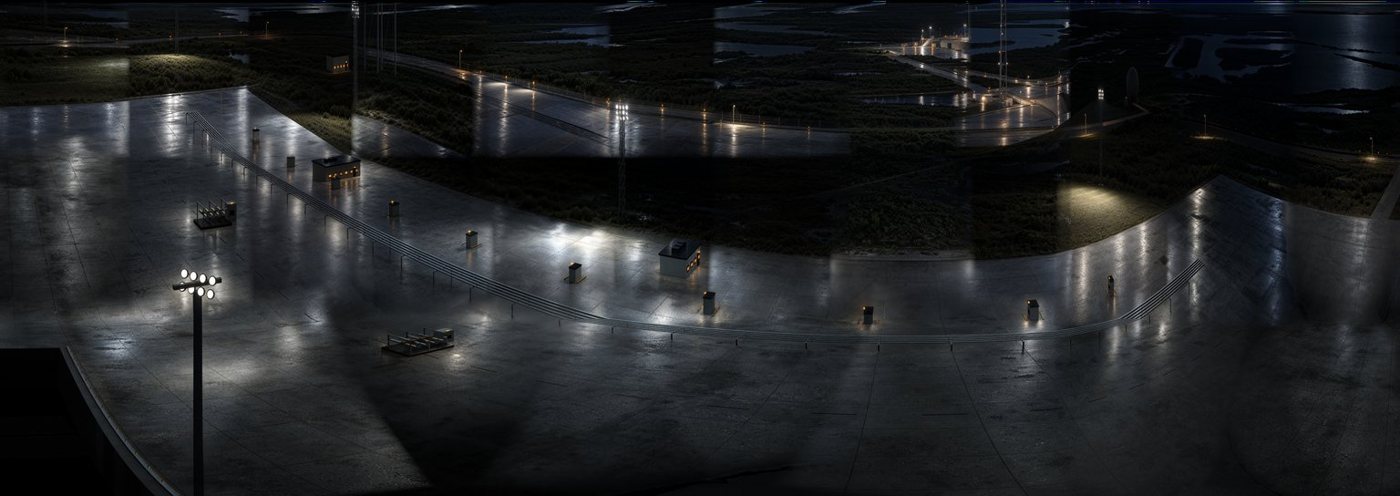
An automatic score had judged the first painted backdrop worse than the bare pad; by eye it was clearly better. The skill forbids using a score that disagrees with human judgement. The score was rebuilt and tested on 14 pairs I had judged and on synthetic damage (blur, darkening, shifts) before use: 14/14 and every stress test passed.
Prevented a broken number from stopping good work.
The align check kept drifted paint out, and showed the tiled method's limit
caught drift; method failed
The skill only lets an AI image be projected if it keeps the render's layout. In MATTE4, 25 of the 54 AI tiles had shifted or rescaled (horizons, coastlines, buildings), so they were held back and those regions fell back to the plain render. That kept wrong geometry off the walls. It also showed the method's ceiling: the remaining patchwork of painted and unpainted tiles reads as blocks and smears, clearly worse than round 1's single painting.
The check worked as designed; the method did not. Rounds 2–4 never beat round 1, and the skill had no rule to go back (see below).
What the run exposed
Gaps in the skill, and in how I used it
- No paint check before lighting (skill gap). The skill says light on grey, then materials, but does not say to check that the real materials reflect believable amounts of light before spending lighting rounds. Cost: two rounds (BAKE3, BAKE4) judged lighting through asphalt-dark paint. Proposed fix, staged for your confirmation: measure grey vs real-material brightness in the hero view at the start of Stage 5, and check each material's reflectance against real values.
- Mixed gates (my error). My BAKE3–BAKE4 briefs made lighting rounds pass a final-material comparison with the concept. The skill's Stage 5 gate compares only light structure on grey; absolute brightness and warmth come after materials. Following the skill as written would have caught the paint at the first fit.
- Two targets that disagree (my error). The skill says one key image. I scored against both the old concept (steel warmth +0.20) and the AI lighting option (+0.12). Once you choose in question 3, that option becomes the single lighting target.
- No "go back" rule (skill gap). The skill says improve or change method, but not: if the new method never beats the best earlier round, return to that round and fix its specific faults. Backdrop rounds 2–4 each replaced the method and each looked worse than round 1. Proposed fix: keep the best round as the baseline, and judge every new method against it.
- Inputs not pinned between rounds (process gap). BAKE7 picked up BAKE6's refitted lights instead of BAKE4's fitted ones, which cost a round. BAKE8 added a hash check on every input. Proposed fix for the skill: each round names its inputs by hash and refuses to run on anything else.
- Lights fitted on grey, then judged on paint (confirmed). BAKE4 solved the light colours on flat grey steel; on the real paint the same lights wash the steel orange (DISPLAY1). Grey is right for judging where light falls, but light colours must be solved on, or re-checked against, the final materials. Proposed fix for Stage 5–6: any fitted light colour is re-validated on final materials before a bake is spent.
- Controls with a known answer (skill gap). Three rounds carried a bug that squared every light colour, and DISPLAY1 measured through it. A white plane lit by one lamp of known colour found it at once. Proposed fix: every measuring or rebuilding chain proves itself on a known-answer case before its numbers count.
- Tool limits not measured up front (skill gap). The AI image tool returns at most about 1254² pixels whatever is asked; MATTE5 found this only after planning a 4096² repaint. Proposed fix: Stage 0 records each tool's real limits (output size, edit and mask support) before methods are chosen.
- Owner questions need pictures where you read them. Question 3 lived only on the status page with pictures and in the chat without them, so it was unclear. Fix: each question will carry its picture in the chat too.
- A budget I set myself blocked the fix. The tower's light maps were capped at 9 MB, which left the decks too coarse to hold a pool of light. The skill should require that any cap on a stage has a stated reason (frame time, memory, the owner's word), so a self-imposed number does not quietly shape the result.
- Budgets you never asked for. The skill made disk raises your call; you have said size does not matter. I removed the disk cap for this project and noted it in the skill's project section.